BMW 507: Models and Specs
1956–1959 · 3.2 litre OHV V8 · Front-engine, rear-wheel drive · Roadster
Overview
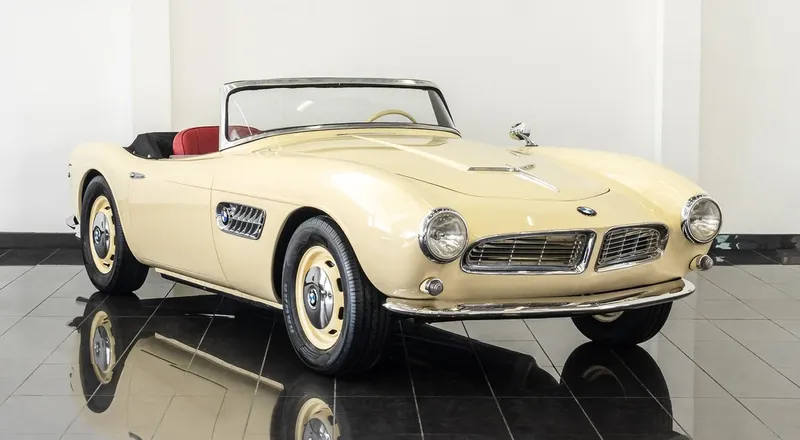
The BMW 507 is one of the defining objects of postwar European design. This two-seater roadster had such visual elan - pun intended - that it singlehandedly changed BMW's design identity, inspiring the Z3 and Z8 nearly forty years after its production ended. The 507 was conceived to challenge the Mercedes-Benz 300 SL in the American export market and to demonstrate that BMW could build a car of international sporting prestige. It succeeded on every aesthetic and engineering measure, yet it failed commercially, with near-fatal consequences for the company. Only 252 examples were built between 1956 and 1959 before BMW discontinued the 507, with each car sold at a significant loss despite a retail price roughly twice the original target. Instead, the 507 found an appreciative audience among the global elite: Elvis Presley, Alain Delon and Ursula Andress all owned examples. The 507’s near-destruction of BMW's finances makes its cultural importance all the more remarkable. Today, with approximately 202 known survivors and auction prices consistently in seven-figure territory, the 507 represents one of the most significant collectible BMWs in existence.
Price
- Starting price
- Average price
- Price range
- -
Specifications
- Production years
- 1956–1959
- Body styles
- Two-seater roadster
- Layout / drive
- Front-engine, rear-wheel drive
- Engine family
- OHV 3168cc V8
- Transmission types
- Four-speed manual
BMW 507 in Detail
The 507 originated from a 1954 proposal by BMW's US importer for a German roadster to compete with the Mercedes 300 SL in the American luxury sports car segment. The 507 was formally unveiled a year later, with a body constructed in hand-formed aluminium over a steel tube frame, which contributed to a kerb weight of just 1,280 kg. The chassis was derived from the contemporary BMW 502 saloon, with front and rear torsion-bar independent suspension giving the 507 more composed handling than most sports cars of the period could muster.
Production began in October 1956 using the M507/1 V8 engine in 140bhp form. The 1957 Series II raised output to 150bhp, while minor body revisions reduced rear weight. Production continued at an extremely low rate before ending in August 1959 with chassis number 70254. The 507's commercial failure left BMW in severe financial difficulty by 1959, ultimately necessitating a shareholder rescue.
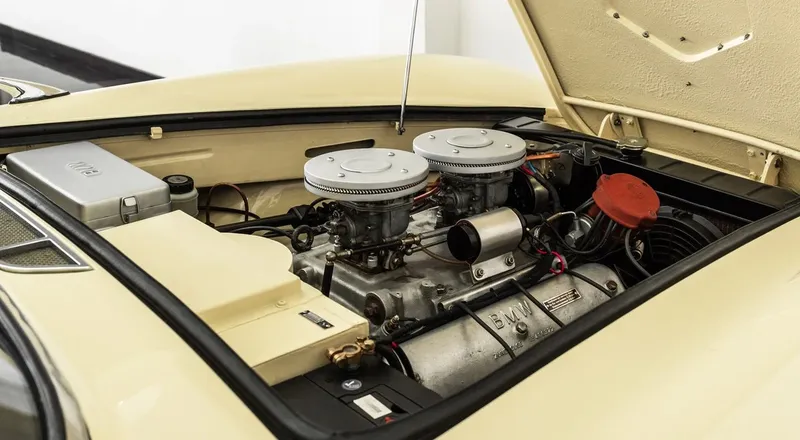
The 507's performance identity is defined by the character of its 3.2-litre OHV V8 rather than its headline figures. The engine is a long-stroke unit producing 150bhp at 5,000 rpm, giving it a broad and progressive power delivery that suits the car's grand touring character rather than delivering outright acceleration. Period road tests recorded 0–60 mph times varying between 8.8 and 11.0 seconds depending on preparation and testing conditions, with top speed figures between 124 mph and 141 mph.
Metric | Figure |
Engine family / displacement | BMW M507/1 OHV V8/3168cc |
Power output | 140 bhp (Series I) to 150 bhp (Series II) |
0–60 mph | 8.8–11.0 sec |
Top speed | 124–136.7 mph |
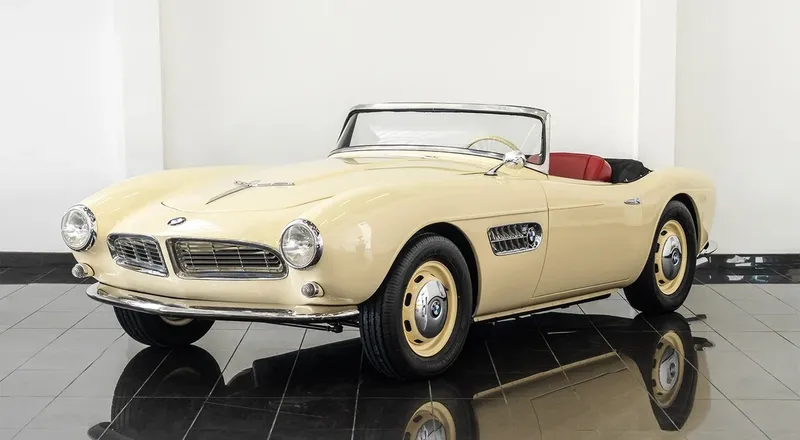
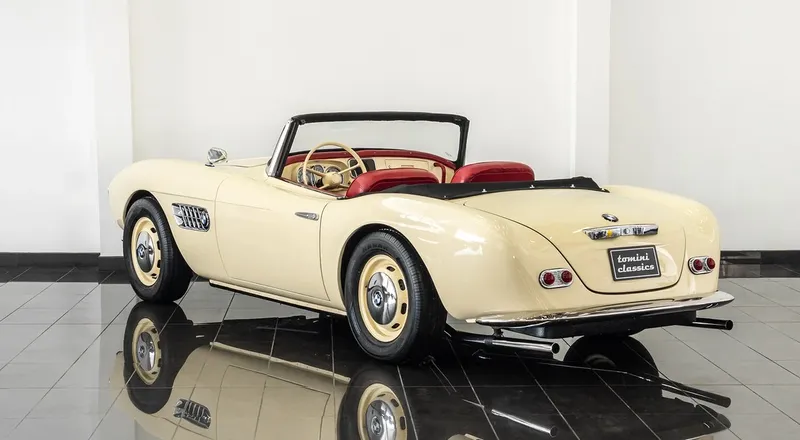
The BMW 507 is defined by a long and low body, with a bonnet that stretches almost the full length of the car before the cockpit rises to meet it. The surfacing is smooth and uninterrupted with no chrome decoration, and the double-kidney grille is resolved into the nose with a pleasing precision.
The cockpit is intimate and driver-focused, with a leather-trimmed dashboard incorporating five round instruments in a row behind a two-spoke steering wheel. The seats are low and close together, while the optional aluminium hardtop transforms this car from a cosy two-seater roadster to an enclosed coupé.


The 507 wasn’t on sale long enough to have generations, but there were key distinctions between Series I and Series II vehicles:
Series I (1956–1957). An M507/1 V8 delivered 140bhp inside an aluminium body hand-formed over a steel tube frame; torsion-bar suspension front and rear
Series II (1957–1959). Compression was raised to 7.8:1 and output to 150bhp; there were minor rear body revisions before the final car was completed in August 1959
The BMW 507 is a 1950s roadster with none of the passive or active safety features of modern vehicles. Braking was by drums all round as standard, with Girling front disc brakes available as a factory option on later examples. The aluminium bodywork offers limited structural resistance in an impact. Approach any 507 as a museum-grade vehicle to be driven on appropriate occasions with care and delicacy.
Pros
Hand-formed aluminium construction means no two cars are identical and every surviving 507 is a unique, individually built object
Just over 200 examples are known to survive, giving the 507 one of the highest survival rates of any 1950s European sports car
The design is timelessly elegant and still looks handsome today
Cons
Production inconsistency was structural; because BMW lost money on every car, originality and build quality vary significantly between individual chassis
Non-original mechanical components are common and even the 507's designer had to replace his car's engine
Celebrity and provenance mythology has created a market in which undocumented ownership claims are difficult to verify
BMW 507 for Sale
The BMW 507 is a vehicle where surviving examples rarely reach the open market. When Car & Classic carries a 507 for sale, it gives potential buyers one of the most significant collector opportunities in the European classic market.
Price trends
Senaste försäljningen
Hittades inte
För närvarande till salu
0
0 pågående auktioner
0 annonser
Totalt sålda
0
Högsta försäljningspris
0 €
Genomsnittspris
0 €
Lägsta pris
0 €
FAQs
Every 507 carries a chassis number in the documented range 70079–70254, and BMW Group Classic maintains records of the known survivor population. Prospective buyers should commission a pre-purchase inspection by a BMW marque specialist with 507 experience, cross-reference the chassis number against BMW Group Classic's registry, and request full documentation of any major mechanical work, particularly engine replacement, which is common in surviving vehicles.
Elvis purchased a BMW 507 while stationed in Germany with the US Army in 1958 and used it throughout his service posting. After his return to the United States, the car passed through several owners and spent years in storage near San Francisco before being acquired for restoration by BMW Group Classic and returned to sender. For reasons best known to himself, Elvis had the car repainted pink, but the restoration returned it to its original white livery. The car is now part of the BMW Group Classic collection in Munich.
The Series I (1956–57) used the M507/1 V8 powerplant at 7.2:1 compression, producing 140bhp. The Series II (1957–59) raised compression to 7.8:1 to generate 150bhp, before making minor revisions to the rear body structure. These are incremental production refinements on the same fundamental car.
There’s no shared mechanical DNA, but the design relationship has been acknowledged by BMW. The controversial-at-the-time Z8 was a conscious homage to the 507's proportions, V8 engine architecture and character, mimicking the 507’s long bonnet, short-tail silhouette and aluminium construction.