Datsun 510: Models and Specs
1968–1973 | 1.3–1.8-litre SOHC/OHV inline four-cylinder | Front-engine, rear-wheel drive | 2/4-door saloon, estate, 2-door coupé
Overview
The Datsun 510 was the third generation of the Bluebird series, sold from 1968 to 1973 and known in Japan as the Nissan Bluebird 1300/1600 long before our own Sunderland-built Bluebird changed perceptions towards the company and its products. The 510 commenced this journey by evolving the brand's reputation from affordable economy transport to a technically credible performance car in international markets, primarily thanks to four-wheel independent suspension, front disc brakes and a single-overhead-cam engine. The 510 has been described as the "poor man's BMW" in specialist publications for five decades. Racing victories in America gave the 510 a motorsport provenance that its modest production origins didn’t necessarily imply, and its subsequent reputation has directly sustained collector demand.
Price
- Starting price
- Average price
- Price range
- -
Specifications
- Production years
- 1968–1973
- Body styles
- 2/4-door saloon, estate, 2-door coupé
- Layout
- Front-engine, rear-wheel drive
- Engine family
- SOHC inline four-cylinder
- Displacement range
- 1.3–1.8 litre
Datsun 510 in Detail
The 510 was developed under Datsun's North American chief, which gives you an indication of which market this car was primarily aimed at. The L16's single overhead camshaft, aluminium cylinder head and cross-flow design welcomed modification and displacement increases; buyers could upgrade from the 1.6-litre L16 to the 1.8-litre L18 and later the 2.0-litre L20B using shared mounting points and ancillaries in the same car.
The chassis used MacPherson strut front suspension and semi-trailing arm independent rear suspension (the same geometry as the BMW 1600-2) with front disc brakes standard on the 1.6-litre variants.
The L-series SOHC engine family was offered in four displacements (1.3, 1.4, 1.6, and 1.8 litres) with the 1.3 and 1.4 units going to base-specification Japanese-market cars and smaller export markets, while performance-oriented export cars received the L16 as standard. The SSS trim's 109 bhp figure over the standard 1600's 96 bhp came entirely from the sports camshaft and twin carburettors.
Variant | Engine | Power | 0–60 mph | Top Speed | Gearbox |
1300 | 1,288 cc L13 SOHC | 68 bhp | 17 sec | 84 mph | 4-speed manual |
1600 | 1,595 cc L16 SOHC | 96 bhp | 13.5 sec | 100 mph | 4-speed manual |
1600 SSS | 1,595 cc L16 SOHC | 109 bhp | 11.8 sec | 106 mph | 4-speed manual |
1600 coupé | 1,595 cc L16 SOHC | 92 bhp | 14.0 sec | 98 mph | 4-speed manual |
1600 estate | 1,595 cc L16 SOHC | 96 bhp | 15.5 sec | 93 mph | 4-speed manual |
1800 (late production) | 1,770 cc L18 SOHC | 105 bhp | 12.0 sec | 103 mph | 4-speed manual |
The Datsun 510 was produced in four body configurations, each with mechanical differences:
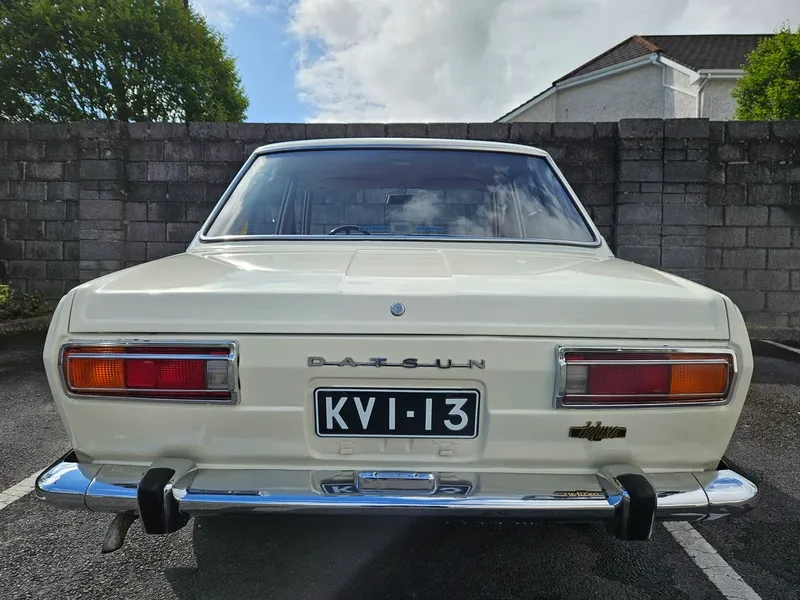
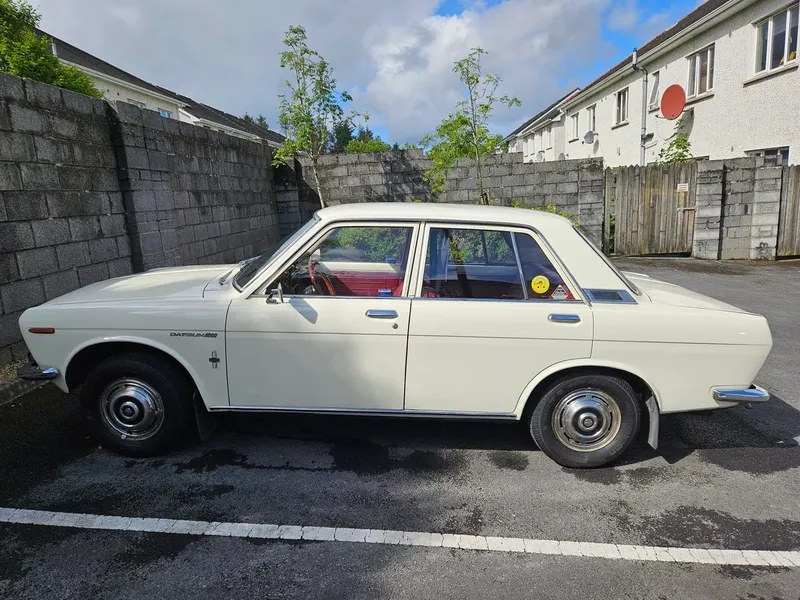
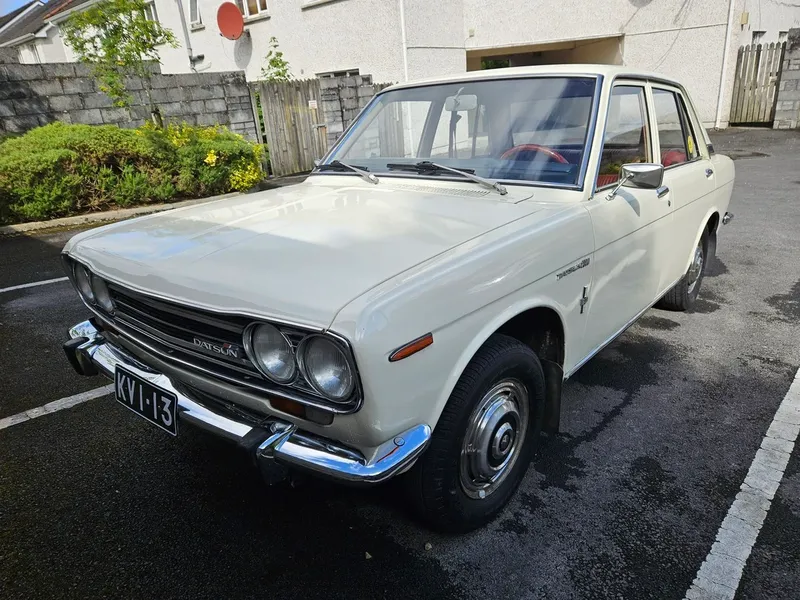
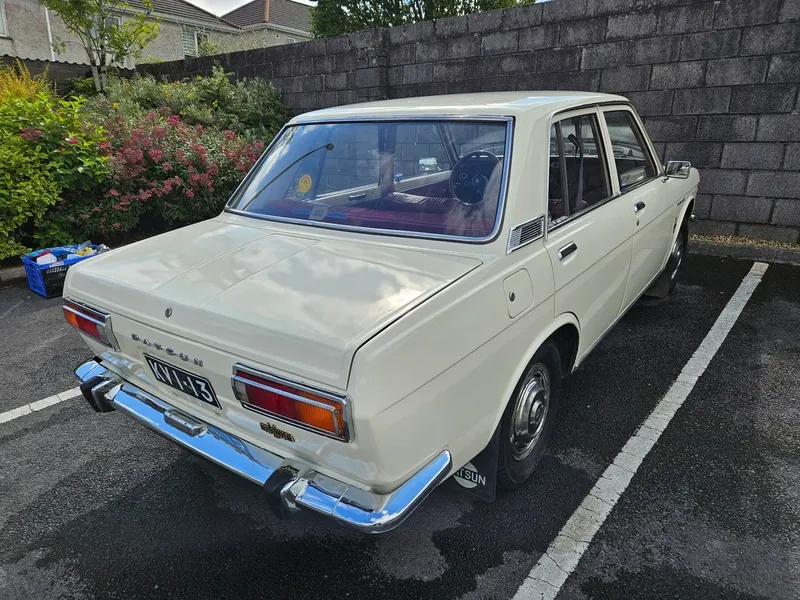
A 4-door saloon was the launch model and the most common body style in Britain.
A 2-door saloon was favoured in North America and was lighter than the 4-door.
Estate models used a live rear axle with leaf springs in place of the saloon and coupés' semi-trailing-arm independent rear setup, though performance was blunted.
A 2-door coupé (Bluebird Coupe) was styled with a fastback roofline and a wide slatted rear panel. Like the 2-door, this wasn’t officially sold in the UK.
Available across 2-door and 4-door body styles, SSS models were fitted with a sports camshaft and twin Hitachi side-draught carburettors producing 109 bhp compared to the standard 1600's 96 bhp, with SSS badging and revised interiors.
The Datsun 510 is identifiable by its upright three-box saloon proportions that followed European sports saloon conventions of the mid-1960s rather than the more rounded forms of Japanese economy cars. The body uses flat surfaces and low-set headlamps within a horizontal front grille to give a wide, stable visual stance. The coupé body departs from this with a fastback rear roofline and a wide body-width slatted panel replacing the conventional tailgate.
Inside, the 510's cabin has a hooded instrument cluster carrying a speedometer and fuel gauge as standard, with a rev counter added on SSS variants. The seating position is upright, and the controls are logically arranged; the dashboard was redesigned during the production run to incorporate round gauges in place of the original horizontal strip speedometer. The 510's cabin philosophy prioritises function and visibility over decoration.


The Datsun 510 was produced in a single generation without a formal model replacement until the 610 arrived in 1973. It went on sale in the UK when Datsun arrived on these shores in early 1970, and from a standing start, the company had annual sales exceeding those of Fiat by 1973.
1968–1971 (launch range). 4-door saloon launch; 2-door saloon and estate follow; SSS trim available
1971–1973 (revised range). The coupé body style was introduced, and the dashboard was redesigned with round gauges
Successor: Datsun 610 (Bluebird U) replaced the 510 in 1973, and the 510 name was not carried forward
What standard safety equipment existed at the time of the 510’s launch consisted mainly of front disc brakes on 1.6-litre variants, with drum brakes on all four wheels on the base 1.3-litre specification. The 510's semi-trailing arm independent rear suspension represents a meaningful safety advancement over the live rear axle of the estate and of most competing economy cars of the period.
Pros
The L16 engine's mounting architecture allows direct displacement upgrades to the L18 and L20, making this one of the most upgrade-accessible Japanese classics of its era
The 510 was reliable at a time when contemporary British cars tended to struggle with cold starts, hot starts and everything in between
The SSS trim's twin Hitachi side-draught carburettor setup raises output to 109 bhp within the standard 1,595 cc displacement
Cons
Only six UK-licensed examples remain on DVLA records; most available examples are North American imports requiring individual import assessment
The estate’s live rear axle and leaf spring rear suspension produce materially different handling characteristics from the saloon and coupé variants
With only 137 UK sales recorded since 2020, the 510 is harder to sell than other Datsun classics
Price trends
Senaste försäljningen
Hittades inte
För närvarande till salu
0
0 pågående auktioner
0 annonser
Totalt sålda
0
Högsta försäljningspris
0 €
Genomsnittspris
0 €
Lägsta pris
0 €
FAQs
The L-series engine is mechanically straightforward, with the SOHC layout giving good access to the valve train and carburation. The 510's architecture was designed with modular servicing in mind, and basic maintenance is achievable without specialist tools. Budget for international parts sourcing from the outset.
The estate uses a live rear axle with leaf springs rather than the semi-trailing arm independent rear suspension of the saloon and coupé. Nissan's engineering rationale was load-carrying capacity: a live axle maintains consistent ride height under varying load, whereas the semi-trailing arm geometry on a heavily laden estate would produce adverse camber changes. The consequence for buyers is that the estate’s handling is less responsive than the saloon's.
The 510 and 240Z were produced concurrently and share the L-series engine range, but they are distinct in both character and market position. The 240Z is a two-seater sports car with a 2.4-litre six-cylinder engine; the 510 is a four-seater saloon with a more modest 1.6-litre four-cylinder powerplant. The 510 offers greater practicality and lower purchase costs, whereas the 240Z offers a more focused driving experience and stronger international collector demand.