Jaguar XJ220: Models and Specs
1992–1994 · 3.5‑litre twin-turbo V6 · Rear mid-engine, rear-wheel drive · Two-seater coupé
Overview
The Jaguar XJ220 is the only purpose-built production supercar in Jaguar's history. This rear-mid-engined two-seater coupé was built between 1992 and 1994 at a purpose-built facility in Oxfordshire, under the Jaguar Sport banner. When it was timed at 217 mph at the Nardo test track in 1992, it became the fastest production car in the world and held the record until the McLaren F1 eclipsed it in 1994. The XJ220 emerged from an unofficial project conceived by Jaguar's chief engineer Jim Randle and a group of volunteers known as the "Saturday Club", who worked on the concept car in their own time without official authorisation. Jaguar’s subsequent cost-cutting decisions to replace the promised V12 and all-wheel drive with a twin-turbo V6 and rear-wheel drive triggered legal action by depositors and cast a shadow over the car's commercial life. Dismal economic conditions by the time of the XJ220’s launch also rendered it a concept from a bygone age where greed was good, and lunch was for wimps. Only 281 cars were built across the XJ220’s two-year production life, making every surviving example a documented, traceable object in one of the smallest production runs of any serious British performance car.Today, the XJ220 is widely regarded as one of the greatest performance cars ever built, as poster-worthy as Ferrari’s F40 or Lamborghini’s Countach.
Specifications
- Production years
- 1992–1994
- Total production
- 281 cars
- Body styles
- Two-seat coupé
- Layout / drive
- Rear-mid-engine, rear-wheel drive
- Engine family
- 3,498cc twin-turbo DOHC V6
Jaguar XJ220 in Detail
From concept to reality
The original Saturday Club XJ220 concept had a 6.2‑litre V12 engine, all-wheel drive and scissor-opening doors. When Jaguar unveiled the concept at the 1988 Birmingham Motor Show, the response was immediate and overwhelming: 1,500 customers placed £50,000 deposits, with the final price set at £361,000. Yet by the time it went on sale four years later, the V12 was replaced by a twin-turbocharged V6, all-wheel drive was replaced by RWD and the scissor doors were replaced by conventional front-hinged items. Some depositors sued Jaguar over the changes.
Even so, the XJ220’s engineering was genuinely advanced. The aluminium honeycomb monocoque chassis provided exceptional structural rigidity at low weight. The bodywork used a combination of aluminium panels and composite sections, while the twin-turbo V6 produced 542 bhp and 475 lb-ft of torque. Performance was blistering, if occasionally terrifying in a RWD car with few driver aids.
The XJ220 S, developed by TWR as a parallel programme, comprised a run of six road-legal carbon-fibre composite cars producing 680 bhp and a top speed of approximately 228 mph. However, the XJ220 S was not a catalogued production variant, but a bespoke programme for specific clients.
The Jaguar XJ220's 217-mph top speed is achieved by a 3.5‑litre six-cylinder engine, which at least proved the V6's validity over the originally promised V12. The twin-turbo V6's 542 bhp and 475 lb-ft of torque, combined with the 1,470 kg aluminium chassis, produced a power-to-weight ratio of approximately 370 bhp per tonne.
Performance figures vary between sources because the benchmark 217 mph was achieved at Nardo's banked oval with catalytic converters removed. Equally, Jaguar's own quoted 0–60 mph figure of 3.5 seconds and 0–100 mph in 7.3 seconds were derived from controlled test conditions.
Engine | Power | 0–60 mph | Top speed |
3,498cc twin-turbo V6 | 542 bhp | 3.5–3.6 sec | 210–217 mph |
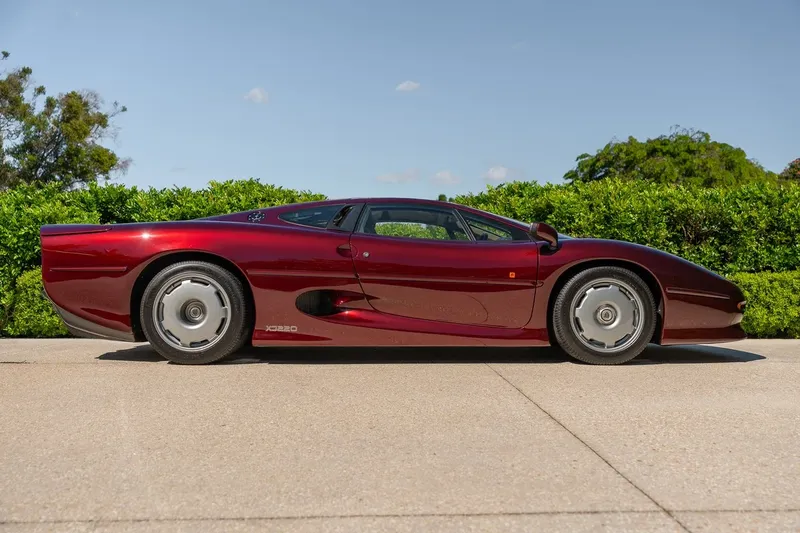
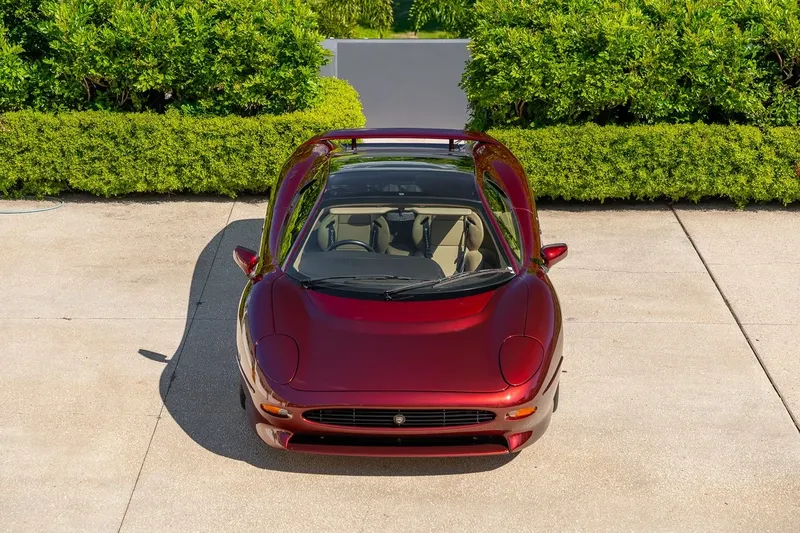
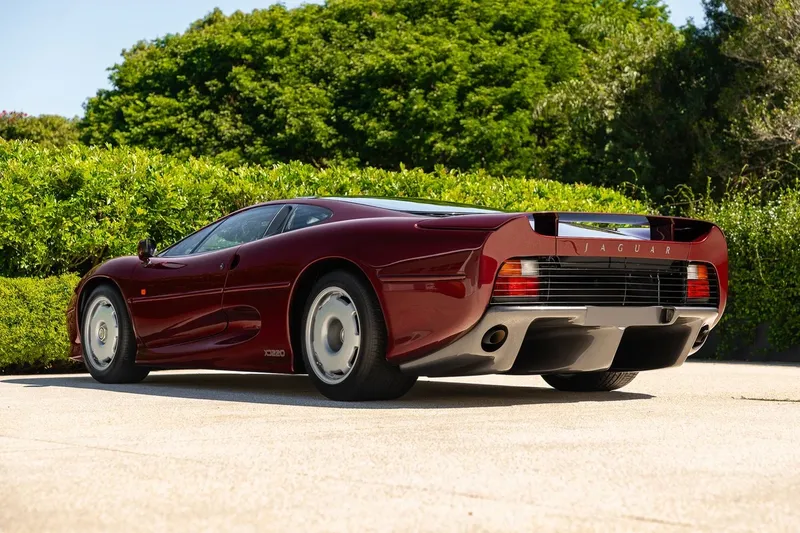
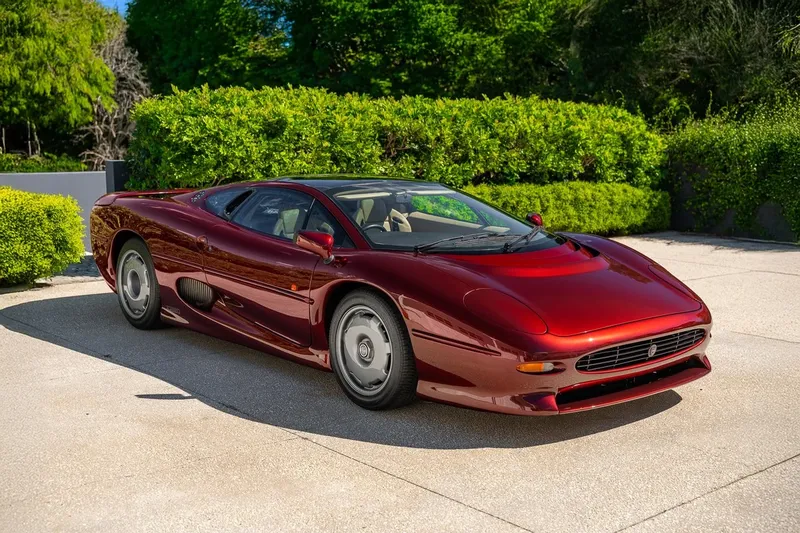
The Jaguar XJ220 is one of the most unmistakable shapes of the 1990s; a long, wide and dramatically low two-seater. The styling follows the logic of the D-Type and E-Type before it: a smooth nose tapering to a wide, flat tail with the occupants placed centrally. At 4,930mm long and 2,220mm wide, the XJ220 is a physically imposing car, wider than a contemporary Ferrari F40 or McLaren F1, and a low roofline of just 1,150mm gives it the stance of a racing car on road tyres.
The XJ220 was designed to be usable, so standard equipment included electric windows, heated mirrors, air-conditioning and tinted glass. Steering is unassisted throughout, providing direct feedback at speed. Disappointingly, the switchgear and control stalks were sourced from Ford, and the rear lights were borrowed from the Rover 214/216 family.


The XJ220 is a single-generation model with no production architecture changes across its two-year run:
Jaguar XJ220 (1992–1994). All 281 production cars were built to a single mechanical specification on an aluminium honeycomb chassis powered by a 542 bhp twin-turbo V6.
Jaguar XJ220 S. Six TWR-built road-legal cars in carbon composite construction; 680 bhp; not a catalogued production variant.
The Jaguar XJ220 was produced at the cusp of the electronic safety-aid era, but was equipped with none of it: no ABS, no traction control, and no stability control in standard specification. This was a deliberate engineering position, since the development team's philosophy prioritised direct driver engagement over electronic intervention, and the unassisted steering was central to that approach. The aluminium honeycomb monocoque provides a high degree of structural rigidity, but the car's 210 mph capability shouldn’t be probed by anyone other than the truly brave and talented.
Pros:
Twin-turbo V6 derived directly from TWR's Le Mans Group C racers, with motorsport provenance, no other road-legal production car of the era matched
281 cars were built across two years, making this one of the smallest production runs of any mainstream supercar from a major manufacturer
Critical reassessment from "unloved" to genuinely great is now complete in the classic car market
The V6/RWD package is probably superior to the originally promised V12/AWD
Cons:
Rubber fuel bags require mandatory replacement every five years, regardless of mileage
The original braking system is widely considered inadequate for the car's performance capability; many cars have been retrospectively modified, affecting originality
Despite the space-age looks, this is still an amalgam of reused Ford and Austin-Rover parts and mechanicals
Lack of safety features is intimidating, given the car’s RWD design and ballistic performance
FAQs
The switch from the 6.2‑litre V12 and all-wheel drive to the twin-turbo V6 and rear-wheel drive was driven by engineering and weight considerations. TWR's twin-turbocharged V6 was lighter and more compact than the V12 alternative, and it also produced comparable power more efficiently. The V6 allowed the XJ220 to achieve a lower centre of gravity and better weight distribution than the V12 would have permitted.
The definitive figure is 217.1 mph, recorded at Nardo in 1992 with catalytic converters removed, and this was the highest speed ever recorded by a production car at that time. With catalytic converters fitted, Road & Track recorded 210.5 mph on a straight level road at Nardo. Jaguar's quoted 0–60 mph time of 3.5 seconds and 0–100 mph in 7.3 seconds are the manufacturer's own figures; independent road test results by Goodwood recorded 3.6 seconds to 60 mph and 7.9 seconds to 100 mph.
The twin-turbo V6 shares engineering DNA with TWR racing units, and the network of TWR and Jaguar Sport-specialist workshops that supported the car at the time of manufacture is still operating. Jaguar Heritage and the Jaguar XJ220 register maintained by the marque's official channels support chassis documentation and provenance verification. The fuel bags are available through XJ220 specialists, where costs are significant but predictable.
The XJ220 S was developed by TWR as a bespoke programme producing six road-legal cars in carbon composite construction, with a 680 bhp state of tune, racing-derived aerodynamics and a stripped interior. The XJ220 S was not a catalogued production option but a purpose-built programme for specific clients.