Lamborghini Espada: Models and Specs
1968–1978 | 3.9-litre quad-cam V12 | Front-engine, rear-wheel drive | 2-door 4-seat coupé
Overview
The Espada was Lamborghini's only true four-seater production car of the 20th century, and it was the company’s best-selling model until Countach volumes expanded in the mid-1980s. Ferruccio Lamborghini commissioned it as a practical GT capable of carrying four adults at speed, using the same quad-cam V12 that underpinned the front-engined 400 GT, but housing it in a radically lower body. At its launch in 1968, the Espada was the fastest production four-seater in the world, with a claimed top speed of 155 mph. Its significance within the Lamborghini range is both structural and commercial. The Espada demonstrated that Lamborghini could build a car with genuine long-distance practicality without abandoning the performance credentials established by the Miura. At the time of its launch, the Espada was more expensive than the Miura, positioned as a flagship rather than a secondary model. For a buyer who wants a historic Lamborghini that seats four, the Espada is the only option on the table.
Specifications
- Production years
- 1968–1978
- Total production
- 1,217 units
- Body style
- 2-door 4-seat coupé
- Layout
- Front-engine, rear-wheel drive
- Engine family
- 3,929 cc quad-cam V12
Lamborghini Espada in Detail
Ferruccio Lamborghini wanted a car that a driver with a family could use without abandoning the mechanical character of Lamborghini's sports cars. The subsequent Gandini-designed body was built by Bertone on a pressed-steel monocoque platform with a roofline of only 1,185 mm, making the Espada the lowest four-seater production car ever built. The body used a full-width glass tailgate with a pronounced fastback roofline, giving the rear passengers better headroom than the exterior silhouette suggested.
The engine was a development of Giotto Bizzarrini's original Lamborghini V12 design, with four chain-driven overhead camshafts, a 60-degree bank angle and six twin-choke Weber 40 DCOE carburettors. The engine was mounted ahead of the front axle centreline, giving a 52/48 per cent front-to-rear weight distribution. Suspension was independent at all four corners via double wishbones, coil springs and adjustable Koni dampers, with anti-roll bars front and rear.
The Espada was assembled at Lamborghini's Sant'Agata Bolognese factory throughout its production run. Most UK-market examples were left-hand drive; right-hand drive cars were produced in small numbers and command a significant premium in the current specialist market. The model was discontinued in 1978 following Lamborghini's bankruptcy filing at the end of a highly turbulent decade, with the Series III remaining in catalogues from 1972 through to the final year of production.
The Espada's performance is defined by the low-rpm torque and linear power delivery of its 3,929 cc quad-cam V12, which produces usable acceleration from below 2,000 rpm and continues punching to 7,500 rpm. The distinction between Series I and Series II/III figures reflects an increase in output from 325 bhp to 350 bhp, achieved through carburettor and intake revisions.
Series | Power | Torque | 0–60 mph | Top Speed | Gearbox |
Series I (1968–1969) | 325 bhp | 290 lb-ft | 6.5 sec | 155 mph | 5-speed manual |
Series II (1970–1972) | 350 bhp | 291 lb-ft | 6.4 sec | 155 mph | 5-speed manual |
Series III (1972–1978) | 350 bhp | 291 lb-ft | 6.3 sec (manual) | 155 mph | 5-speed manual / 3-speed auto (from 1974) |
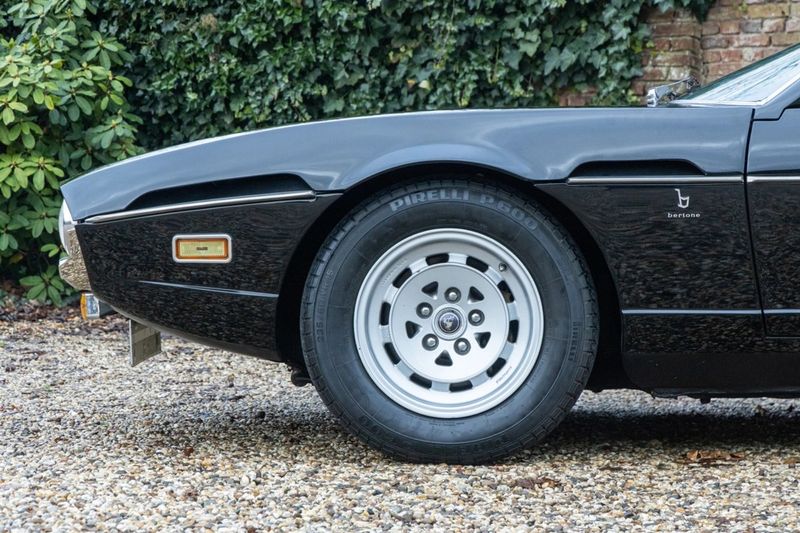
The Series I (1968–1969, 186 units) used a 3,929 cc V12 engine producing 325 bhp at 6,500 rpm, with magnesium alloy wheels sitting ahead of Girling four-wheel ventilated disc brakes. The Series I is the rarest of the three Espada generations.
The Series II (1970–1972, 575 units) raised engine output to 350 bhp at 7,500 rpm courtesy of revised carburettor jetting and intake tuning, alongside an updated dashboard layout and minor exterior trim revisions. Late Series II cars from spring 1972 adopted five-bolt wheel fixings in place of the distinctive original centre-lock designs, which are now extremely difficult to obtain. The Series II accounts for nearly half of all Espadas produced and is the most commonly encountered today.
The Series III (1972–1978, 456 units) introduced a completely new dashboard and centre console designed by Bertone, with revised spring and damper rates, modified rear suspension arms, improved brake servo assistance and wider 215-section tyres replacing the original 205s. From March 1974, a three-speed Borg Warner automatic gearbox became available as an option, but it was a poor fit with the V12's power characteristics and wasn’t popular with buyers.
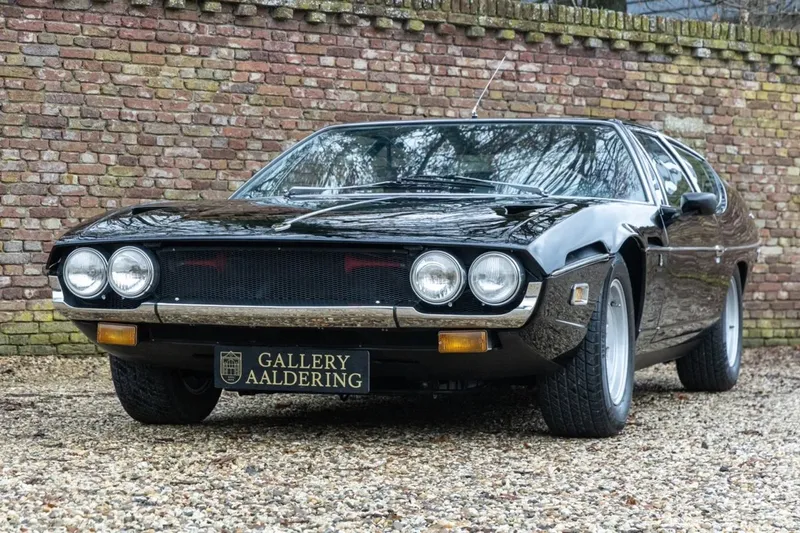
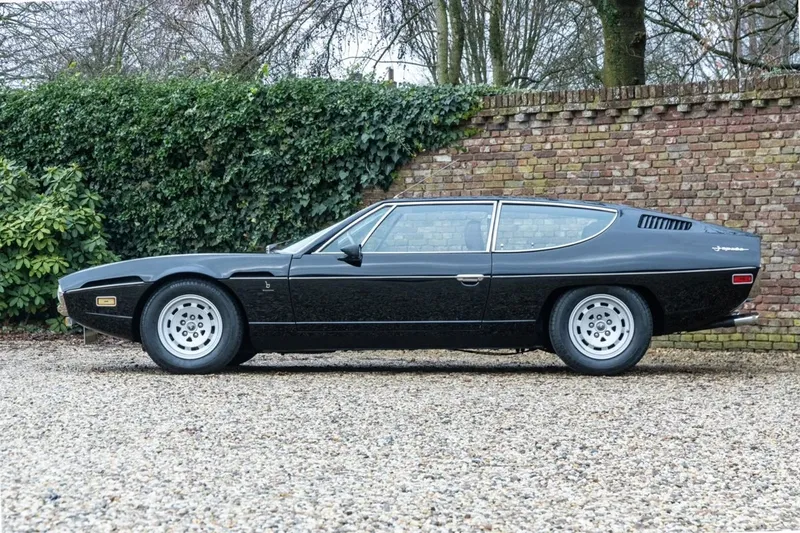
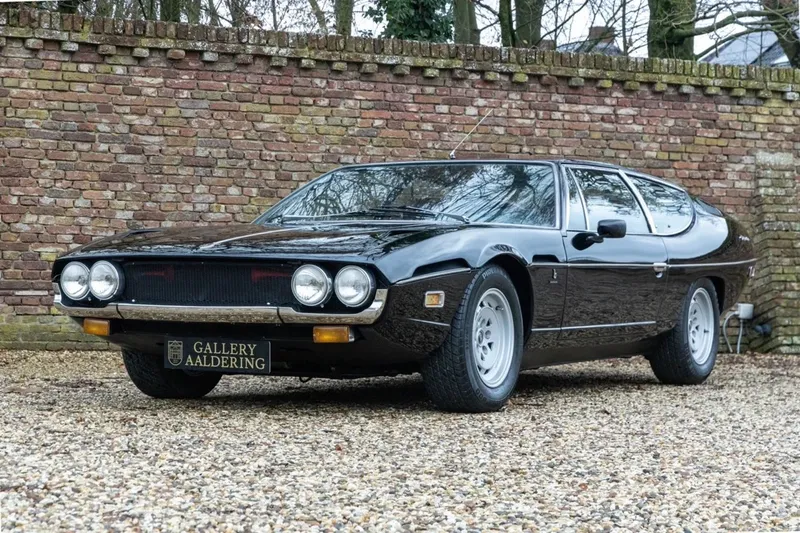
The Espada is identifiable even from a distance by its combination of extreme length (4,738 mm) and a Napoleonic lack of height, with a 1,185 mm roofline that sits below most contemporary two-seat sports cars. Gandini's design uses a long and flat bonnet, a sharply raked windscreen and a full-width glass tailgate that integrates the rear window into the body without a conventional bootlid.
Inside, the Espada's cabin is oriented around four adult seats on a 2,650 mm wheelbase, with the rear bench positioned lower than in a conventional saloon to make the most of the available interior height. The dashboard on Series I and II cars features an instrument cowl with ancillary controls on a central console; the Series III replaced this entirely with a new Bertone-designed layout that extended the full width of the dashboard. Air conditioning, power steering and electric windows were standard on the majority of production cars, but unusual in any competitor of the period.


The Espada was produced in a single continuous lifecycle with three series updates.
Series I (1968–1969). Total of 186 units built, identifiable by their centre-lock Campagnolo wheels and original Bertone dashboard
Series II (1970–1972). A further 575 units; 350 bhp engine; updated dashboard and trim; five-bolt wheels from spring 1972
Series III (1972–1978). All 456 units had a revised Bertone dashboard, improved suspension and brakes and an automatic gearbox option from March 1974
Standard safety equipment in this pre-nanny-state age comprised four-wheel ventilated disc brakes with dual-circuit Girling servo assistance (which was quite advanced in 1968), with brake servo assistance added to the Series III. The Espada's 1,525 kg dry weight and 155 mph capability place significant demands on the braking system, so brake condition is a primary inspection point for any prospective purchase.
Pros
No other model in the marque's history provided this combination of V12 performance and genuine rear passenger accommodation
With 1,217 units built and a specialist network across Europe, the Espada is not so scarce that parts sourcing becomes prohibitive
Series I and II manual-gearbox cars with the five-speed Lamborghini unit deliver a driving experience directly connected to the V12's power curve
Cons
Right-hand drive examples represent a small minority of total production; UK buyers seeking an original RHD car face a corresponding price premium
Series III cars fitted with the Borg-Warner three-speed automatic are regarded by specialists as the least satisfying configuration
Series I Campagnolo centre-lock magnesium wheels are irreplaceable in original spec; stress fractures from age or improper storage can’t be repaired
FAQs
Mechanical parts for the Espada's V12 engine (such as carburettor components, gaskets, bearings, and valve-train items) are available from UK suppliers. The five-speed Lamborghini gearbox shares components with the 400 GT and Islero, but body panels and original interior trim are challenging to source. The Lamborghini Registry and marque specialist networks in Italy and the UK are the primary resource for body and trim items.
The Series III's most consequential changes for a buyer are the improved brake servo assistance, revised spring and damper rates, wider tyres and the redesigned Bertone dashboard. The Series III stops more effectively from speed than its predecessors, while the new dashboard is more modern but replaces the driver-focused instrument cowl of the Series I and II with a wider, flatter design that divides opinion. The Borg Warner automatic option, available from March 1974 on Series III cars, is the one specification to avoid, for reasons outlined above.
The Espada and Miura were produced concurrently, and the Espada was more expensive at launch. The Miura's mid-engine layout, two-seat configuration and greater motorsport association have historically seen it enjoy greater popularity than the Espada, even though the latter uses an identical V12 engine and can seat four people in relative comfort.