Lamborghini Jalpa: Models and Specs
1981–1988 · 3,485cc DOHC V8 · Mid-engine, rear-wheel drive · Two-seater Targa
Overview
The Lamborghini Jalpa was the car that kept Lamborghini alive through the most turbulent decade in its history. Positioned below the Countach, it was the final expression of Lamborghini's ambition to build a V8-engined sports car for buyers who found the Countach too extreme and the Ferrari 308 too ordinary. The Jalpa was anything but ordinary, producing 255bhp from a 3,485cc mid-engine DOHC V8 inside a Bertone-designed Targa body, with a layout that placed the drivetrain behind the cockpit. The Jalpa was lighter and more manageable than its bigger brother, designed for road use rather than provocation. Where the Countach demanded physical effort and total commitment, the Jalpa asked only that its driver respect the limits of a rear-wheel-drive mid-engine sports car. That distinction, which critics occasionally dismissed as a lack of drama, made the Jalpa the more coherent and usable of the two Lamborghinis. Only 410 cars were produced across the Jalpa’s seven-year production run, making the Jalpa rarer in absolute terms than the contemporary Ferrari 308 by an order of magnitude.
Specifications
- Production years
- 1981–1988
- Body styles
- Two-seat Targa
- Layout
- Mid-engine, rear-wheel drive
- Engine
- 3,485cc DOHC V8
- Transmission
- 5-speed manual
Lamborghini Jalpa in Detail
The Jalpa's lineage can be traced back to the technically sophisticated but hopelessly unreliable Urraco V8 coupé from 1972, which never achieved the commercial success Lamborghini needed. By 1980, freshly rescued from receivership, Lamborghini recognised that a credible entry-level model was essential f0r its commercial survival.
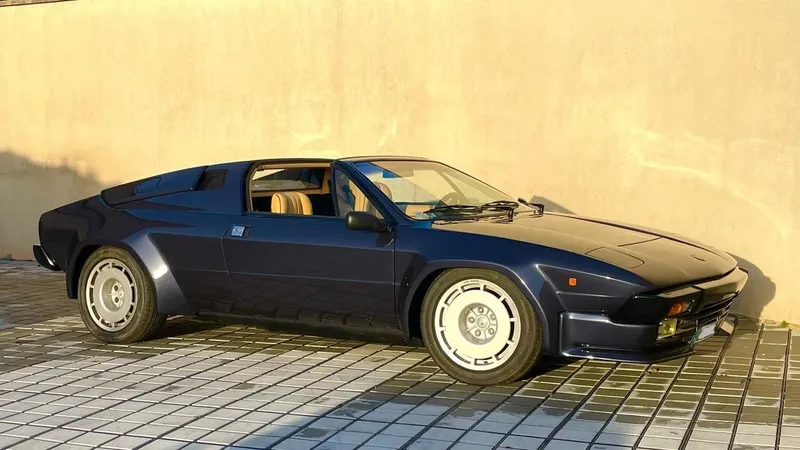
The Jalpa was designed by Marcello Gandini at Bertone, who was also responsible for the Countach, Miura and Urraco. The Jalpa was angular, with sharp creases along the flanks and a Targa roof panel that popped off to open up the cockpit. It continued in production through two changes of Lamborghini ownership, and throughout a decade where the company thrashed around for an identity, even releasing the borderline-absurd LM002 off-roader.
Chrysler Corporation acquired Lamborghini in 1987 and ended Jalpa production in the 1988 model year, by which point the Diablo was already in development as the Countach's successor. The V8 lineage that had begun with the Urraco ended in 1988 and wasn’t reinstated until the Urus SUV arrived thirty years later.
There was only one engine, one gearbox and one state of tune across the 1981–1988 Jalpa production run. Its 3,485cc DOHC V8 produces 255bhp at 7,000rpm and 231lb-ft of torque at 3,500rpm. Crucially, the timing belt that had proved problematic on the Urraco's V8 was replaced by a timing chain, removing the high-consequence failures of the earlier unit. Four twin-choke Weber 42 DCNF carburettors fed the engine, and injection was never adopted on the Jalpa despite its availability on the contemporary Countach LP500S. The five-speed manual gearbox was shared with other Lamborghini models of the period.
Specification | Detail |
Engine | 3,485cc DOHC V8, four twin-choke Weber 42 DCNF carburettors |
Power | 255bhp |
Torque | 231lb ft |
0–62mph | 6.0 seconds |
0–100mph | 19.1 seconds |
Top speed | 155mph |
Kerb weight | 1,510kg |
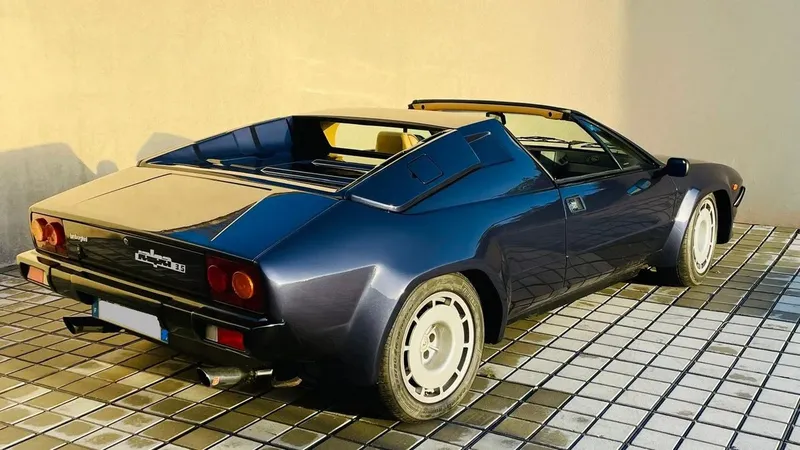
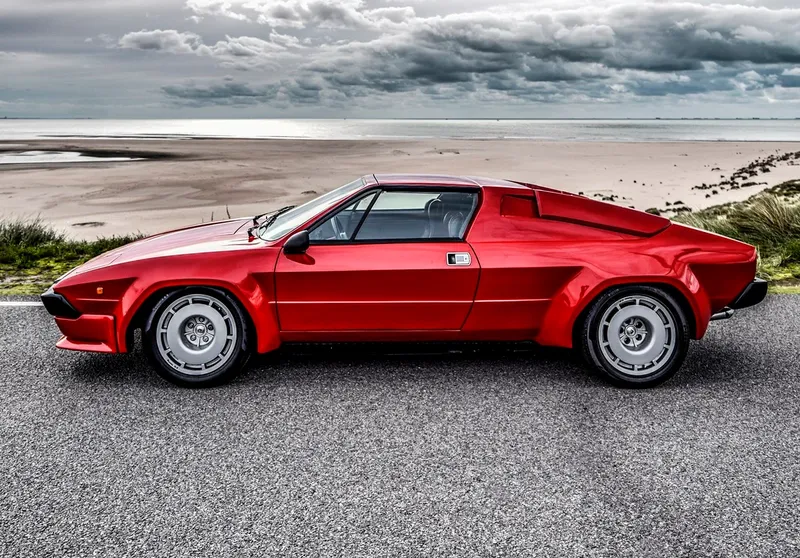
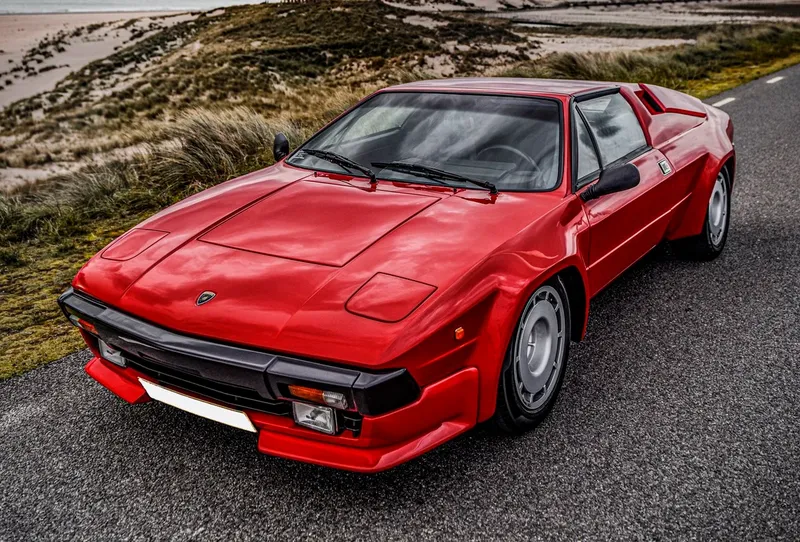
The Jalpa has pronounced rectangular wheel arch extensions that give the car a planted, wide-shouldered stance. The flanks carry a sharp horizontal feature line from the front wheel arch to the tail, interrupted by an engine intake vent behind the doors. The nose is low and angular with rectangular headlamps set into a full-width front panel; at the other end, the tail ends abruptly above a body-width diffuser section. However, it’s what’s in between that tends to appeal to enthusiasts, with a removable roof panel stored behind the seats under the engine cover. Closed, the Jalpa is a tightly proportioned two-seater; open, it becomes more connected, with the V8 soundtrack no longer filtered.
Instruments are grouped in a driver-facing binnacle ahead of a leather-trimmed steering wheel, with surfaces upholstered in fabric or leather. There’s no pretence at the walnut-and-hide dynamics of the period's grand tourers, but you can tell this isn’t a GT because storage is negligible, with the Targa roof panel occupying most of the available space behind the seats.


The Lamborghini Jalpa has no generations and no variants. It was the third and final car in Lamborghini's V8 lineage, with the Urraco (1972–1979) establishing the mid-engine V8 format and the Silhouette (1976–1979) introducing the Targa body and a 3.0-litre engine. The Jalpa completed the evolution with the 3.5-litre chain-drive V8 and that Bertone body.
No Jalpa was built with anti-lock brakes, airbags or electronic stability systems, since the production run ended in 1988 before any of these technologies entered the Italian supercar market. Braking is by four-wheel ventilated discs, though early models lacked servo assistance. The Targa body structure, while distinct from a conventional fixed-roof coupé, provides adequate rigidity for normal road use.
Pros
The 3,485cc V8's adoption of a timing chain in place of the Urraco's timing belt gives the Jalpa a more robust reliability record than its forefather
Lamborghini's Polo Storico programme officially supports the Jalpa with factory documentation, parts traceability and certification services
With only 410 cars produced across a seven-year production run, the Jalpa is rarer in absolute terms than the Lamborghini Miura (764 cars) and significantly rarer than the contemporary Ferrari 308 (over 12,000 cars)
The Jalpa resolved key issues that prevented the Urraco and Silhouette from achieving success
Cons
The engine mounts on all Jalpa P350 cars were carried over from the lower-torque Urraco and are a documented structural weak point
Early production Jalpa P350 cars required engine removal to change spark plugs due to sealed airboxes. Lamborghini later added an access panel to address this, so check spark plug accessibility on any vehicle you’re viewing
The Jalpa was the last V8 Lamborghini produced until the 2018 Urus SUV, so parts need to be sourced from specialist suppliers or new-old-stock channels
The exterior design is not one of Lamborghini’s better attempts, and it looks very dated nowadays
FAQs
The Jalpa was directly benchmarked against the Ferrari 308 and 328, aiming for the same market and price bracket with the same mid-engine V8 formula. The Ferrari 328 has substantially higher values today, a larger ownership community and a wider specialist network globally. By contrast, the Jalpa offers genuine rarity, plus the distinctive Targa body that neither the 308 nor the 328 offered as standard.
Exactly 410 cars were produced between 1981 and 1988, all to the P350 specification. Provenance verification is straightforward against such a short registry, and any Jalpa offered for sale should be cross-referenced with Lamborghini's Polo Storico programme (which maintains factory documentation for the model) before purchase.
Nothing directly. Production ended in 1988 when Chrysler's ownership prioritised the Diablo project as the Countach's successor. The Gallardo (2003), also positioned as a smaller Lamborghini, used a V10 rather than a V8 and is therefore the spiritual successor in market positioning.
For mechanical and engine parts, the position has improved significantly in recent years. Lamborghini's Polo Storico programme provides factory documentation and some direct parts supply for the Jalpa; specialist suppliers hold dedicated Jalpa parts inventories covering brakes, seals, body panels and drivetrain components.