Lamborghini Miura: Models and Specs
1966–1973 · 3.9‑litre V12 · Transverse mid-engine, rear-wheel drive · Two-seater coupé
Overview
The Lamborghini Miura can make a strong claim to having singlehandedly invented the modern supercar, having established every architectural and aesthetic convention that has defined the supercar genre for the six decades since. This two-seater mid-engined coupé was designed by three engineers working in their own time without official Lamborghini authorisation, driven by a belief that a mid-engined road car was technically achievable and commercially compelling. The bare chassis they presented to Ferruccio Lamborghini in 1965 prompted an immediate green light for production, and the Bertone-bodied car that followed at the 1966 Geneva Motor Show generated one of the most significant responses in motor show history. The Miura mattered because it was a trailblazer - the first mid-engined production supercar, the first road car to reach 170+ mph, and the first to combine that performance with coachbuilt styling. It established Lamborghini's identity as Ferrari's most credible rival and created the template that every supercar manufacturer (Ferrari included) has followed since.
Specifications
- Production years
- 1966–1973
- Total production
- 764 cars
- Body styles
- Two-seat coupé
- Layout / drive
- Transverse mid-engine, RWD
- Engine family
- 3,929cc DOHC V12
Lamborghini Miura in Detail
An act of automotive insubordination
The Miura's transverse mid-engine chassis concept was developed in secret, with no approval or authorisation from Lamborghini bosses. The team behind it reasoned that a V12 mounted transversely behind the driver was the only way to achieve both the correct performance and the proportions. Bertone's Marcello Gandini (just 27 years old) produced the body design in a matter of weeks for the 1966 Geneva Motor Show, and the car that appeared on the stand was immediately recognised as a new visual language for performance cars.
Production & Evolution
Production began in 1967, while the P400 S arrived in 1969 with a power increase to 370 bhp, improved interior specification, chrome-surround headlight nacelles and ventilated disc brakes replacing the solid units of the P400. It addressed the earliest car's light front end and carburettor flooding with revised front suspension geometry and carburettor positioning.
The P400 SV of 1971 was the most thoroughly developed Miura, generating 385 bhp from revised carburettors with a split engine/gearbox sump eliminating the shared-oil arrangement that had caused lubrication concerns on earlier cars. Production ended in 1973, with the final SV delivered shortly before the Countach LP400 assumed the role of Lamborghini's definitive performance car.
The Miura's performance identity is defined by the free-revving V12 engine's weight distribution created by the transverse mid-engine layout. The 3.9‑litre V12 was designed specifically for the Miura, with chain-driven dual overhead camshafts and a firing interval that produces the distinctive flat-plane V12 sound, which became one of the car's most celebrated characteristics. Its 385 bhp maximum output, 1,293 kg weight and 98.4-inch wheelbase produced a power-to-weight ratio of 295 bhp per ton in SV form.
Variant | Power range | 0–60 mph | Top speed |
P400 3.9‑litre V12 (1966–1969) | 350 bhp | 6.7 sec | 171 mph |
P400 S 3.9‑litre V12 (1969–1971) | 370 bhp | 5.9 sec | 176 mph |
P400 SV 3.9‑litre V12 (1971–1973) | 385 bhp | 5.7 sec | 180 mph |
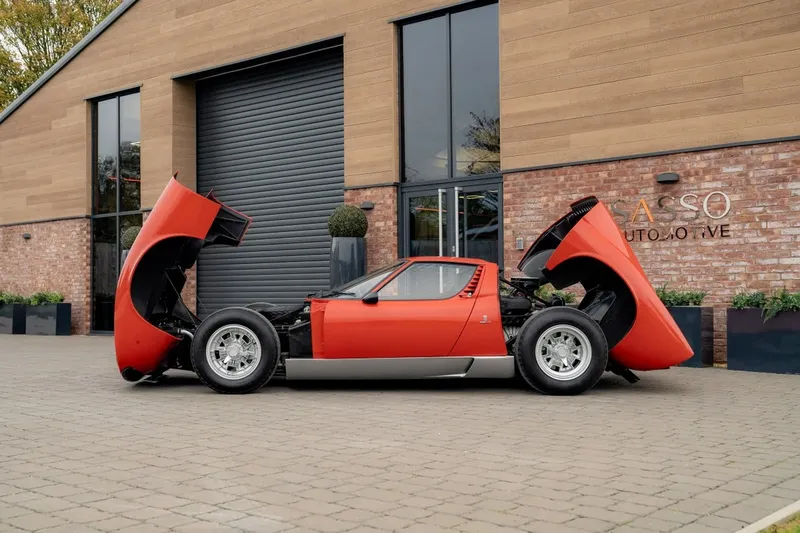
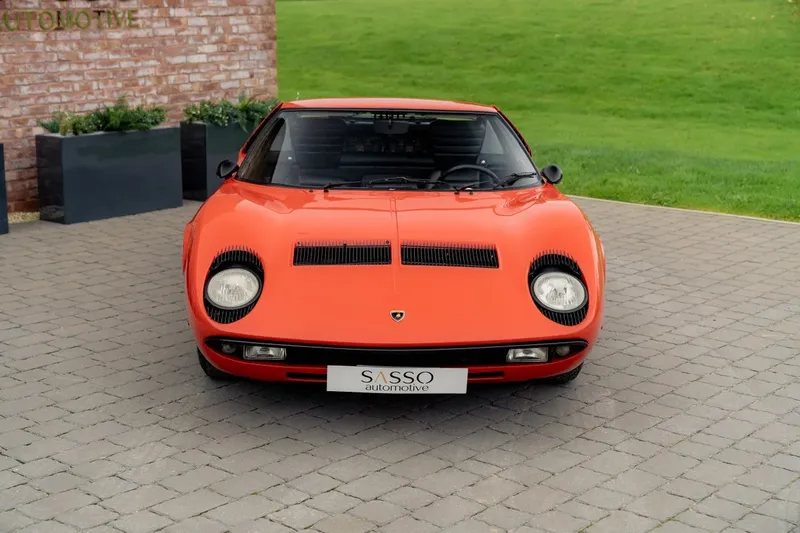
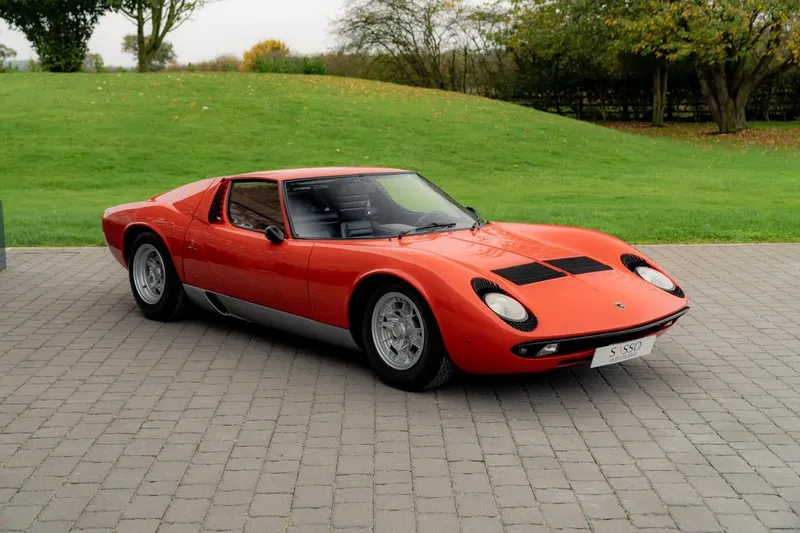
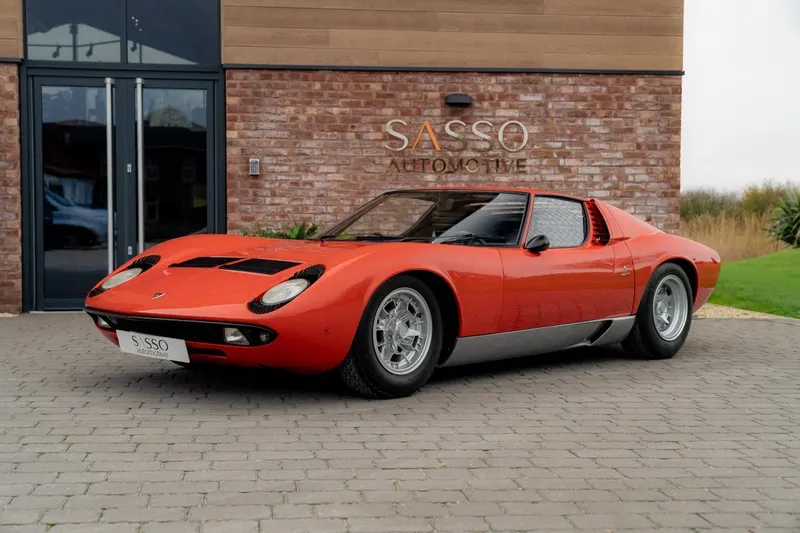
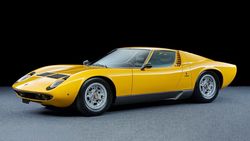
The Lamborghini Miura remains the most recognised automotive silhouette of the 1960s. Gandini's design places the V12, gearbox and final drive behind the driver, allowing a bonnet of near-racing car length that contains nothing but a spare wheel and copious luggage space. Eyelash headlight surrounds give the front end an expression that no subsequent Lamborghini has successfully replicated.
Inside, the cabin is closer to a competition car than a grand tourer with deeply cowled instruments, a small-diameter steering wheel positioned almost horizontally and a console that places the gear lever naturally to hand. The seats are fixed, and the pedal box adjusts, while the overall ambience is intimate, purposeful and entirely serious.


The Miura is a single-generation model with three progressive variants, each more fully developed than the last:
Lamborghini Miura P400 (1966–1969). The original 350 bhp model, with 275 built, was the founding specification and the most historically important variant.
Lamborghini Miura P400 S (1969–1971). The S generated 370 bhp and received ventilated discs and revised suspension geometry; 338 built.
Lamborghini Miura P400 SV (1971–1973). With 385 bhp, a widened rear track and a split sump, the most developed Miura was also the most valuable production variant, with 150 built.
The Lamborghini Miura predates electronic technology and all related legislation. Four-wheel disc brakes were standard throughout, while the mid-engine layout provides inherently more balanced weight distribution than a front-engined car. These are pre-regulation cars of the highest specification for their era, and road use should reflect appropriate awareness of their limitations.
Pros:
Only 764 cars were ever built across the production run, so it has genuine and irreplaceable rarity
Bertone/Gandini design is universally regarded as being among the finest automotive bodywork of the 20th century
Active specialist and restoration community in Italy and the UK sustains parts and knowledge
Cons:
Shared engine/gearbox oil sump on P400 and S requires expert management
Running costs are exceptional, and all major work requires specialist Lamborghini V12 knowledge
Values have risen to levels that make regular road use a significant financial risk
Lamborghini Miura for Sale
Car & Classic connects buyers with Lamborghini Miura listings from specialist dealers and private vendors, representing every entry point into the most significant supercar of the 1960s.
FAQs
It was manufactured between 1966 and 1973 in Sant'Agata Bolognese, though only 764 cars were ever produced. Although the 1974 Countach wasn’t intended as a direct replacement, it did usurp the Miura as Lamborghini's flagship model.
They’re not suitable for anyone working to a budget. The 3.9‑litre V12 requires specialist knowledge for all major service work; UK and European Lamborghini specialists capable of correctly maintaining a Miura are a small community, and parts sourcing for worn or damaged components requires active engagement with that network.
Availability is manageable through the right specialist network, albeit rarely straightforward. The V12 engine's all-alloy construction and chain-driven camshafts are well-understood, and the Lamborghini Registry maintains detailed production and parts records. Weber carburettor components are widely available through specialist suppliers. Bodywork panels require specialist fabrication or sourcing from dismantled cars, and costs are high.
No. One Roadster was built as a Bertone show car for the 1968 Brussels Motor Show, but it was never put into series production despite Lamborghini considering it. This single example has changed hands privately at values well beyond any production Miura.