Subaru BRAT: Models and Specs
1978–1994 · 1.6–1.8-litre boxer-four (naturally aspirated and turbocharged) · Front-engined, part-time four-wheel drive · 2-door coupé utility
Overview
Despite its unfortunate acronymic name, the Subaru Bi-drive Recreational All-terrain Transporter occupies a unique position in the compact truck market of the late 1970s and 1980s. Built on the practical underpinnings of Subaru’s Leone station wagon, it was a direct response to North American demand for small four-wheel-drive trucks, and it was the only vehicle in that class to offer standard AWD across the entire range from day one. The BRAT’s character was defined by a car-derived unibody mated to a pickup bed fitted with rear-facing jump seats and an available T-top roof. It was simultaneously a clever piece of regulatory engineering, a working vehicle and a pop-culture fixture, with President Ronald Reagan using one on his California ranch. As such, the BRAT has gradually accumulated a devoted collector following.
Price
- Starting price
- 2 304 €
- Average price
- 5 715 €
- Price range
- 2 304 € - 17 282 €
Specifications
- Production years
- 1978–1994
- Body style
- 2-door pickup/ute
- Layout / Drive
- Front-engine, part-time 4WD
- Engine family
- 1.6/1.8-litre boxer-four
- Transmission
- 4-speed manual; 3-speed automatic
Subaru BRAT in Detail
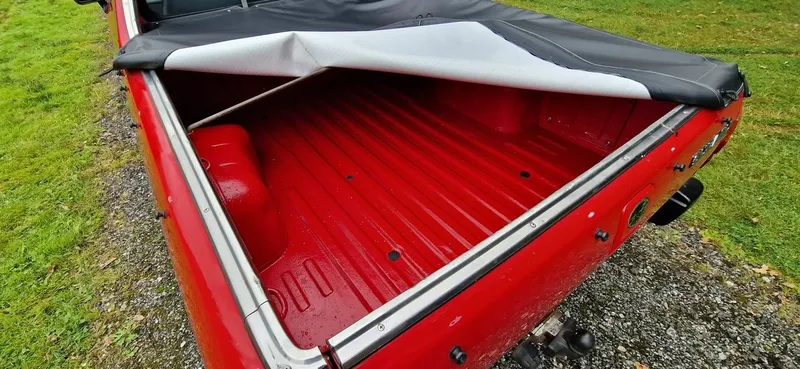
The BRAT was conceived at the direct request of Subaru of America’s president, who identified a gap in the US market for a small, capable and affordable four-wheel-drive pickup. Japanese compact trucks from Toyota, Nissan, and Mazda were already growing in popularity, so Subaru's engineering team simply welded on a cargo bed in place of their Leone station wagon's rear load area.
In the United States, light-duty trucks were subject to a 25 per cent import tariff introduced in 1964 and known, rather obliquely, as the Chicken Tax. By installing two rearward-facing jump seats in the cargo bed, Subaru reclassified the BRAT as a passenger vehicle, slashing the applicable tariff by 90 per cent. These plastic jump seats were trimmed to match the interior and became one of the BRAT's most distinctive features, before being discontinued after the 1985 model year.
The BRAT was built in multiple locations across its production life including South Africa and New Zealand, and it was marketed globally under half a dozen different names. It was never officially sold in Japan, despite some models being manufactured there.
North American sales ceased in 1987 but other markets continued receiving the car until 1994. The BRAT was succeeded by the Subaru Baja (2003–2006), a four-door unibody pickup that failed to replicate the BRAT's popularity or cultural significance.
The EA-71 engine which originally powered the BRAT was a 1.6-litre carburettor boxer-four producing 67 hp. The move to the 1.8-litre EA-81 in 1981 brought a modest power increase to 73 hp alongside the addition of a dual-range transfer case that meaningfully improved off-road versatility. The 1983–1984 turbocharged variant summoned up 95 hp and 123 lb-ft of torque from the EA-81T, paired exclusively with a 3-speed automatic that was definitely not designed with keen drivers in mind.
Metric | EA-71 1.6L (Gen 1) | EA-81 1.8L NA (Gen 2) | EA-81T 1.8L Turbo (Gen 2) |
Displacement | 1,595cc | 1,781cc | 1,781cc |
Power | 67 hp | 73 hp | 95 hp |
Torque | 81 lb-ft | 94 lb-ft | 123 lb-ft |
Transmission | 4-speed manual | 4-speed manual | 3-speed automatic |
Top speed | 85 mph | 88 mph | Not published in period tests |
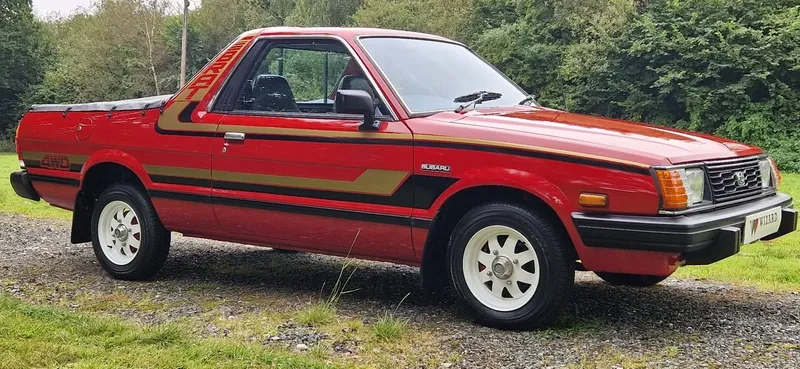
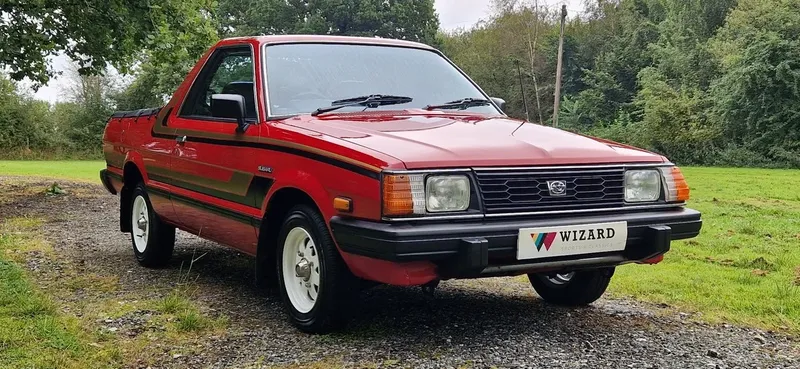
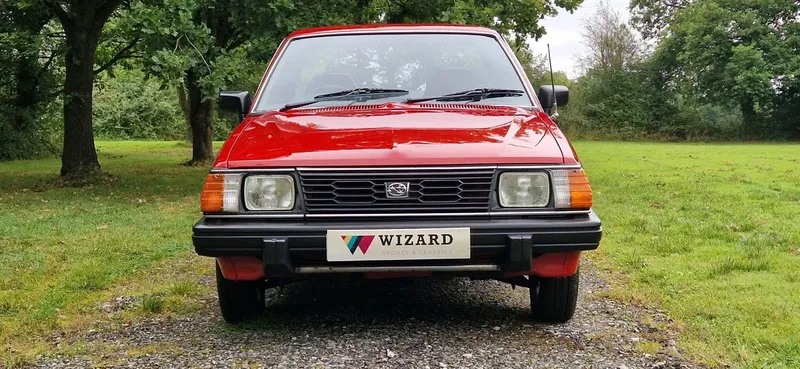
The BRAT's proportions are those of a compact coupé sporting a working bed, which is pretty much what the car was, right down to its short overhangs and low roofline. The front end is clean and purposeful, with a spare tyre located under the bonnet between the engine and firewall. An available T-top split roof gave the car a leisure dimension that sat comfortably alongside its utility character. That character is maintained inside, where the cabin is functional and compact. There was no attempt at luxury, but the quality of fit and finish reflected Subaru's reputation for reliable construction. The rear-facing cargo bed jump seats were the BRAT's most visually distinctive feature, blurring the boundary between car and truck.


[Gen 1 — 1978–1981]
Leone Gen 1 platform, EA-71 1.6-litre boxer-four but no dual-range transfer case, round headlights, rear-facing jump seats
[Gen 2 — 1982–1994]
Leone Gen 2 platform, fully restyled body with rectangular headlights, EA-81 1.8-litre with dual-range transfer case. Turbocharged variant available 1983–1984
The BRAT was designed and sold entirely within the pre-electronic-safety-aids era. Passive safety was provided by seatbelts in the cab only; the rear-facing jump seats in the cargo bed offered no restraint system and were exposed to the elements. The car's unibody construction (shared with the Leone) provided a level of structural integrity.
Pros
Standard part-time 4WD on every BRAT gives it genuine off-road capabilities that no comparable compact truck of its era offered
Rear-facing jump seats are a one-of-a-kind collector feature
Unburstable Subaru mechanicals mean the BRAT can cover huge mileages
Provenance-documented examples are capable of achieving significant auction premiums
Cons
Unibody construction integrates the cargo bed into the vehicle's structure, so rust at the bed/sill junction is a structural issue, not just a cosmetic one
Examples imported outside their original market may carry registration documentation under a different nameplate (Brumby, 284, Shifter, MV)
Jump-seat cars ended production in 1985, meaning later examples lack the feature most strongly associated with the BRAT's identity
The jump seats themselves are uncomfortable, beltless and exposed to the elements
Price trends
Senaste försäljningen
2 000 £
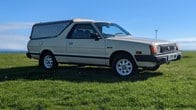
1992 Subaru Brat
För närvarande till salu
1
0 pågående auktioner
1 annons
Totalt sålda
10
Högsta försäljningspris
17 282 €
Genomsnittspris
5 715 €
Lägsta pris
2 304 €
FAQs
They’re the same vehicle. The Brumby is the Australian-market name for the BRAT, sold through to 1994. European markets received the car as the 284, Shifter or MV. The mechanical specification was consistent across different markets, with minor regional variations in trim and emissions compliance.
In the US, it was registered and taxed as a passenger car due to its rear jump seats, but in Australia, it was marketed and registered as a utility vehicle under the Brumby name. Mechanically, the BRAT is a car-derived unibody coupé utility.
Mechanical components shared with the Leone (the EA-71/EA-81 engines, transmission and suspension) are generally sourceable through Subaru specialist suppliers and the active BRAT owner community. Body panels, cargo bed components and those iconic jump seats are hard parts to source, since no new-old-stock supply exists.
A Gen 2 naturally aspirated manual with a documented North American history and intact jump seats will offer buyers the broadest parts availability, the widest owner community knowledge base and the most collectible configuration.