Ford GT40: Models and Specs
1964–1969 · 289ci–427ci Ford V8 · Mid-engine, rear-wheel drive · Two-seat coupé
Overview
The Ford GT40 was the car that ended Ferrari's long-standing dominance at Le Mans, and for that reason alone, it deserves its place in the history books. Conceived in 1963 as Ford's direct response to a failed attempt at acquiring Ferrari, it was designed as a purpose-built endurance racing prototype with a single brief: win the 24 Hours of Le Mans. Four consecutive victories between 1966 and 1969 were the result, and this run remains unmatched by any other car bearing a single nameplate. Within Ford's wider history, the GT40 sits entirely apart from the production range. It was not a performance derivative of anything in the showroom. Built at Ford Advanced Vehicles in Slough, England, it was a professional racing car sold in tiny numbers to private buyers for road use, making it more of a homologation tool than a grand tourer.
Price
- Starting price
- € 69.603
- Average price
- € 146.593
- Price range
- € 69.603 - € 290.000
Specifications
- Production years
- 1964–1969
- Body styles
- Two-seat coupé
- Layout
- Mid-engine, rear-wheel drive
- Engine family
- Small-block V8 (289/302ci); big-block V8 (427ci)
- Transmission types
- 5-speed ZF manual; 4-speed manual
Ford GT40 in Detail
In 1963, Ford entered negotiations to purchase Ferrari, but when Enzo Ferrari abruptly terminated talks, Ford redirected its resources towards building a car capable of defeating Ferrari at Le Mans. The immediate technical foundation was the Lola GT Mk6, a low-slung, mid-engined coupé unveiled at the London Racing Car Show in January 1963. Ford acquired two Mk6 GTs as rolling test beds and established Ford Advanced Vehicles in Slough, under engineer Roy Lunn. The car that emerged took its name directly from its overall height of 40.5 inches, as dictated by aerodynamic necessity and FIA GT class regulations.
Early prototypes ran at Le Mans in 1964 and suffered repeated mechanical failures. The 1965 season brought podiums but no outright win. The decisive breakthrough came in 1966 when the newly developed Mk II, powered by a seven-litre FE-series V8 delivered a 1-2-3 finish at Le Mans. In 1967, the Mk IV won Le Mans with Dan Gurney and A.J. Foyt, the first all-American pairing to win the race outright in an American car.
Production of the GT40 in all forms ceased in 1969, but a continuation series was subsequently built by Safir Engineering between 1981 and 1992, using sequential GT40P chassis numbers within the original numbering range.
The most dominant Le Mans prototype of its era used a modified production V8 engine rather than a bespoke racing unit. The Windsor small-block 289ci used in road-going Mk I cars was shared in principle with the Shelby Cobra 289 and Ford Mustang, developed for racing through carburation/camshaft/compression changes rather than wholesale redesign.
The 427ci FE big-block in the Mk II and Mk IV operated in an entirely different register, since it was a torque-led NASCAR-derived unit producing 485bhp and valued for reliability across 24 hours rather than peak output. The GT40 was not independently road-tested in period for 0–100mph figures, and no manufacturer road-car data was published.
Specification | Detail |
Engine family | Small-block V8 (289/302ci); big-block V8 (427ci) |
Displacement range | 4,181cc (255ci) – 6,997cc (427ci) |
Power range | 306 bhp – 485 bhp |
Torque range | 329 lb ft – 475 lb ft |
Top speed | 165mph – 205mph |
Kerb weight | 820kg – 1,215kg |
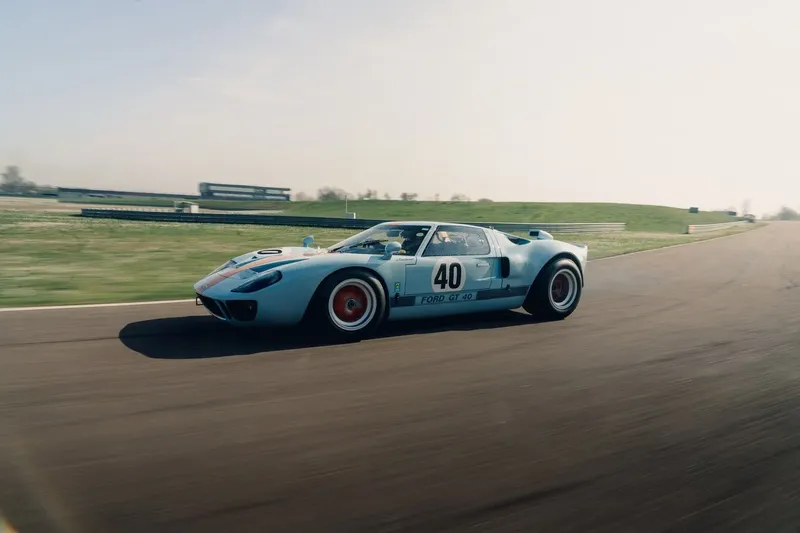
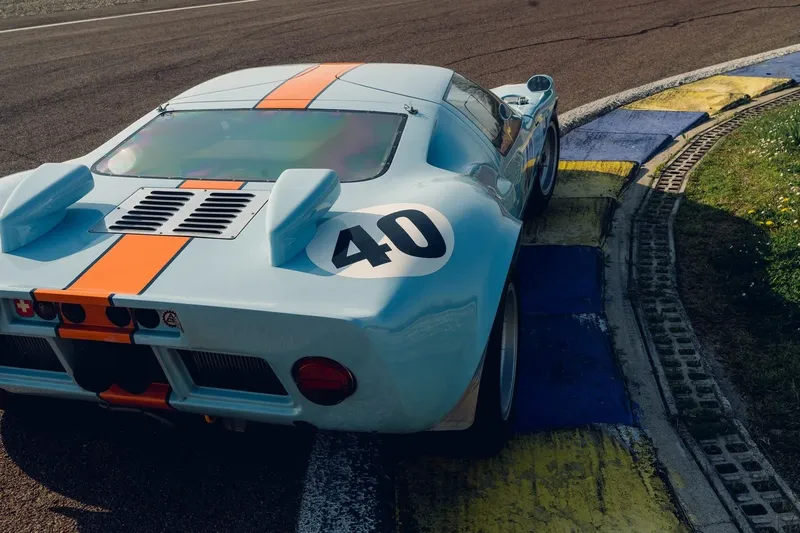
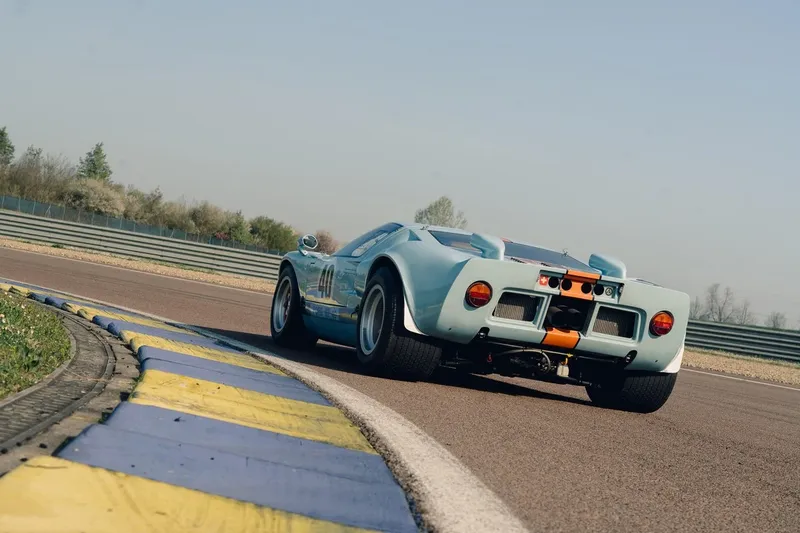
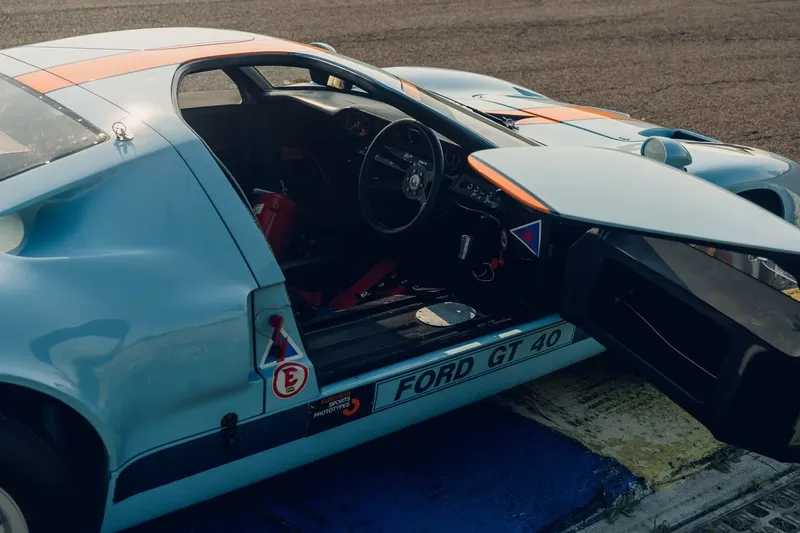
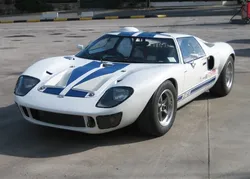
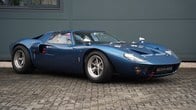
No other road car of the 1960s approaches the GT40's stature - or lack of it. At 40.5 inches overall, the body sits lower than the bonnet line of most contemporary saloons. The silhouette is a continuous fastback sweep with no conventional bonnet: the entire front bodywork pivots forward as a single panel, and the tail lifts as one piece to reveal the engine. Doors are cut into the roofline, so entry requires lowering oneself into the cabin while simultaneously swinging legs under the sill, with the upper door frame following the roofline inward.
Inside, the cabin is stripped to competition essentials across all variants. Road cars received trimming and additional soundproofing compared to race versions, but headroom, legroom and lateral space are all compressed by the racing monocoque. Driver accommodation comes from adjusting pedal position fore and aft rather than moving the seat or steering column.


The GT40 has no sequential generations. The four Marks ran concurrently between 1964 and 1969, with a total original production of just 105 cars.
Variant | Years | Type | Key Distinction |
Mk I | 1964–1969 | Racing and road | Core variant; 289ci Windsor V8; 31 road cars; won Le Mans 1968 and 1969 |
Mk II | 1965–1967 | Racing only | 427ci FE V8, 485bhp, 205mph; won Le Mans 1966; no road version |
Mk III | 1966–1969 | Road only | Detuned 302ci Windsor, 306bhp; only 7 built; the sole GT40 designed from the outset for road use |
Mk IV | 1967 | Racing only | Aluminium honeycomb chassis; 427ci V8; won Le Mans 1967; 4 cars built |
The GT40 is a product of early-1960s Group 4 sports car regulations, where occupant safety engineering was rudimentary at best. Road cars carried no roll protection, no crumple zones and no passive safety systems, whereas race versions had a competition roll cage as standard.
Braking was by four-wheel solid disc, which was advanced for its era and effective. The low centre of gravity and wide track gave stable handling characteristics for a 1960s mid-engined car, but the driving position, constrained outward visibility, and absence of driver aids mean the GT40 demands skill and diligence from behind the wheel.
Pros
Thunderous performance in all variants
The Windsor 289ci/302ci V8 is a production-derived engine with an established international rebuild network
Every Mk I and Mk III carries a continuously maintained entry in the GT40 Enthusiasts Club chassis register, giving authenticated examples a traceable ownership lineage
Four consecutive Le Mans outright victories between 1966 and 1969 give the GT40 a competition record unmatched by any other car sharing a single nameplate
Cons
These cars are extremely rare and consequently tend to be hugely sought after when they come up for sale
No GT40 should be purchased without independent chassis authentication against the GT40 Enthusiasts Club register before any other due diligence begins
The Mk III's behind-sill luggage compartments were noted at the time for becoming extremely hot in use. This is not a place to store boxes of chocolates
Accommodation for drivers above six feet requires a structural and irreversible Gurney bubble modification to the roofline that affects concours eligibility and auction presentation value on any original car
Ford GT40 for Sale
Original GT40s (almost exclusively Mk I road cars) rank among the rarest and most consistently appreciating collector cars at auction, whereas replica and continuation GT40s represent an entirely different market at a fraction of that cost. View the Car & Classic GT40 selection here.
Price trends
Meest recente verkoop
£ 75.000
1991 Ford GT40
Momenteel te koop
13
0 live veilingen
13 advertenties

Totaal verkocht
17
Hoogste verkoopprijs
€ 290.000
Gemiddelde prijs
€ 146.593
Laagste prijs
€ 69.603
FAQs
The Ford GT40 (1964–1969) is the original mid-engined Le Mans car built at Slough. The Ford GT (2005–2006) is a modern tribute using a supercharged 5.4-litre V8, produced in the United States as a homage and never factory-entered in racing. The Ford GT (2017–2022) is another distinct model with a 3.5-litre twin-turbocharged EcoBoost V6, built for GT Le Mans class competition and limited to 1,350 units. None of the three shares mechanical components with the others.
A total of 105 GT40s were produced across all variants between 1964 and 1969. Of these, only 38 were road-legal cars available to private buyers, with 31 Mk I road cars and 7 Mk III cars. The remainder was factory racing machinery. Any road-going GT40 that comes to market is therefore either a genuine Ford Advanced Vehicles original, a Safir Engineering continuation car (built 1981–1992) or a high-quality replica.
Mk I road cars and Mk III cars were homologated for road use at the time of manufacture and remain registerable and road-legal in the UK, predating modern type approval requirements. In practice, road use is occasional and deliberate rather than habitual; the reclined driving position, fixed pedal arrangement and significant mechanical sensitivity make the GT40 a car that demands experience and preparation. Running costs are substantial and should be budgeted for carefully before purchase.
Chassis number authentication via the GT40 Enthusiasts Club register is a non-negotiable first step before viewing, surveying or any price discussions.