Honda Beat: Models and Specs
1991–1996 · 656cc inline-three · Mid-engine, rear-wheel drive · Two-seat roadster
Overview
Kei cars have never enjoyed the adoration in Britain they command in their home country of Japan, but the Honda Beat showed what this diminutive class of car could accomplish. The smallest mid-engined roadster ever built for production, the Beat was one of the last projects personally approved by Soichiro Honda before his death in August 1991 - the same month the car went on sale. Built to Japan's kei car regulations with a maximum engine size of 660cc and dimensions limited to 3,295mm in length, the Beat featured a five-speed manual gearbox and a rear mid-engine layout that placed the driving experience above every other consideration. Honda developed the Beat alongside the Suzuki Cappuccino and Mazda AZ-1, forming a brief golden age of Japanese kei sports cars that ended in 1996 when all three went out of production simultaneously. The Beat is the only one without forced induction, defining its character as high-revving and mechanical rather than turbocharged and immediate.
Price
- Starting price
- Average price
- Price range
- -
Specifications
- Production years
- May 1991 – February 1996
- Body styles
- Two-seater roadster
- Layout
- Mid-engine, rear-wheel drive
- Engine
- 656cc SOHC 12-valve
- Transmission
- 5-speed manual
Honda Beat in Detail
Honda's decision to build a kei sports car emerged from the company's internal "Exciting H" concept studies of the late 1980s, which explored what a dedicated driver's car could look like within Japan's kei regulations. Three proposals were developed simultaneously, and the Beat was chosen.
Its engineering centrepiece was the MTREC system - an acronym of Multi Throttle Responsive Engine Control. Rather than feeding all three cylinders from a single throttle body, as virtually every other kei car engine of the period did, Honda gave each of the Beat's three cylinders its own individual throttle body. Derived from Honda's motorcycle racing technology, it had no equivalent in any other production kei car. The result was a 656cc engine that produced 63bhp at 8,100rpm (the kei car power ceiling at the time) with a throttle response and rev character unlike anything else in the economy car sector.
The steel monocoque chassis used MacPherson struts at all four corners, while a soft-top folded manually into a recess behind the seats. The PP1-110 specification added ABS and a limited-slip differential as the only mechanical upgrades offered above the base PP1-100.
Production ended in February 1996; Honda cited falling kei sports car demand and the cost of meeting evolving safety regulations as the reasons for discontinuation. The Beat's total production of 33,635 cars makes it the lowest-volume of the three kei sports cars of its generation.
The Honda Beat's performance identity is defined entirely by the character of its MTREC-equipped 656cc inline-three. Every Beat carries the same E07A engine in the same state of tune and the same five-speed manual gearbox. There is no performance variant, no higher-output specification and no factory power upgrade at any point across the production run. The car's electronically limited top speed of 84mph reflects Japan's kei car regulations rather than the engine's mechanical capability; the rev ceiling of 8,100rpm and the individual throttle body response define the Beat's character.
Specification | Detail |
Engine | 656cc SOHC 12-valve inline-three |
Power | 63bhp |
Torque | 44lb ft |
Top speed | 84mph |
0–60mph | Approximately 8.5 seconds |
Kerb weight | 760kg |
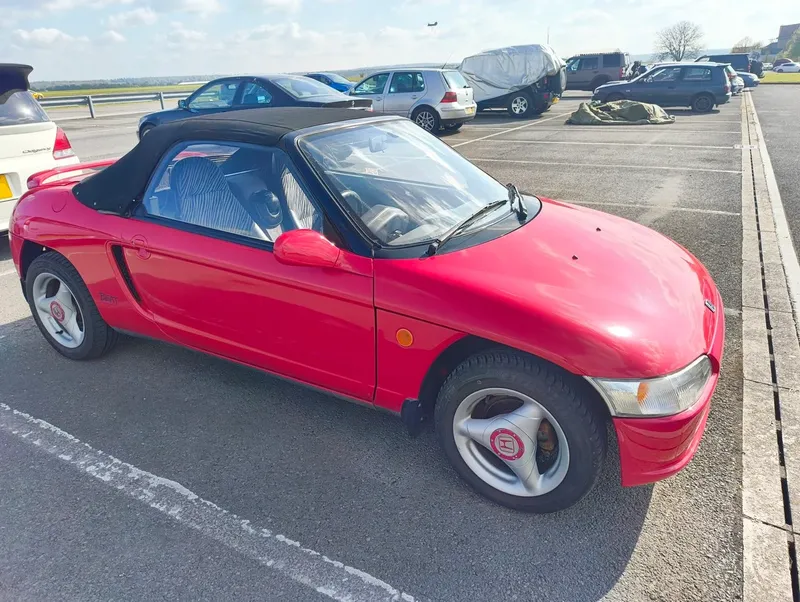
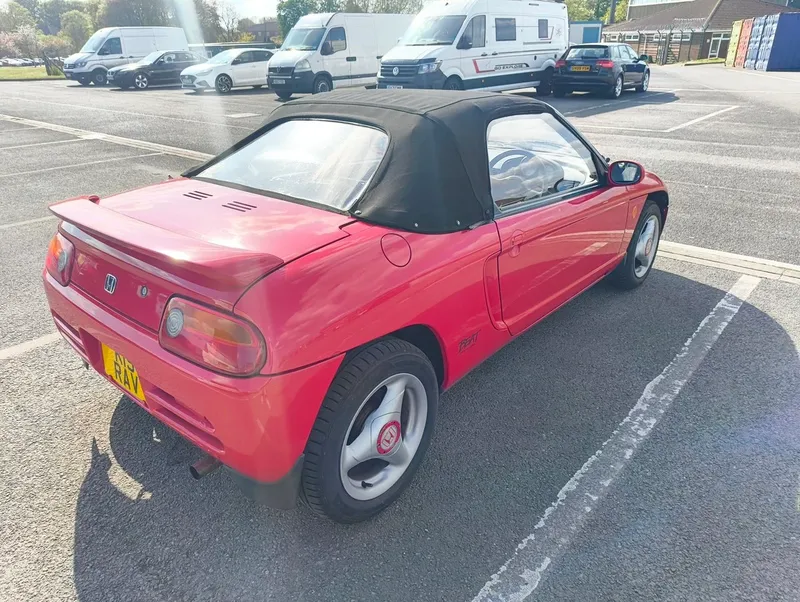
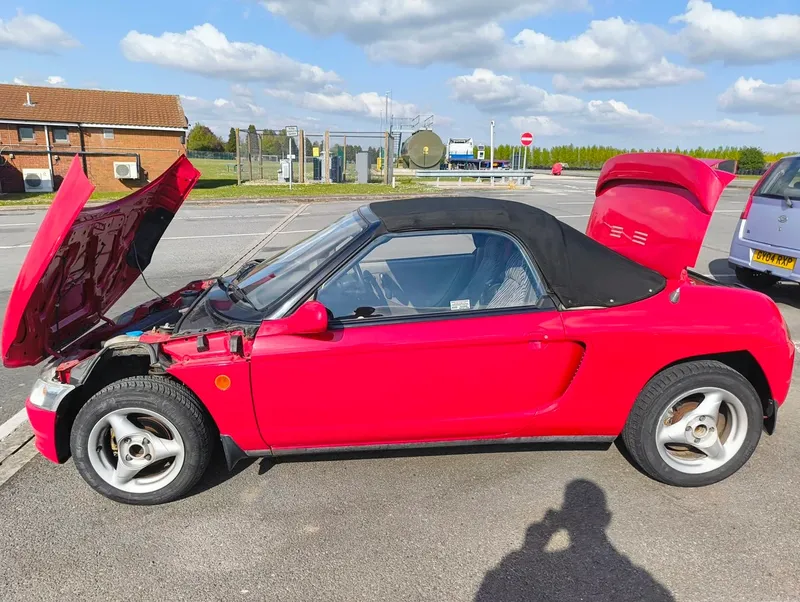
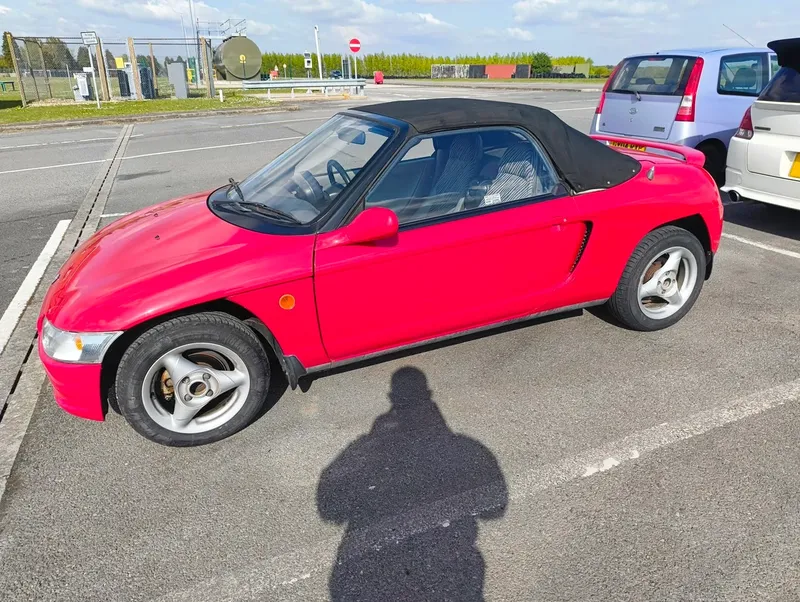
The Honda Beat looks (and is) tiny, but its proportions are those of a scaled-down mid-engine sports car rather than an economy car. The short overhangs, wide stance relative to its length and low bonnet line communicate its layout. The folding soft-top disappears behind the seats into a recess flush with the body line, while the tail carries the engine cover as a flat deck above the rear wheels; luggage access is through the front compartment.
Inside, the cabin accommodates two adults in fixed bucket seats with limited but sufficient legroom for drivers up to around 5 feet 10. The instrument binnacle is driver-facing with a central rev counter larger than the speedometer. There is no storage, no cupholders and no pretence of interior comfort.
The Honda Beat has no generations and no structural variants. All cars use the same PP1 platform, E07A engine and five-seat manual gearbox. The PP1-110 specification added ABS and a limited-slip differential over the base PP1-100.
The Honda Beat was produced under Japan's kei car regulations between 1991 and 1996 and was never subject to European type approval requirements. No airbags were fitted to any Beat; the PP1-110 specification added ABS as the only active safety system.
The car's 760kg kerb weight, open body and absence of structural protection above the sill line make it comparable to a contemporary Mazda MX-5 in basic passive safety, albeit without the first-generation Mazda's driver airbag. No crash test data exists for the Honda Beat under any recognised European or global standard.
Pros
The MTREC system was not used in any other kei production car, and it gives the E07A engine a throttle response and high-rev character that no turbocharged competitor of the period replicates
Suspension components and several drivetrain ancillaries are shared with the Honda Civic, CRX and Prelude of the early 1990s, which reduces sourcing difficulty for wear items and running gear
The Beat was the last vehicle personally approved by Soichiro Honda before his death in August 1991, which gives the car a unique provenance context
Cons
Safety was limited even by 1990s standards, and the Beat did not qualify for European crash testing
The manual soft-top was the only roof option throughout the entire production run; there is no powered alternative and the mechanism wasn’t upgraded at any point
With only 33,635 cars produced and no official imports, there is a limited supply of cars in good condition nowadays
Price trends
Most recent sale
Not found
Currently for sale
0
0 live auctions
0 adverts
Total sold
0
Highest sale price
€0
Average price
€0
Lowest price
€0
FAQs
Honda Beats can be registered and driven in the UK as grey imports under the Single Vehicle Approval process, or on age-related registration through the DVLA, provided they meet current MOT requirements. As a Japanese domestic model, the car is right-hand drive, while the Beat's electronically limited 84mph top speed is more than adequate for UK motorways.
The Version F (1992), Version Z (1993) and Version C (1994) introduced specific colour combinations, with alloy wheels replacing the base steel items and cosmetic details including rear spoilers and colour-coded interior elements.
The E07A engine is a Honda unit from the company's early-1990s quality peak, which has proved mechanically durable and straightforward to service. The reliability variables specific to Beats are rubber components (engine mounts, bushings and CV boots degrade with time), soft-top weather sealing, and the fuel tank, which corrodes from the inside on cars left undriven with stale fuel.
The three cars are direct contemporaries, all produced between 1991 and 1996 under the same kei regulations. The Cappuccino uses a turbocharged 657cc three-cylinder engine with a removable hard-top roof system, whereas the AZ-1 is a mid-engined gull-wing coupé with a supercharged 657cc three-cylinder powerplant.