
Ariel Atom: Models and Specs
2000–present, four-cylinder and V8 engines, exposed tubular chassis, rear-wheel drive, two-seat open sports car.
Overview
Best remembered as the car which turned Jeremy Clarkson’s face inside out, the Ariel Atom is one of Britain’s most iconic modern vehicles. It turned the tiny Ariel company into one of Britain’s leading low-volume performance manufacturers by stripping the sports car back to an exposed chassis with minimal bodywork, very low weight and huge performance from relatively compact engines. Within Ariel’s range, the Atom is the pure road-and-track machine. It’s not a luxury sports car, a grand tourer or a conventional track-day coupé. Its identity is built around lightness, mechanical honesty and direct driver involvement. Ariel describes the Atom’s philosophy bluntly: no roof, no doors and no cupholders, because less is more. The Atom became a benchmark for extreme lightweight performance. It proved that a small British manufacturer could build a road-legal car with acceleration and driver engagement that challenged far more expensive supercars (and even many superbikes), while keeping the core formula simple and brutally focused.
Price
- Starting price
- € 31.499
- Average price
- € 41.279
- Price range
- € 31.499 - € 67.950
Specifications
- Production years
- 2000–present
- Body styles
- Two-seat exoskeletal sports car
- Layout / drive
- Rear-wheel drive
- Engine family
- K-series/K20, K20C turbo, V8
- Transmission types
- Manual and sequential gearboxes
Ariel Atom in Detail
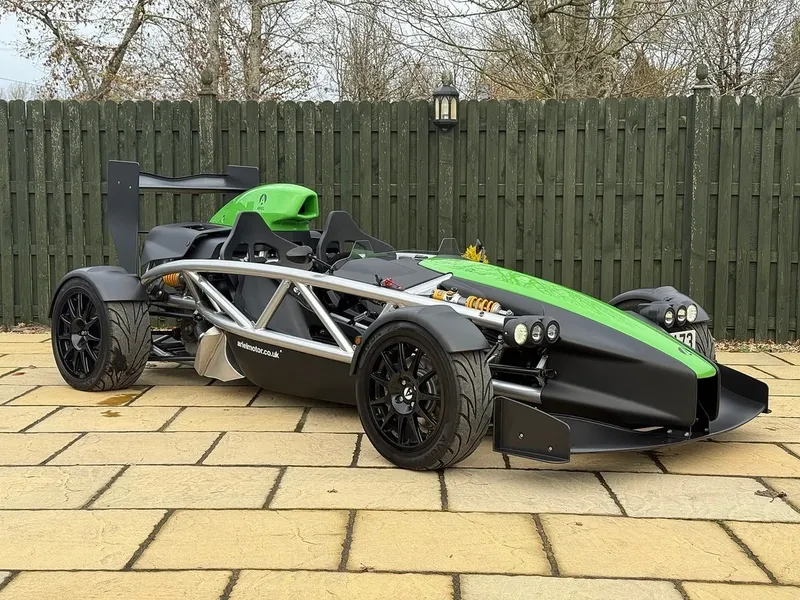
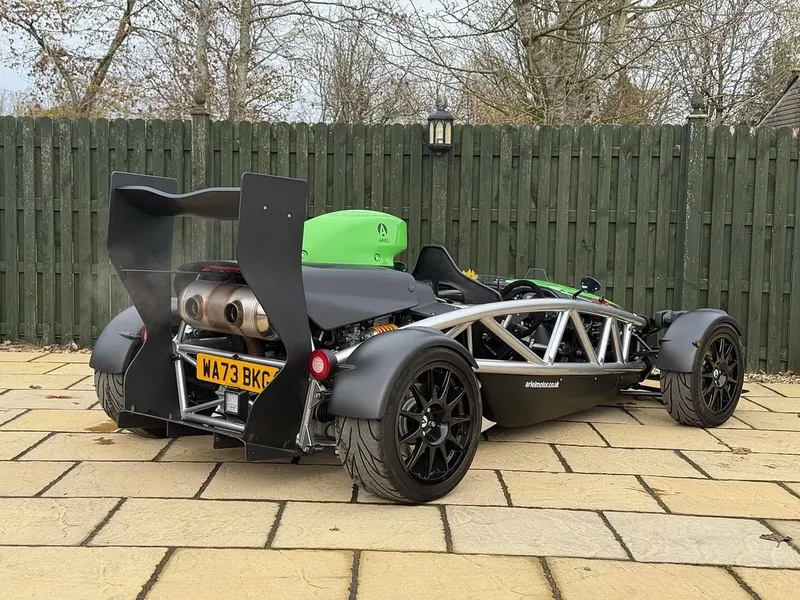
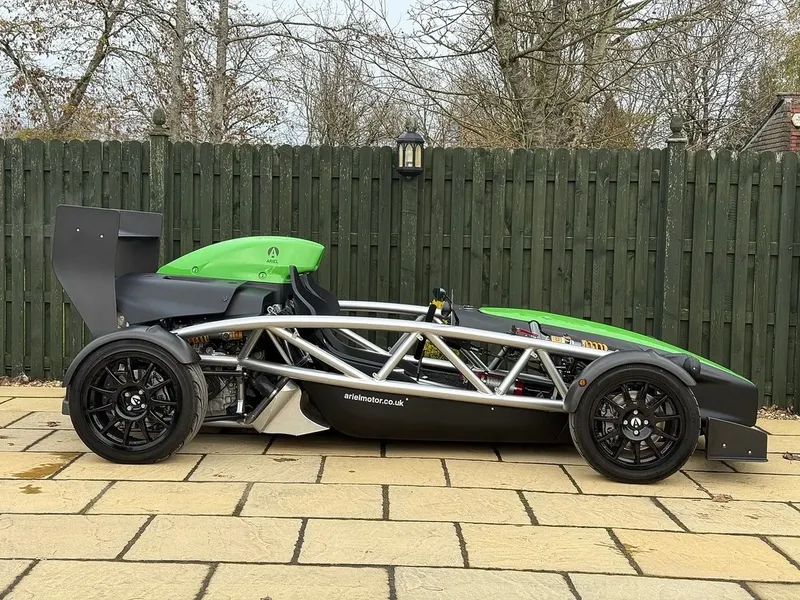
The Ariel Atom was born from a radical rethink of what a road-going sports car could be. Instead of wrapping performance in a conventional body, Ariel made the structure part of the visual identity. The tubular frame isn’t hidden beneath styling; it is the styling. That decision gave the Atom its instantly recognisable look and its unusually direct relationship between engineering and design.
The original Atom used Rover power, but the Atom 2 upgraded to Honda’s Civic Type R K20A engine. This gave rise to the Atom 2 in 2003, with the supercharger option following in 2005. Next up was the 2007 Atom 3 with up to 245 bhp in naturally aspirated form and 300 bhp when supercharged. The Atom 3.5 kept this powerplant and allied it to updated suspension, steering, engine management, bodywork and control interfaces.
The Atom 4 was a major reset, with only three parts carried over from the previous car: the clutch pedal, brake pedal and fuel cap. Yet the model’s character has remained consistent across all versions: lightweight construction, exposed mechanical design, rear-wheel drive, a power-to-weight ratio which could make Ferraris weep, and a driving experience that puts the driver directly in the airflow and at the heart of the action.
The Ariel Atom’s performance evolution is defined less by displacement and more by power-to-weight ratio. Early cars used relatively modest engines by supercar standards, but the Atom’s extremely low mass allowed it to deliver explosive acceleration. Over time, Ariel moved from Rover power to naturally aspirated and supercharged Honda engines, then to the turbocharged Honda K20C engine in the Atom 4, and finally to extreme limited-production versions such as the Atom V8 and Atom 4RR.
As a result, performance figures vary significantly between standard road cars, supercharged versions, limited-run V8 cars and modern turbocharged variants. The Atom 4 could hit 0–60 mph in 2.8 seconds and 0–100 mph in 6.8 seconds, whereas the Atom 4RR reportedly reaches 0–62 mph in 2.4 seconds and 0–100 mph in 5.1 seconds.
Engine family | Power | 0–100 mph | Top speed |
Rover / Honda four-cylinder engines, Honda K20C turbo, limited V8 versions | 120–525 bhp | 5.1–6.8 sec | 162 mph+ depending on version |
The Atom’s performance identity is about immediate acceleration, wind-in-the-hair exposure and the way its low mass and exposed tyres change its braking, steering and cornering response.
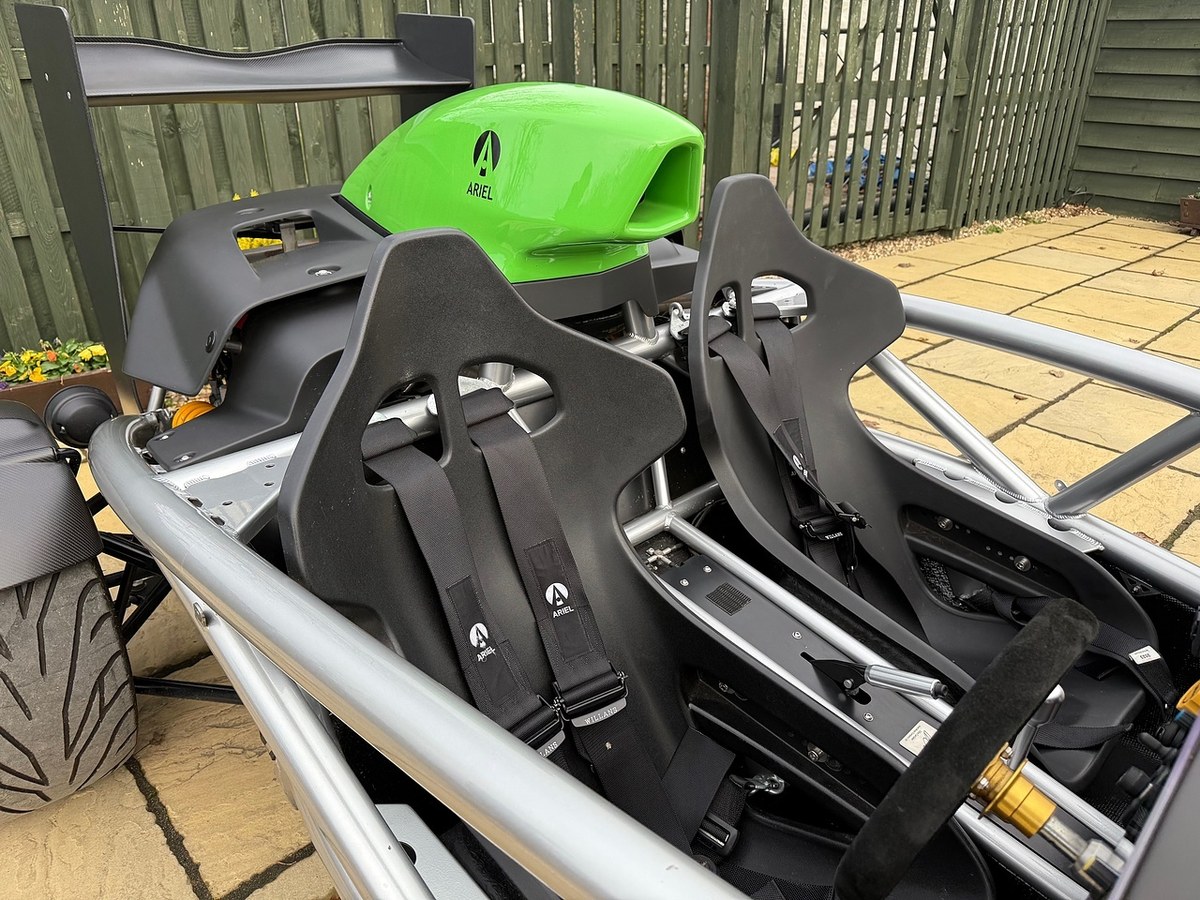
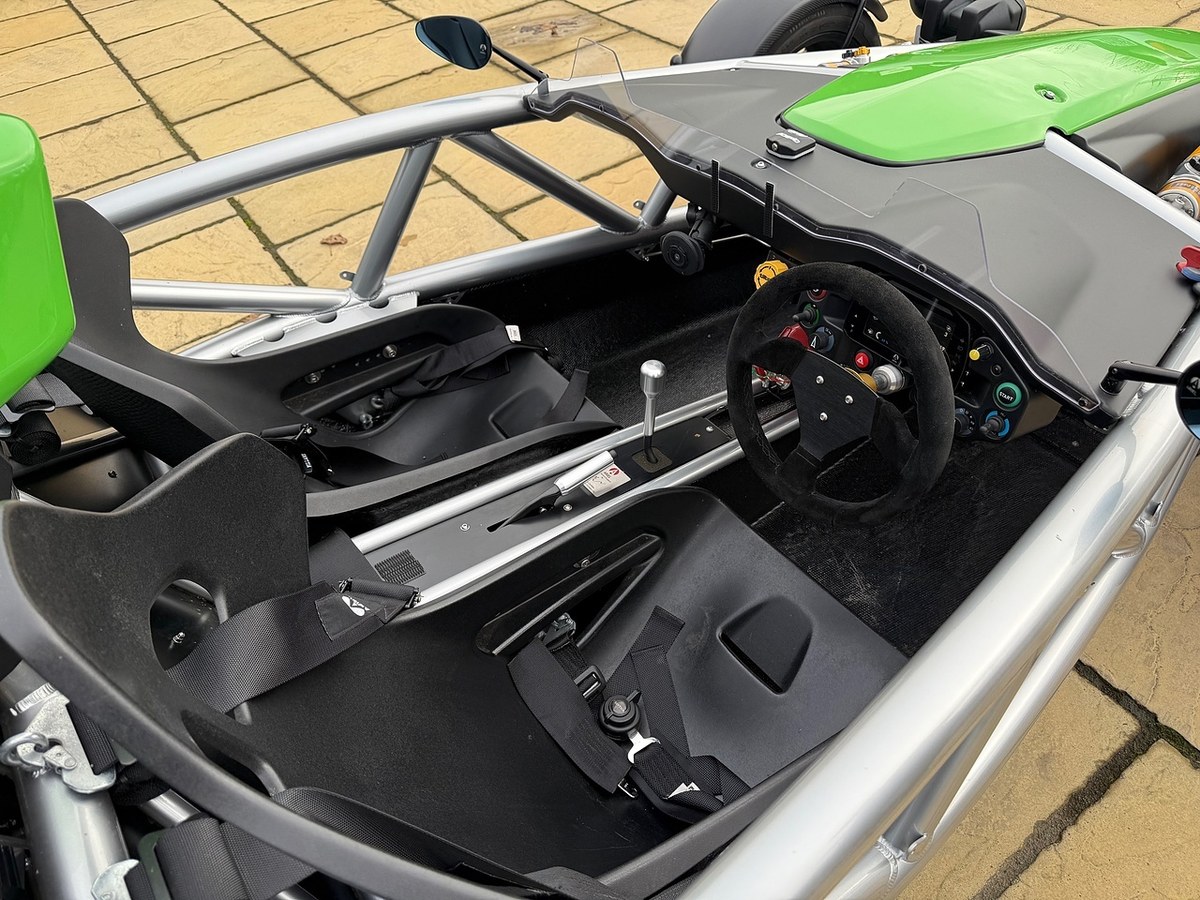
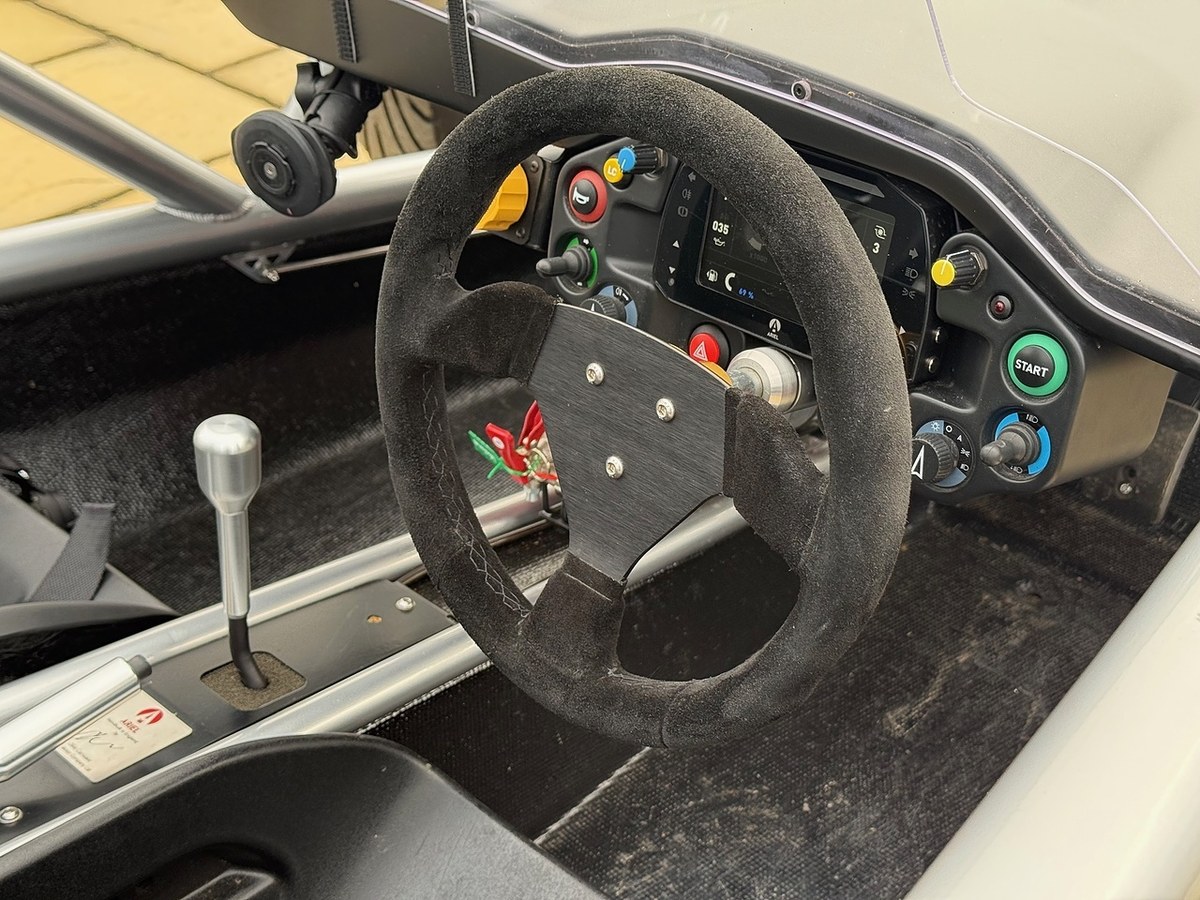
The Ariel Atom is easy to spot in a car park because it barely has a body at all. Its exposed tubular frame, visible suspension, open wheels, tiny nose section and almost complete absence of decorative surfacing still have the power to shock. Where most sports cars use styling to suggest performance, the Atom puts its performance hardware on show instead.
The visual DNA is closer to a single-seat racing car or hillclimb special than a conventional road car, but Ariel keeps the Atom road-legal and usable enough for serious owners to enjoy outside the circuit. The philosophy of the cabin (if you can even call it that) is the same as the exterior. There’s no attempt to isolate the driver from noise, wind or vibration. Instead, those sensations become part of the experience. This is why the Atom’s design has aged differently from most cars. It was never fashionable in the conventional sense, so it hasn’t really gone out of fashion.
Generation | Summary |
Atom 1 | Original Rover-powered Atom; established the exposed chassis, minimalist body and lightweight road/track formula. |
Atom 2 | Introduced Honda Civic Type R K20A power in 2003, with later supercharged versions packing much more performance. |
Atom 3 | Launched in 2007 with the K20Z4 Type R engine, a completely revised chassis and up to 300 bhp in supercharged form. |
Atom 3.5 | A major refinement phase rather than a clean-sheet reinvention, with updates to the suspension, steering, engine management, bodywork and control interfaces. |
Atom 4 | Fourth-generation Atom, described by Ariel as an all-new car with new chassis, suspension, steering, brakes, bodywork, seats, electronics and turbocharged Honda Type R power. |
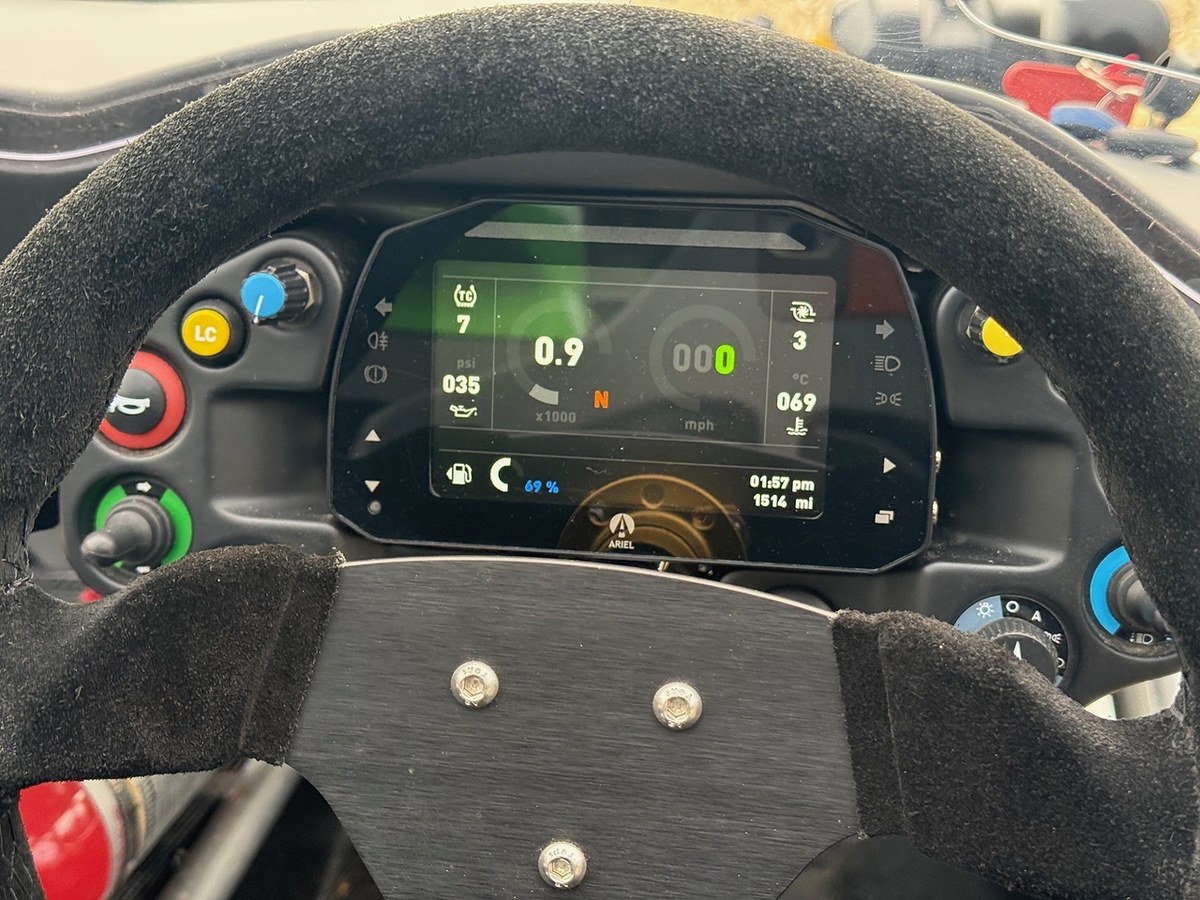
The Ariel Atom sits outside normal sports-car safety expectations because it is intentionally exposed. It has no conventional roof or full body structure, but the company highlights the Atom’s steel chassis, torsional rigidity, inboard pushrod suspension and engineering focus. Safety-conscious buyers are unlikely to choose this over a Volvo, but they should be aware that early analogue Atoms lacked the new electronics (such as traction and launch control) found on the Atom 4, for example.
Pros
The exposed chassis gives the Atom a unique identity that no normal-bodied sports car can copy.
Screaming Honda engines give the model a strong reputation for high-revving performance and engineering credibility.
The Atom’s generational updates are meaningful, so buyers can clearly separate early analogue cars from later, more developed versions.
Cons
The “less is more” philosophy means almost no weather protection, refinement or everyday comfort.
Later Atoms are much more developed, which can make early cars feel rawer and less resolved by comparison.
Because the Atom’s appeal depends so much on specification and intended use, two examples from the same generation can feel very different.
Prijsontwikkeling
Meest recente verkoop
£ 39.995
2005 Ariel Atom

Momenteel te koop
3
0 live veilingen
3 advertenties


Totaal verkocht
10
Hoogste verkoopprijs
€ 67.950
Gemiddelde prijs
€ 41.279
Laagste prijs
€ 31.499
FAQs
The Atom 3 is part of the naturally aspirated and supercharged Honda era, with a revised chassis and strong track-day reputation. The Atom 3.5 refined that formula with updates to its suspension, steering, engine management and controls. The Atom 4 represented a much larger change, with a new chassis, new bodywork, new ergonomics and a turbocharged Honda engine, making it feel more modern and (relatively) more refined.
The Atom is built around an exposed tubular chassis with almost no bodywork, so the structure becomes the styling. Unlike a conventional track-focused coupé, there’s no attempt to incorporate comfort, luggage space or weather protection. Its appeal comes from its low weight, visible components and a driving experience that feels closer to a single-seat racing car than a normal roadgoing vehicle.
The Atom 500 V8 is better understood as a high-performance Atom variant rather than part of the regular production line. It used a radically different V8 engine and was produced in very limited numbers, so buyers should treat it as a collectible halo version, rather than comparing it against standard four-cylinder Atoms.
The Atom can be road legal, but its road usability is very different from a normal sports car. It has no conventional roof, doors or full weather protection, so it suits buyers who want an extreme open-air driving experience rather than everyday comfort. Many owners use Atoms for road blasts and track days, but the car’s exposed nature means it’s much more specialised than a Lotus Elise, Caterham or Porsche Boxster.