Ford Capri Mk2 (1974–1977): Models and Specs
1974–1977 · 1.3-litre–3.0-litre Pinto OHC/Cologne V6/Essex V6 · Front-engine, RWD · Hatchback coupé
Overview
The Mk2 shares many of the original Capri’s design details, but with a welcome added dose of practicality. Introduced at the Brussels Motor Show in February 1974, it replaced the Mk1's separate boot with a full three-door hatchback body. The floor pan, rear-wheel drive layout and engine range were carried over from the Mk1 without alteration; what changed was everything above the waistline and around the driver. Against its predecessor, the Mk2 is wider and taller with better sound insulation, a new dashboard, optional power steering and a folding rear seat that gave the car load-carrying capability for the first time. The introduction of the Ghia trim level represented a deliberate move to broaden the Capri's appeal beyond the performance buyer into the executive-comfort market.
Specifications
- Production Years
- February 1974–1977
- Body Style
- 3-door hatchback coupé
- Layout
- Front-engine, rear-wheel drive
- Engines
- 1,263cc/1,593cc/1,981cc/2,274cc/2,994cc
- Transmission
- 4-speed manual; 3-speed automatic
Ford Capri Mk2 in Detail
Ford's decision to introduce a hatchback body was driven by customer research following the Mk1's first three years in production, which identified the separate boot as a practical shortcoming. The new body was developed with Ghia's involvement; Ford had acquired an interest in the Italian design house in 1970, and the Mk2 was one of the first Ford products to benefit from that relationship in both design and interior specification.
The floor pan and mechanical architecture were carried over from the Mk1, making development significantly faster than a ground-up new car. Spring and damper rates were recalibrated across the range to deliver a marginally softer ride than the Mk1.
In March 1975, Ford introduced the JPS (John Player Special) limited edition at the Geneva Motor Show. Finished in Midnight Black with gold coachlines, it referenced the John Player Special Formula One livery prominent in UK motorsport at the time. Available from June 1975 in both 1.6 and 3.0-litre variants, it was the only factory special edition of the Mk2 era. All UK Capri production was consolidated at the Cologne factory in 1976, ending Halewood's involvement.
Variant | Engine | Power | 0–60 mph | Top Speed | Transmission |
1300L | Pinto 1.3-litre OHC | 54 bhp | 17.0 sec | 87 mph | 4-speed manual |
1600 GL | Pinto 1.6-litre OHC | 72 bhp | 13.0 sec | 99 mph | 4-speed manual |
2000 GL/S | Cologne V6 2.0-litre | 90 bhp | 11.0 sec | 107 mph | 4-speed manual |
2300 GT/S/Ghia | Cologne V6 2.3-litre | 107 bhp | 10.0 sec | 114 mph | 4-speed manual |
3000 S/Ghia | Essex V6 3.0-litre | 138 bhp | 8.9 sec | 123 mph | 4-speed manual/auto |
Outright performance figures are broadly unchanged across equivalent engine specifications compared to the Mk1, because the Mk2's additional body weight was offset by improved aerodynamics. The Cologne V6 2.3-litre was new to the UK range in the Mk2, adding a mid-range option between the 2.0-litre and 3.0-litre that the British-market Mk1 had never offered.
The Mk2 shares the Mk1's 2,559 mm wheelbase, so all dimensional changes are in body width (+53 mm) and height (+82 mm). The wider rear haunches are the most visible dimensional consequence, giving the Mk2 a slightly more planted stance than the Mk1, albeit at the cost of a heavier visual rear end.
L. Entry trim; 1.3 or 1.6-litre with minimal equipment
GL. Mid-range; improved interior, chrome trim
GT. Instrument pack, sportier specification; 2.0/3.0-litre
S. Sports seats, rear spoiler on some markets
Ghia. The luxury flagship; leather facings, vinyl roof, chrome; 2.3/3.0-litre
JPS (John Player Special). Factory special; Midnight Black, gold coachlines; 1.6/3.0-litre; Geneva 1975
No RS homologation variants were produced during the Mk2 period, since the RS programme was exclusive to the Mk1 era.
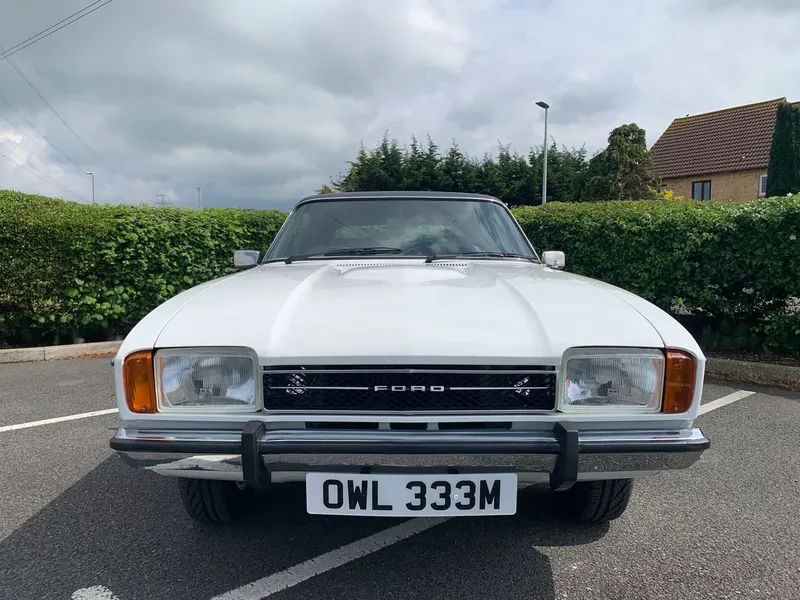
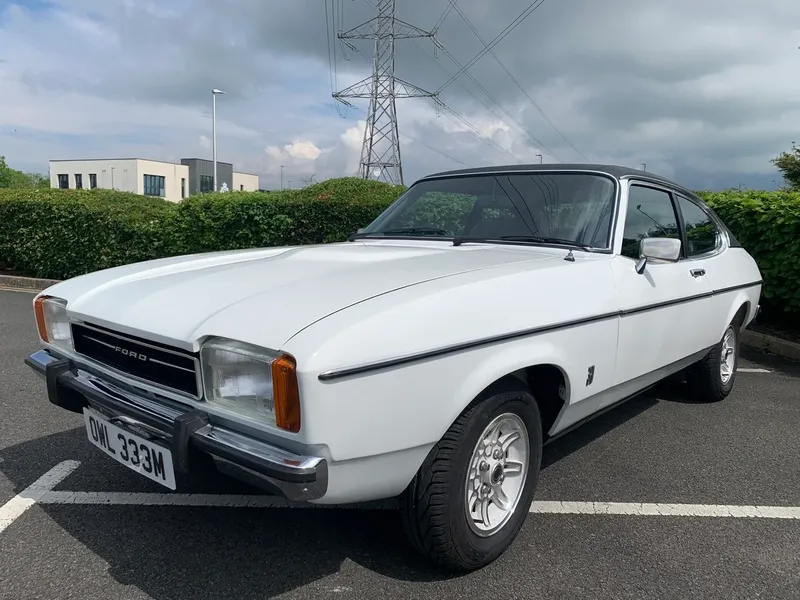
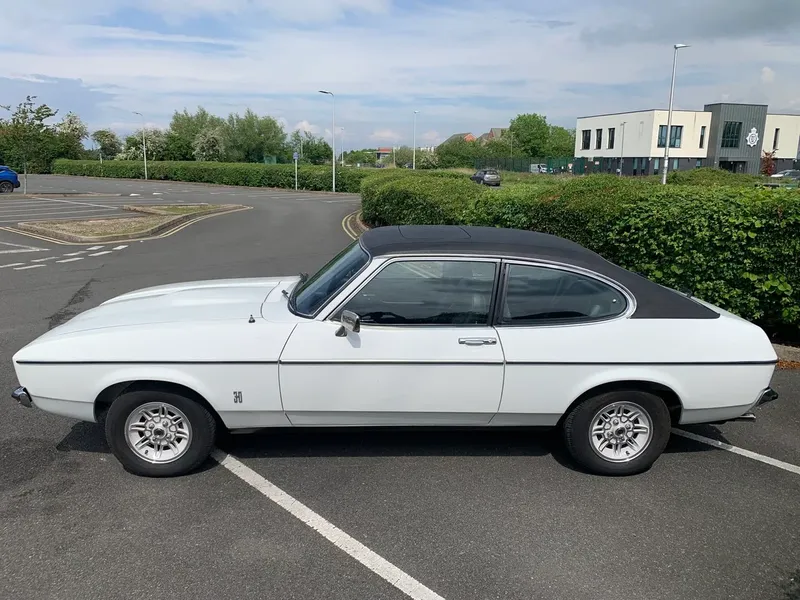
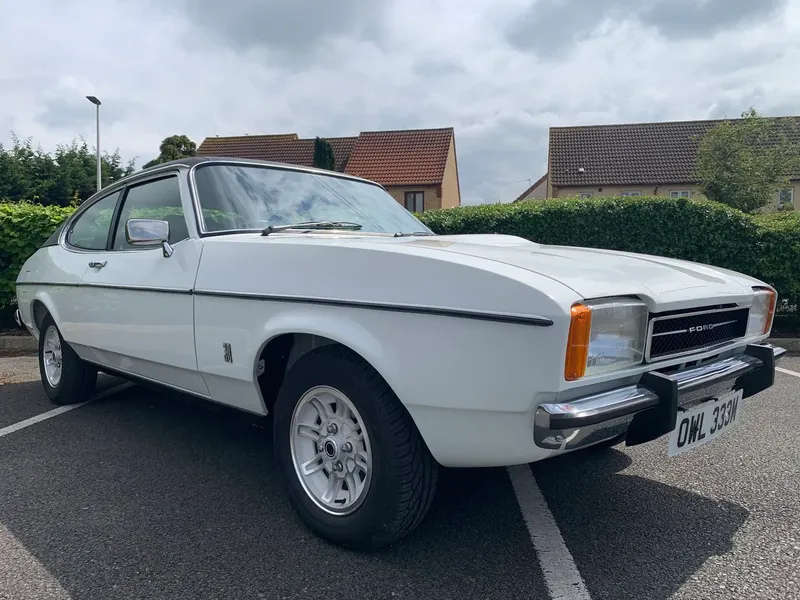
The Mk2's defining exterior change from the Mk1 is the hatchback tailgate replacing the separate bootlid. The rear roofline maintains a similar rake but terminates in a full-width tailgate. The car is visibly wider at the rear haunches, and the front end was restyled with a new grille and revised bumper arrangement. The Ghia specification added a vinyl roof as standard, while the JPS edition's Midnight Black paint with gold coachlines is the most visually distinctive Mk2 factory specification.


The Mk2 introduced a comprehensively revised cabin over the Mk1: a new fascia with improved ergonomics, better sound insulation throughout the range, and leather seat facings on the Ghia. The folding rear seat was a first for the Capri, expanding luggage capacity beyond the Mk1's fixed-seat arrangement. The JPS interior carried black-on-black trim with gold detailing matching its exterior livery.


Safety equipment on the Mk2 is consistent with the baseline outlined on the Ford Capri overview page. Front disc brakes were standard across all but the entry 1.3-litre model, with rear drums retained throughout the range.
Body and Structure
The tailgate aperture seal channel is the Mk2's greatest corrosion risk. Water pooling in the tailgate seal causes rust to progress inward through the rear roof rail, which is an issue not present on the Mk1's separate-boot body. Corrosion is frequently evident under seam sealer on cosmetically restored cars. The tailgate hinges and check straps should be operated during inspection since correct-specification replacements are increasingly difficult to source.
Interior
Ghia leather seat facings and JPS interior items deteriorate significantly with age and correct-specification replacements aren’t widely available. The folding rear seat mechanism should be operated during inspection to confirm correct function; also check the carpet beneath for water damage from perished rear seals.
Cologne V6 2.3-litre
This unit wasn’t offered in the Mk1. Check for oil leaks at the rocker covers and timing chain rattle on cold start. These are the same characteristics as the Cologne 2.0-litre but with slightly higher thermal loading due to the larger displacement.
FAQs
The Mk2 is the first generation to have introduced the hatchback body, which was carried forward unchanged into the Mk3. It’s the only generation to have been offered with the Cologne V6 2.3-litre in the UK market, and the only generation to carry the JPS factory special edition. Unlike the Mk1, there were no RS homologation variants; unlike the Mk3, it was never offered with the 2.8 Injection.
Mechanical parts for all Pinto, Cologne V6 and Essex V6 engines are broadly available through the Ford Capri Owners Club network and specialist suppliers. Body panels including front wings, sills and floors are available in reproduction form. Tailgate seal channels and tailgate-specific hardware are harder to source than equivalent Mk1 parts due to the Mk2's shorter production run.
The Mk2 was manufactured for just three years (1974–1977), which was the shortest production run of any Capri generation. This means fewer cars were built than either the Mk1 or the long-running Mk3, and Mk2-specific body components (particularly the tailgate seal channel and rear light clusters) are proportionally scarcer in the aftermarket. Mechanical parts are unaffected by this, as the engine and drivetrain carried forward into the Mk3.