Ford Escort RS Cosworth: Models and Specs
1992–1996 · 2.0-litre turbocharged inline-four · Front-engine, AWD · 3-door hatchback
Overview
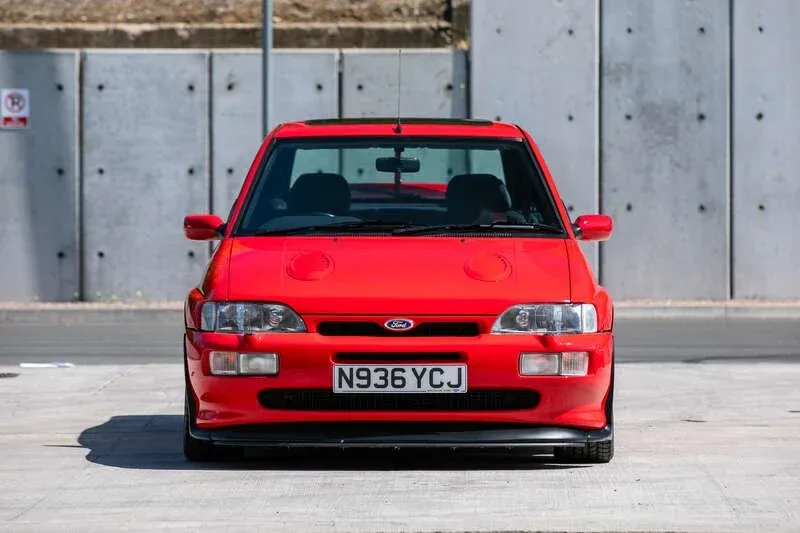
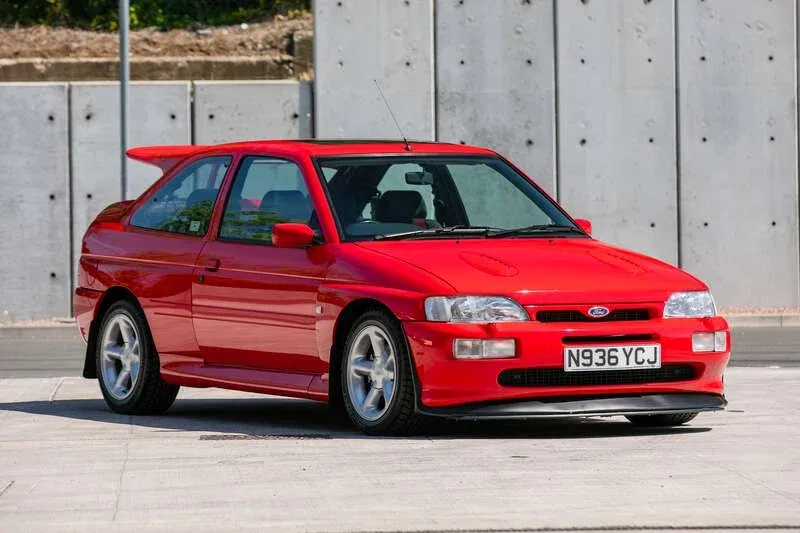
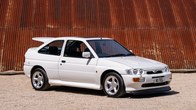
With cultural connotations foreign buyers wouldn’t appreciate (or understand), the Ford Escort RS Cosworth is an icon of British motoring. This Group A homologation special wore everyday Escort bodywork over Sierra Cosworth 4×4 mechanicals. The direct successor to the Sierra RS Cosworth in spirit and engineering DNA, the Escort was more compact, more purposeful and more obviously inspired by motorsport obligations than any other volume road car of its era. The Escort RS Cosworth isn’t a hot hatch in the traditional sense. It’s a 224 bhp, four-wheel-drive turbocharged sports car that happens to be a hatchback. Indeed, it was one of the last production cars where a buyer could purchase the mechanical underpinnings of a works rally car. That demanding and uncompromising motorsport character defines every aspect of the Cossie ownership experience. This is not a car for shrinking violets.
Price
- Starting price
- 4 995 €
- Average price
- 64 754 €
- Price range
- 4 995 € - 130 000 €
Specifications
- Production years
- 1992–1996
- Body styles
- 3-door hatchback
- Layout / drive
- Front-engine, permanent four-wheel drive
- Engine family
- 1,993 cc turbocharged inline-four
- Transmission types
- 5-speed manual
Ford Escort RS Cosworth in Detail
The Escort RS Cosworth was conceived in the late 1980s, after the two-wheel-drive Sierra RS Cosworth proved too large and slithery to be competitive in Group A rallying. The styling was designed in 1989, a year before the Mk5 Escort was launched, while body tooling was executed by coachbuilders Karmann at the same German facility where all production Cosworths were assembled.
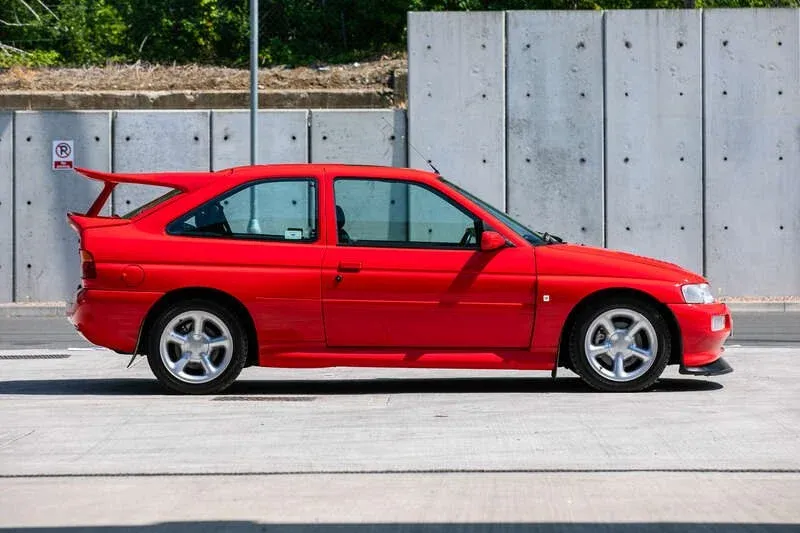
The engineering involved a shortened Sierra Cosworth 4×4 floorpan being draped in as-yet-unreleased Escort Mk5 body panels, though only the front doors and roof are directly shared with the standard Escort. Permanent four-wheel drive with a 34/66 front/rear torque split was carried over from the Sierra via an uprated five-speed gearbox, while the longitudinally mounted Cosworth YBT 1,993 cc 16-valve twin-cam turbocharged engine produced 224 bhp at 6,250 rpm.
Production began in February 1992, with 2,500 units completed by 1 January 1993 to fulfil FIA Group A homologation requirements. These Motorsport Base-specification cars were all equipped with a non-functioning water injection system under the rear passenger seat to demonstrate Group A capability to the FIA. From June 1994, a revised Small Turbo version entered production featuring a Garrett T25 turbocharger, Ford EEC IV engine management and enlarged piston oil squirters for improved cooling. Production ended in early 1996 when the car could no longer meet new EU noise regulations, by which time 7,145 examples had been built.
The Escort RS Cosworth's performance identity is defined by one constant across the entire production run: turbocharged torque delivery through a permanently engaged four-wheel-drive system. Both the Big Turbo (YBT, Garrett T3/T04B) and Small Turbo (YBP, Garrett T25) variants share the same 1,993 cc Cosworth-developed block, producing an identical displacement across two distinct states of tune with meaningfully different character.
Specification | Big Turbo (YBT) | Small Turbo (YBP) |
Engine family | 1,993 cc inline-four turbo | 1,993 cc inline-four turbo |
Power range | 224 bhp | 219 bhp |
0–62 mph | 5.7 sec | 5.7 sec |
Top speed | 144 mph (with whale-tail spoiler)/147 mph (spoiler deleted) | 144 mph (with whale-tail spoiler)/147 mph (spoiler deleted) |
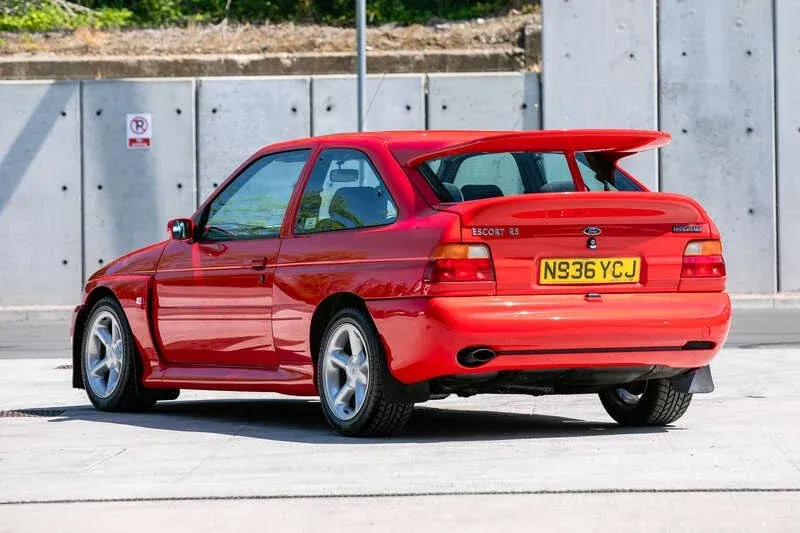
The Escort RS Cosworth is immediately recognisable by its adjustable whale-tail spoiler, which gives the car an aerodynamic presence wholly unlike any contemporary hot hatch. Combined with the deep front splitter, these aero elements are calibrated to produce measurable downforce at speed. The body sits noticeably wider and lower at the rear than a standard Mk5 Escort, with 50 per cent of its body panels different.
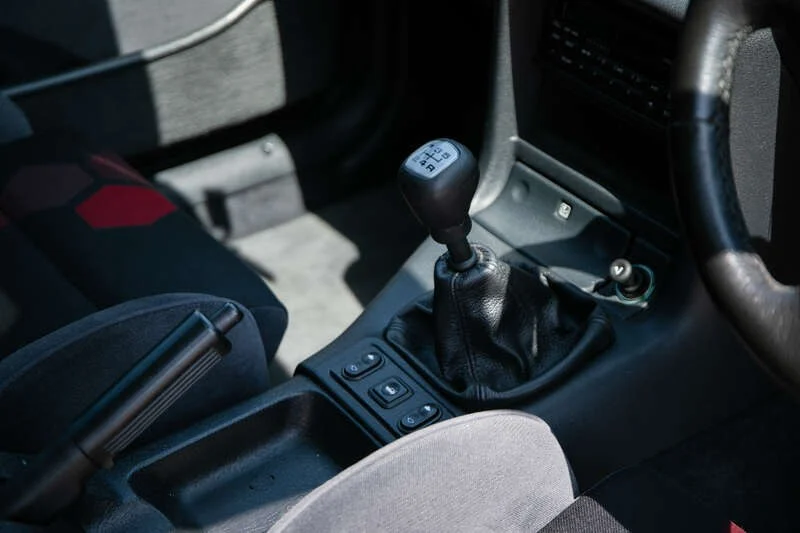
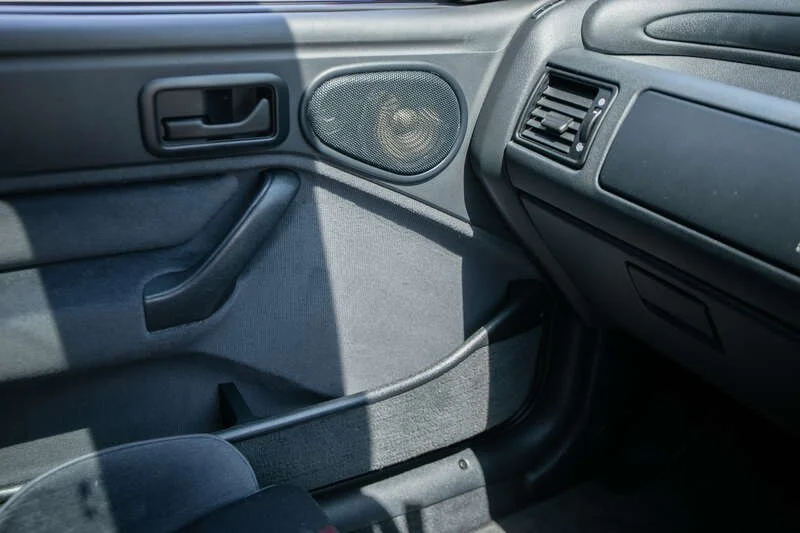
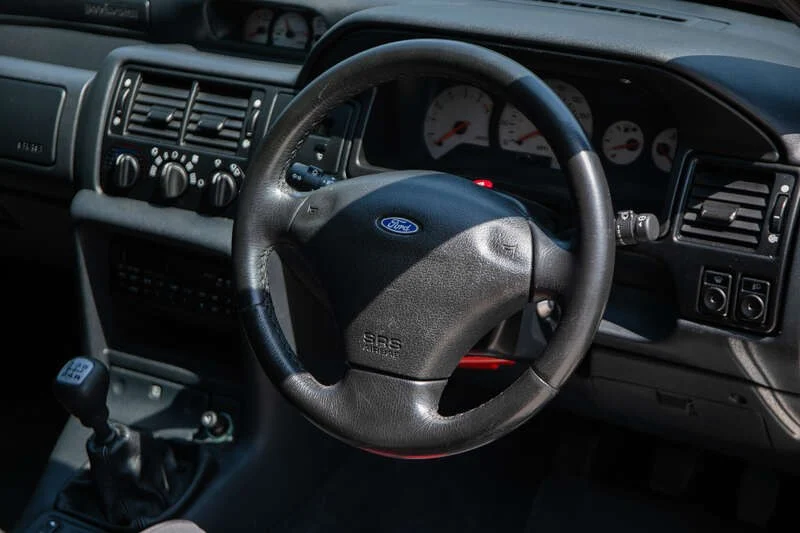
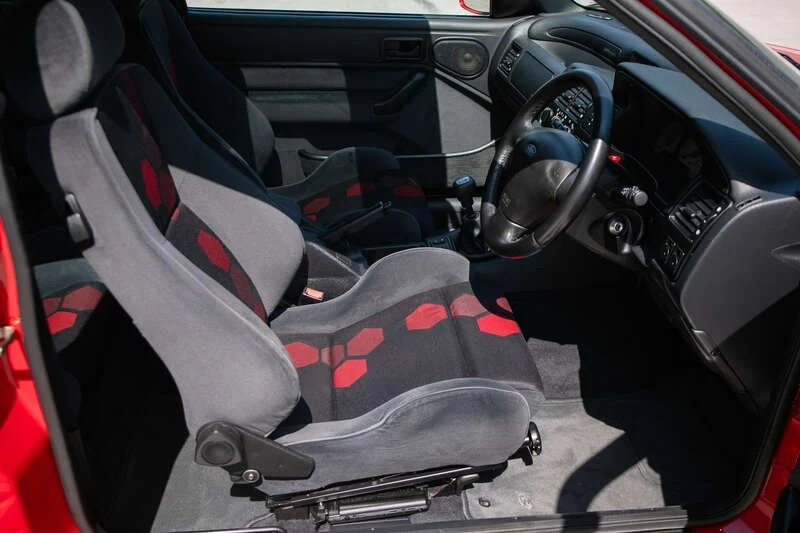
Inside, the cabin philosophy is more Escort than Cosworth. Recaro bucket seats, a motorsport-influence instrument layout and minimal soft furnishings signal the car's competitive origins, but they hardly scream supercar. The Lux edition added leather seats, air conditioning, a heated windscreen and electric sunroof.
Big Turbo (1992–1994). Garrett T3/T04B hybrid turbo, Weber-Marelli IAW P8 management, 224 bhp; includes the 2,500 FIA homologation cars
Small Turbo (1994–1996). Garrett T25, Ford EEC IV management, individual coil packs per cylinder, 219 bhp; Standard and Lux trim only
The Escort RS Cosworth was developed and launched in the early 1990s, placing it firmly in the pre-electronic-safety-aid era. The AWD system provides passive traction advantages, but driver skill remains the primary safety input. A driver's airbag became available from 1994 onwards on Standard and Lux variants, but the original Motorsport Base homologation cars carry no airbag provision.
Pros
First production car to generate aerodynamic downforce simultaneously at the front and rear
Sierra Cosworth 4×4 mechanicals inside an Escort body creates engineering distinctions that no other road car of its era or price can match
Only 7,145 Cossies were produced in four years, with just 68 leaving the factory in the final year; rarity supports long-term values
Has a unique cultural imprint on society that gives its name a uniquely evocative power
Cons
Despite the monumental performance, the interior is typical Escort, which means it’s drab and plasticky
Big Turbo models deliver power through a pronounced boost surge, which is demanding to manage on real roads
The non-functioning water injection system on the 2,500 homologation cars routinely causes confusion during pre-purchase inspections
The car was withdrawn because it failed EU drive-by noise regulations, which is worth remembering if you live near a monastery or a primary school
Tendências de preços
Venda mais recente
67 495 £
1994 Ford Escort RS Cosworth Mark 5 Saloon

Atualmente à venda
17
0 leilões ao vivo
17 anúncios



Total vendidos
46
Preço de venda mais alto
130 000 €
Preço médio
64 754 €
Preço mais baixo
4995 €
FAQs
The Escort RS Cosworth competed at World Championship level between 1993 and 1998, winning eight events as a Group A car in the hands of legendary drivers including François Delecour, Miki Biasion, Tommi Mäkinen and Carlos Sainz. A further two victories were recorded in World Rally Car guise in 1997 before the car was superseded by the Focus RS WRC.
It’s a family hatchback, but its motorsport-derived character makes regular use demanding. The Big Turbo's power delivery is abrupt in traffic, ground clearance is limited and standard specification omits many everyday creature comforts.
The specialist aftermarket for the Cosworth YB engine family is well established, and a network of RS/Cosworth-specialist suppliers remains active in the UK. Mechanical consumables are generally obtainable, though original body panels and interior trim items have become progressively harder to source in good condition.
A well-documented Small Turbo Standard or Lux in unmodified condition is the most commonly recommended entry point. It’ll be simpler to live with than the Big Turbo, less likely to have been tuned or rallied aggressively, and has a wider pool of original specification cars to choose from.
The combination of high resale values, a reputation for theft dating back to the 1990s and the car's explosive performance means specialist classic car insurance via a marque-experienced insurer is strongly recommended. And it won’t be cheap.