Ford Zephyr: Models, Specs and Buyer’s Guide
Core Specs: 1950-1972 • 2.3-3.0 L six-cylinder (inline & V) • ~68-140 bhp
Ford Zephyr Overview
The 1950s were an austere time in the UK, but Ford of Britain did their best to lighten the gloom. In the early 1950s, the Zephyr arrived as the six-cylinder companion to the four-cylinder Consul, two core elements in Ford’s expanding range of family cars. The closely related Zodiac was effectively a premium Zephyr, launched in 1953. Indicating Ford’s desire to move with the times, the Zephyr was a pioneering car in many ways. It introduced modern concepts like unitary construction, hydraulic brakes, 12-volt electrics and independent front suspension. From the outset, the Zephyr helped to popularise new chassis thinking, with the Mk I among the first mass-produced cars to use MacPherson-strut front suspension, long before this layout became widely adopted. Model development extended through the 1950s and 1960s, with the Mk II debuting in 1956, the Mk III breaking cover in 1962, and the 1966 Mk IV acknowledging Britain’s increasing appreciation of roomier, faster executive saloons. Body styles also extended to coachbuilt programs: Abbott of Farnham produced estate conversions which, unusually, were sold through Ford dealers. Finally, it’s a myth that the Zephyr gave its name to the TV show Z-Cars, although Zephyrs were popular police cars at the time and did enjoy a prominent role in the series.
C&C Expertise
A car aimed squarely at the post-war British middle class, the Zephyr is a stately saloon that felt like a glimpse of American luxury with an English twist. Practical, robust, and often seen in period police dramas, owning a Zephyr offers the chance to experience the backbone of 1950s and '60s family transport, complete with a distinctive six-cylinder rumble.
Ford Zephyr Price
- Starting price
- £1,900
- Average Price
- £8,082
- Price Range
- £1,900 - £36,995
Ford Zephyr Specifications
- Manufacturer
- Ford Motor Company Ltd (Ford of Britain).
- Production
- c. 1951–1972 (Mk I–Mk IV). Launched in 1950; final Mk IV introduced in 1966.
- Vehicle Class
- Large family / executive saloon.
- Layout and Drive
- Front-engine, rear-wheel drive (across all generations).
- Body Styles
- 4-door saloon; coachbuilt estate (by Abbott of Farnham); coachbuilt convertible (by Carbodies).
Ford Zephyr in Detail
Introduced for the 1951 model year as the six-cylinder companion to the Consul, the Zephyr arrived with modern unitary construction. It was among the first mass-produced cars to use MacPherson-strut front suspension, setting the tone for British Fords through the 1950s.
For 1962, the restyled Mk III split into Zephyr 4 (four-cylinder) and Zephyr 6 (six-cylinder) designations. Contemporary tests praised the Mk III’s long-legged performance and updated running gear, reflecting its move toward a more executive offering.
The Mk IV (launched 1966) was a clean-sheet redesign introducing V-series V4/V6 engines, independent rear suspension and all-disc brakes. The Zephyr line wound down in 1972 as Ford of Europe entered the Granada era.
From its 1951 debut through to its late-1960s swansong, the Zephyr family evolved from overhead-valve inline-fours and sixes to Ford of Britain’s “Essex” V4/V6 range in the Mk IV. These robust engines were paired with 3 and 4-speed manuals (with optional overdrive) and, from the mid-1950s onwards, Borg-Warner automatic options. Front MacPherson struts were a Zephyr hallmark from the start, while rear suspension was a live axle on Mk I–III, moving to independent rear suspension on the Mk IV.
Core Technical Themes (All Generations)
Layout: Front-engine, rear-wheel drive.
Suspension: MacPherson-strut front from Mk I; Mk IV added independent rear suspension.
Transmissions: 3-/4-speed manuals (overdrive available); Borg-Warner automatic offered from the late 1950s/early 1960s.
Brakes: Drums early on; front discs optional from 1960 and widely adopted from mid-1961.
Model (test year) | Engine | 0–60 mph | Top speed |
Zephyr 6 Mk I (1953) | 2.2L OHV inline-6 (≈68 bhp) | 19.0 s | 80 mph |
Zephyr Convertible Mk II (1961) | 2.5L OHV inline-6 | 17.0 s | 88.3 mph |
Zephyr 4 Mk III Automatic (1963) | 1.7L OHV inline-4 | 23.0 s | 80 mph |
Executive (Zodiac) Mk IV (1967) | 3.0L Essex V6 | 13.1 s | 100 mph |
Below, we’ve created a table showing the dimensions of each generation of Zephyr:
Era / Model (representative) | Wheelbase (mm / in) | Length (mm / in) | Width (mm / in) | Height (mm / in) |
Mk I - Zephyr 6(c.1953 saloon) | 2,642 / 104.0 | 4,366 / 171.9 | 1,626 / 64.0 | 1,511 / 59.5 |
Mk II - 1961 Zephyr (saloon) | 2,718 / 107.0 | 4,534 / 178.5 | 1,752 / 69.0 | 1,549 / 61.0 |
Mk III - 1963 Zephyr 6 (saloon) | 2,718 / 107.0 | 4,581 / 180.4 | 1,752 / 69.0 | 1,461 / 57.5 |
Mk IV - 1966–67 Zephyr 6 (saloon) | 2,921 / 115.0 | 4,699 / 185.0 | 1,813 / 71.4 | 1,490 / 58.7 |
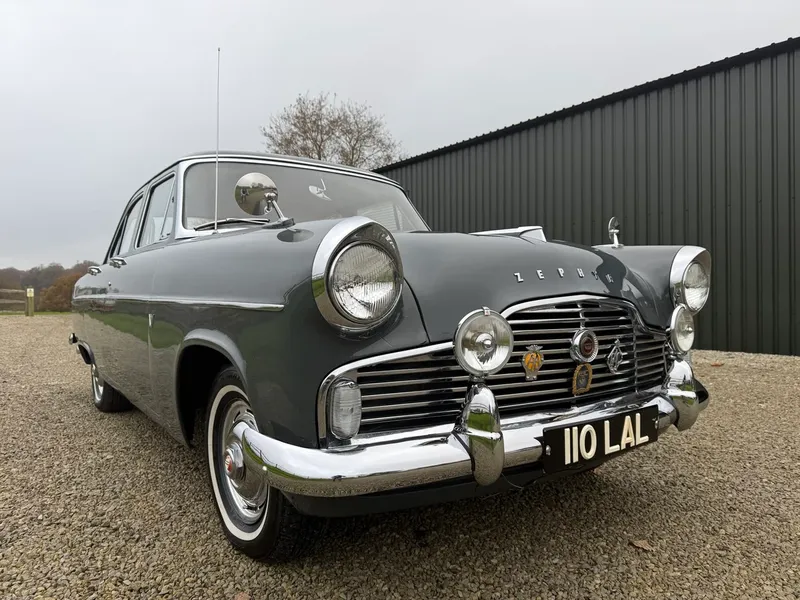
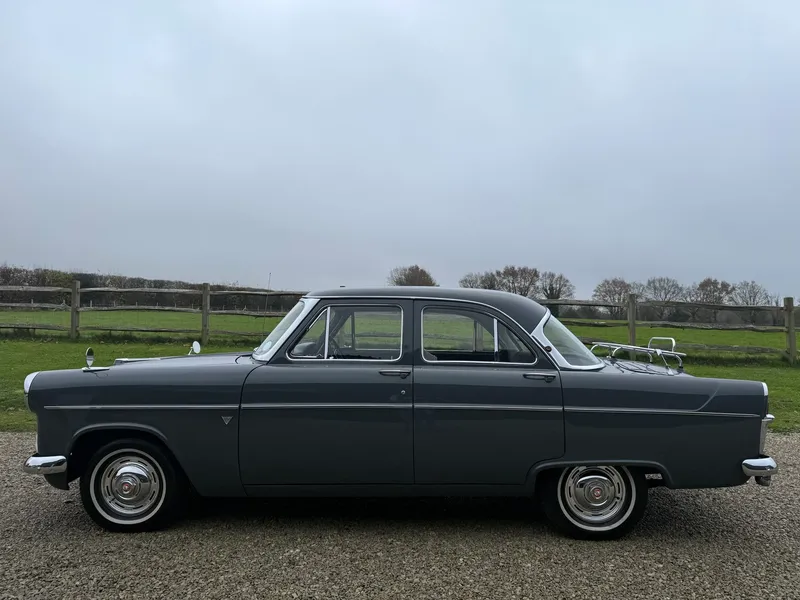
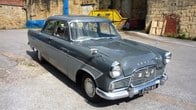
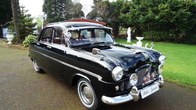
Clean, post-war three-box saloon proportions defined the Mk I with its full-width grille, smooth flanks and restrained chrome. Coachbuilt variations extended the profile, while Carbodies manufactured factory-approved convertibles, and Abbott of Farnham created dealer-sold estate conversions with a lengthened roof and bespoke tailgate.
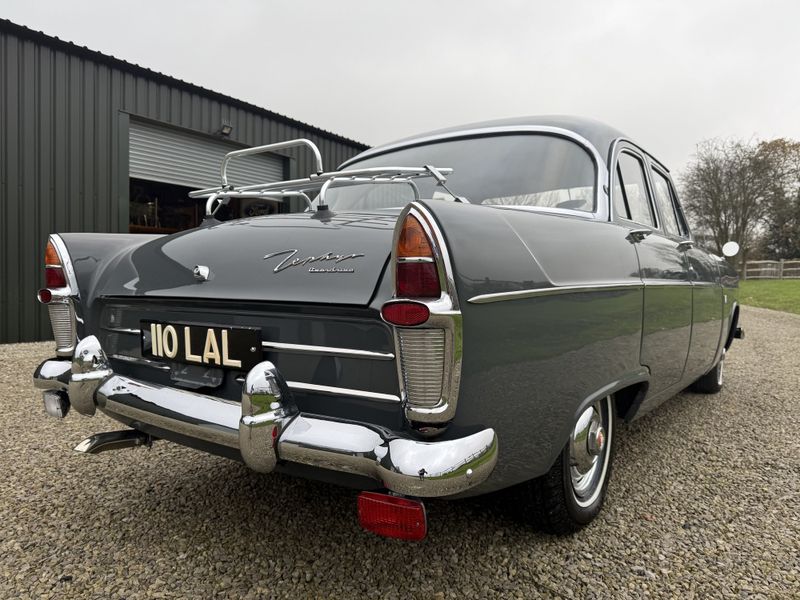
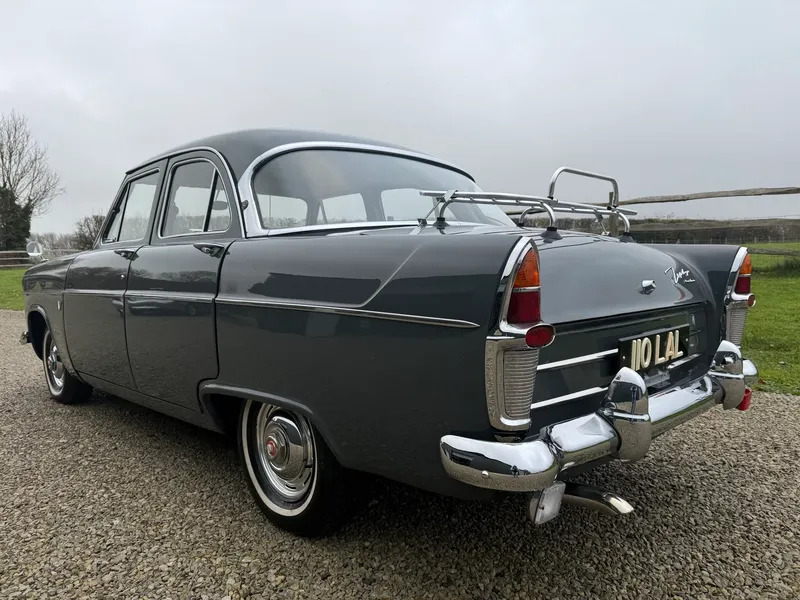
The Mk II (1956) brought a crisper, more American-influenced look, including extra brightwork and subtle fins on a longer, wider body. Early “Highline” cars sat taller before a later “Lowline” roof brought the stance back down again. Abbott’s estates continued with neatly integrated rear quarters and glass.
For the Mk III (1962), Ford reshaped the front end, and Zephyr 6 models adopted a full-width grille encasing the headlamp surrounds. During the production run, the nose/grille was lowered for a sleeker face, and period testers noted the car’s tidier, more contemporary surfacing compared to its predecessor.
The all-new Mk IV (1966) wore squarer and more formal lines on a longer wheelbase. Range hierarchy was visible in a quad-lamp fascia on Zodiac versions, while the Zephyr retained simpler treatment. The new body sat over a re-engineered chassis with independent rear suspension.


The Zephyr was intended to be practical, airy and unpretentious, so early cars paired two wide bench seats with simple pull-knob controls and a clear instrument binnacle. Period tests noted the comfortable bench seating with rear armrest, good stowage and a full-width parcel shelf across the cabin.
Layout and seating
Six-seat bench layout on Mk I–III, typically trimmed in vinyl (with leather available). The Mk III offered a boot of almost 22 cu ft, more than meeting the car’s family brief.
Factory brochure materials highlighted newly designed seats with lower backs and built-in foam rubber roll tops, plus easy-to-clean Vynex headlining and revised door pads.
Controls and instrumentation
Early Zephyrs used a column-shift manual gearlever and a facia-mounted handbrake. The Mk I grouped speedometer/odometer, ammeter, fuel gauge and warning lamps, while later Mk III cars added a hooded 120-mph speedo and temperature gauge.
Brochures emphasised a curved, wide-angle windscreen, wide-sweep wipers, and wide-opening doors. Period tests praised its powerful heating and generally excellent visibility, thicker screen pillars notwithstanding.
Mk IV (1966–1972) uplift
The Mk IV debuted a more formal cabin, while the Executive specification added fully reclining front seats with inertia-reel belts, carpeting throughout and a radio set into the walnut fascia.


Passive Safety (By Era)
Structure and basics (Mk I–III): Monocoque construction with hydraulic brakes and MacPherson-strut front suspension.
UK law required front seat belts to be fitted to new cars from 1 January 1965, but many pre-’65 Zephyrs were retro-fitted at the time.
Braking and stability advances
Mk III (1962–66): The Mark III sported servo-operated Girling front disc brakes with rear drums. Period road tests recorded a major improvement in stopping performance.
Mk IV (1966–72): Power-assisted disc brakes on all four wheels and independent rear suspension offered a notable safety leap in terms of high-speed stability and fade resistance.
Price trends
Most recent sale
£6,950
1961 Ford Zephyr
Sep 18, 2023
Currently for sale
9
0 live auctions
9 adverts



Total sold
27
Highest sale price
£36,995
Average price
£8,082
Lowest price
£1,900
FAQs
There were four in total: Mk I (1951–56), Mk II (1956–62), Mk III (1962–66) and Mk IV (1966–72). After this, the Granada era commenced.
Inline-six (Mk I–III), an added inline-four for Zephyr 4 (Mk III), then V4/V6 “Essex” engines on the Mk IV. These were paired with 3/4-speed manuals (overdrive available) and Borg-Warner automatics.
Maurice Gatsonides and Peter Worledge won the 1953 Monte Carlo Rally in a Ford Zephyr.
In 1972, the UK range shifted to the pan-European Consul/Granada programme.