Riley Elf: Models and Specs
1961–1969 · 848cc–998cc inline-four · Front-engine, front-wheel drive · Two-door saloon
Overview
The Mini was an outstanding piece of automotive design, but it always had its limitations. Foremost among these was the lack of practicality resulting from its tiny dimensions, and the absence of luxury in an interior which elevated minimalism to an artform. The Riley Elf was BMC's solution, with an extended rear body incorporating a lockable boot, a walnut veneer dashboard, leather upholstery and a distinctly styled nose. Despite being built on the same ADO15 subframe architecture as the Mini, the Elf appealed to more comfort-conscious buyers who found the Mini's stripped-out minimalism unappealing yet recognised the merit of its engineering. The Elf arrived after Riley’s acquisition by BMC in 1952 had reduced it to a badge rather than an independent engineering entity. The Elf was among the last Rileys produced before the marque was discontinued in 1969, which was the same year Elf production ended. It shared its final year with the Wolseley Hornet (a near-identical car wearing Wolseley trim), and neither were replaced by the Mini Clubman which adopted the upmarket Mini role from 1969 onwards.
Price
- Starting price
- Average price
- Price range
- -
Specifications
- Production years
- 1961–1969
- Body styles
- Two-door saloon
- Layout
- Front-engine, front-wheel drive
- Engine family
- A-Series inline-four
- Displacement
- 848cc/998cc
Riley Elf in Detail
The Elf project was a response to BMC's realisation that the Mini's stark interior and limited boot space were commercial constraints in the lower-middle market. The Riley and Wolseley marques had recently been absorbed into the BMC group, retaining their premium connotations, and the solution was to extend the Mini's rear bodywork to accommodate a proper boot and to restyle the front with a chrome grille specific to each badge. The platform underneath was unchanged: the same rubber-cone suspension, the same transverse A-Series engine in an oil-bath gearbox and the same steel monocoque bodyshell forward of the B-pillar.
The Elf and its Wolseley Hornet twin were launched in 1961, carrying the 848cc A-Series unit producing 34bhp. Inside, both cars received walnut veneer dashboard cappings, improved seat fabrics and a more considered instrument layout than the spartan original Mini. The 1963 Mk II saw the 848cc engine replaced by a single-carburettor version of the 998cc unit from the Mini Cooper, producing 38bhp and a useful increase in torque. Hydrolastic suspension replaced the original rubber cones in 1964, considerably improving ride quality. An automatic transmission option became available in 1965.
The Mk III arrived in 1966 with two visible changes: wind-up door windows and concealed external door hinges. The Elf received these upgrades two years earlier than any Mini variant, while front disc brakes and a fully synchronised gearbox also joined the specification at the Mk III stage. Production of both the Elf and the Hornet ended in 1969, by which point total Riley Elf production across all three Marks had reached 30,912 cars.
The Riley Elf's performance identity is defined by the BMC A-Series engine family, and performance figures track closely to the Mini's. The meaningful evolution across the Elf's production life was the step from 848cc to 998cc at Mk II, which lifted top speed by around ten per cent and reduced the 0-50mph time by three seconds. Beyond that, performance variations between Mk II and Mk III cars were negligible.
Specification | Detail |
Engine family | BMC A-Series inline-four |
Displacement range | 848cc (Mk I) – 998cc (Mk II–III) |
Power range | 34bhp (848cc) – 38bhp (998cc) |
Torque | 44lb ft (848cc) – 52lb ft (998cc) |
Top speed | 70mph (Mk I) – 75.7mph (Mk II–III) |
0–50mph | 18.3 sec (Mk I) – 15.2 sec (Mk II–III) |
Fuel consumption | 32.9mpg (Mk I) – 35.7mpg (Mk II–III) |
Mark | Years | Key Changes |
Mk I | 1961–1963 | 848cc, 34bhp; rubber-cone suspension; rod gearchange |
Mk II | 1963–1969 | 998cc, 38bhp; Hydrolastic suspension from 1964; automatic option from 1965 |
Mk III | 1966–1969 | Front disc brakes; wind-up windows; concealed door hinges; full synchromesh gearbox |
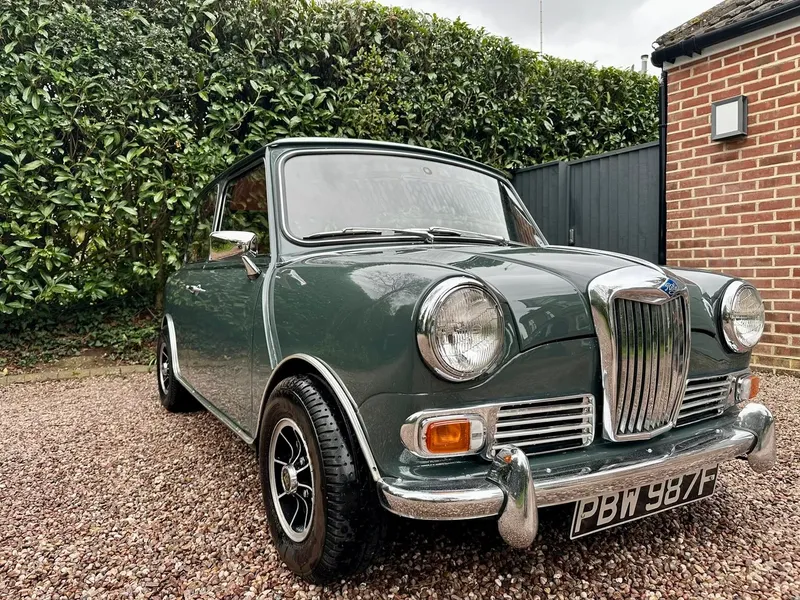
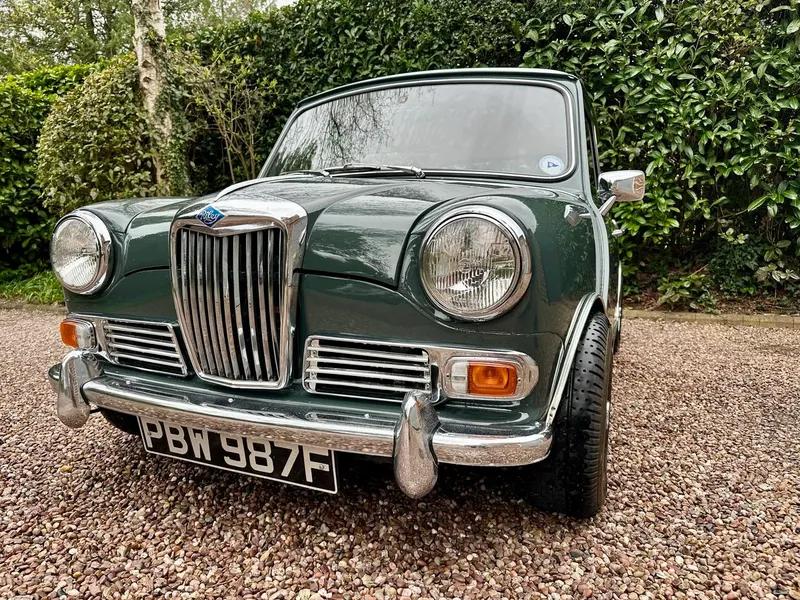
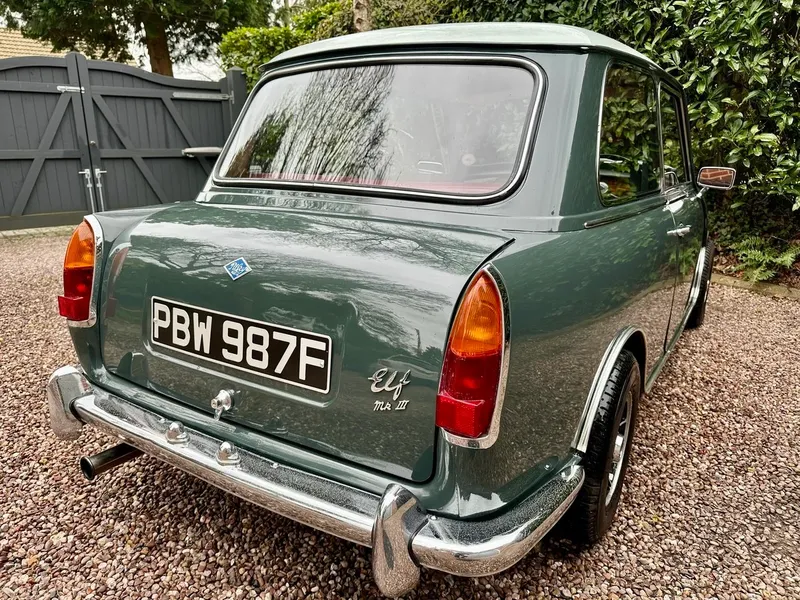
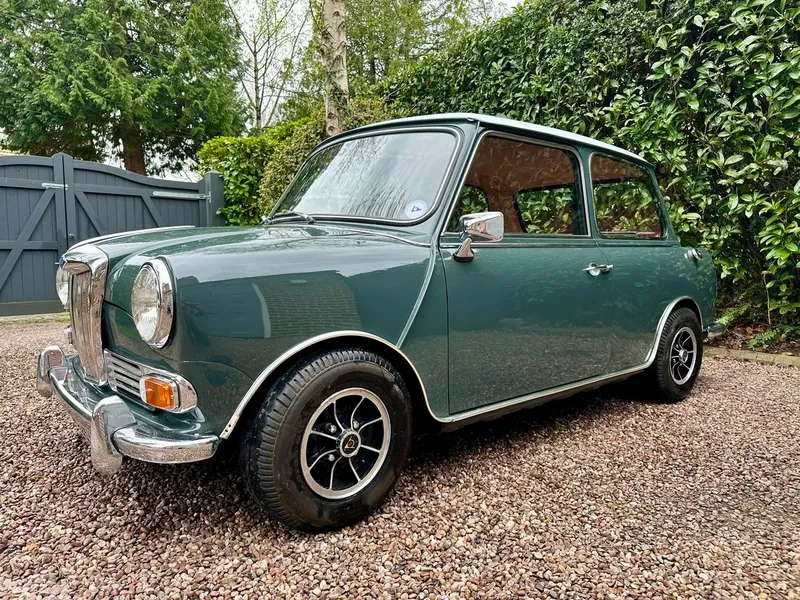
The Riley Elf is immediately identifiable by its rear bodywork and its nose. The extended tail adds proper rear fins, a horizontal chrome strip across the boot lid and a separate lockable luggage compartment in place of the Mini's parcel shelf arrangement. The front wears a vertical-bar chrome grille specific to the Riley badge, flanked by round headlamps.
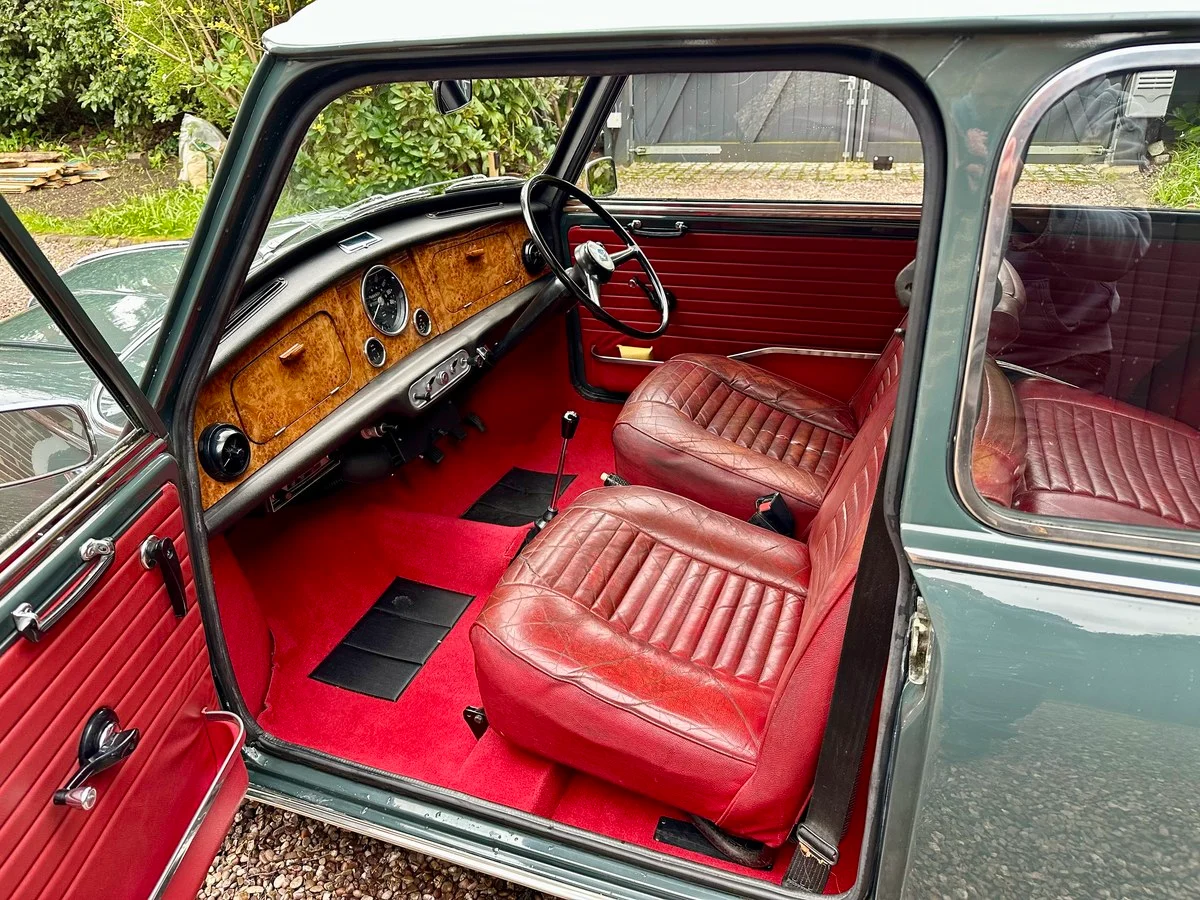
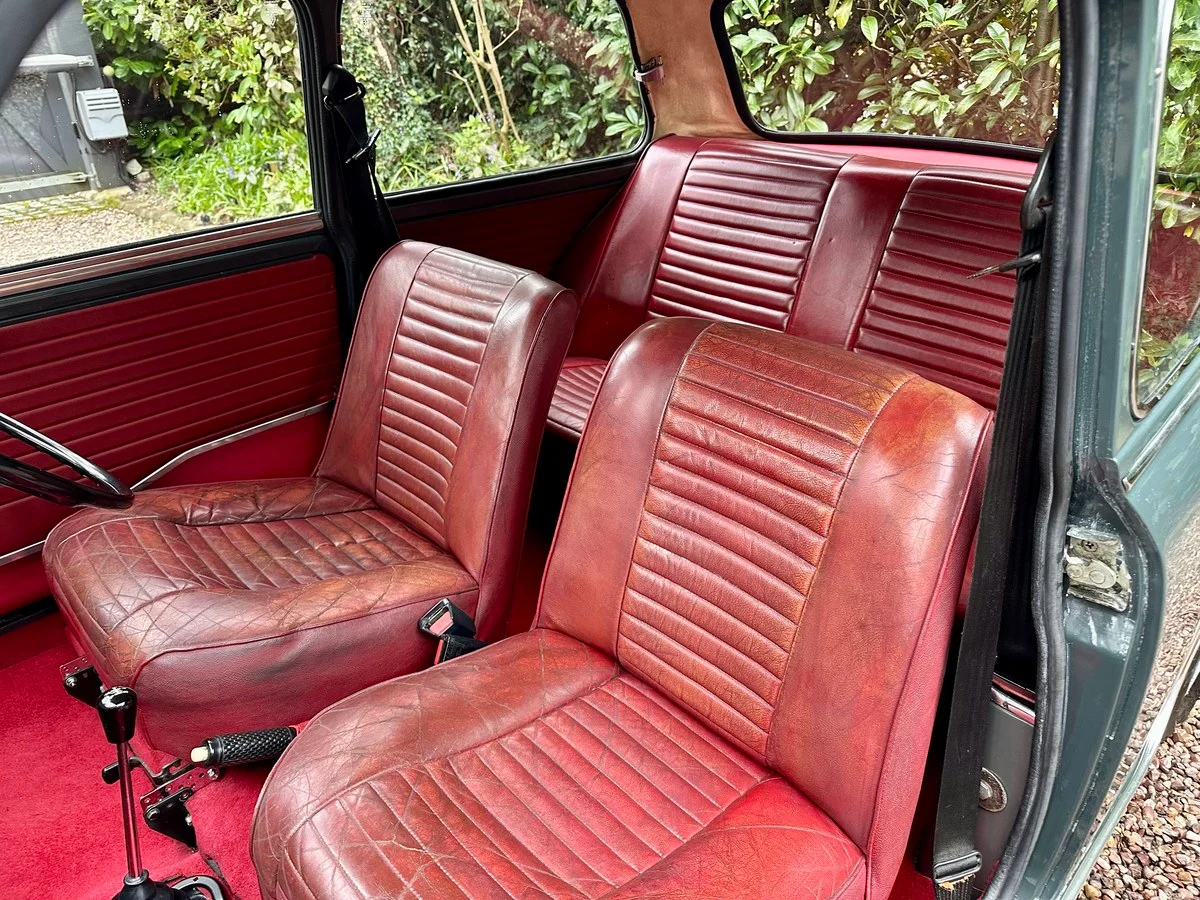
In profile, the Elf is clearly longer than the standard Mini, but the additional length sits entirely behind the rear wheels, so the wheelbase is identical to the standard car. Inside, the cabin philosophy is a more radical departure from standard Mini practice. Where the original Mini had a shelf dashboard and a central instrument binnacle to save money, the Elf presents a walnut-veneer cap across a conventional fascia, individual front seats with better upholstery, and a more formally arranged interior. It’s still small, but the atmosphere is very different from a standard Austin or Morris Mini of the same period.
It might have sported wood and leather, but the Elf was still a product of an age before ADAS. The Mk I and Mk II used drum brakes on all four wheels, though the Mk III introduced front disc brakes as standard, bringing braking performance in line with that of the contemporary Mini Cooper. Seat belts were optional and were progressively fitted as standard during the production run.
Pros
The BMC A-Series engine, gearbox, subframes, brakes and suspension components are shared across over five million ADO15-based cars, giving the Riley Elf access to one of the broadest mechanical parts and specialist networks of any British classic
The Mk III's wind-up windows and concealed door hinges predated their introduction on the mainstream Mini by two years
With only 30,912 cars produced and a buyer profile historically drawn from older users, well-documented Elfs frequently come with shorter ownership chains and more conservative usage histories than standard Minis
Cons
Riley-specific body trim is not interchangeable with standard Mini parts and is a sourcing challenge for any Elf restoration
The extended rear bodywork creates corrosion traps at the boot floor, rear inner wing joins and fin bases, which are specific to the Elf
Despite its more luxurious interior, the Mark I and II were still mechanically primitive with rubber-cone suspension and no fully synchronised gearbox
Prijsontwikkeling
Meest recente verkoop
Niet gevonden
Momenteel te koop
0
0 live veilingen
0 advertenties
Totaal verkocht
0
Hoogste verkoopprijs
€ 0
Gemiddelde prijs
€ 0
Laagste prijs
€ 0
FAQs
The Riley Elf and Wolseley Hornet are essentially the same car sold under different BMC marque badges. Both use the identical ADO15 extended rear body, the same A-Series engine and the same mechanical specification at each equivalent Mark. The distinctions between them relate to badges, grille design and minor interior details.
The Riley Elf shares the Mini's platform, subframes, engine, gearbox and mechanical architecture forward of the B-pillar, but it’s not the same car. The Elf has an entirely different rear body with an extended bootlid, a different front end with a Riley-specific grille/bonnet and a different cabin with a walnut veneer dashboard and upmarket upholstery.
A Mk III from 1966 to 1969 is the best choice, since it brings front disc brakes, wind-up windows and a fully synchronised gearbox. Any Elf purchase should include an inspection of the boot floor, rear inner wing joins and fin bases by a specialist familiar with the Elf body rather than the standard Mini.
The Mini has higher values at comparable conditions, a larger owner community and a significantly broader parts supply for bodywork and trim. The Elf offers lower entry costs, a boot and a walnut-and-leather cabin which has gained a distinct period charm. For buyers who want something less commonly seen and more formally appointed, the Elf's lower values and identical mechanical base make it a compelling alternative.