Wolseley Hornet: Models, Specs and Buyer’s Guide
Core Specs: 1961–1969 • 848–998 cc inline-four (A-Series) • 34–38 bhp
Wolseley Hornet Overview
The words ‘Wolseley Hornet’ will stir a warm glow of nostalgic recognition among many people. Launched in 1961 as Wolseley’s upmarket take on the Mini, the Hornet retained the donor car’s celebrated A-series transverse engine and front-wheel-drive layout. It distinguished itself with an extended tail including a usefully large boot, Wolseley’s illuminated grille, extra brightwork and a wood-veneer dashboard. In March 1963 the Mk II Hornet gained the larger 998cc 38 bhp A-series engine, complemented from 1964 onwards by Hydrolastic suspension, which significantly improved the Mini’s limited ride comfort. The Mk III (October 1966) added wind-up windows and concealed door hinges, as well as improved ventilation. and other minor refinements before production ended in 1969, with a total of 28,455 units having been produced.
C&C Expertise
The British Motor Corporation, quite rightly, comes in for a lot of flak. But, in the 1960s, its uncanny ability to identify what buyers wanted before buyers realised they wanted it was impressive. Take the Hornet. It revived an old Wolseley name, but it was something entirely new - a properly posh version of a car originally designed as purely utilitarian. Downsizing solicitors and aspirant housewives flocked to buy them, with over 28,000 leaving showrooms throughout the ‘60s. Today, they’re extremely rare and well worth seeking out if you fancy something a little different.
Wolseley Hornet Price
- Starting price
- 5 500 €
- Average price
- 8 138 €
- Price range
- 5 500 € - 26 500 €
Wolseley Hornet Specifications
- Manufacturer
- Wolseley (British Motor Corporation)
- Model Class
- Mini-based compact saloon
- Production Years
- 1961–1969
- Total Built
- 28,455
- Platform / Layout
- ADO15, transverse front-engine, front-wheel drive
Wolseley Hornet in Detail
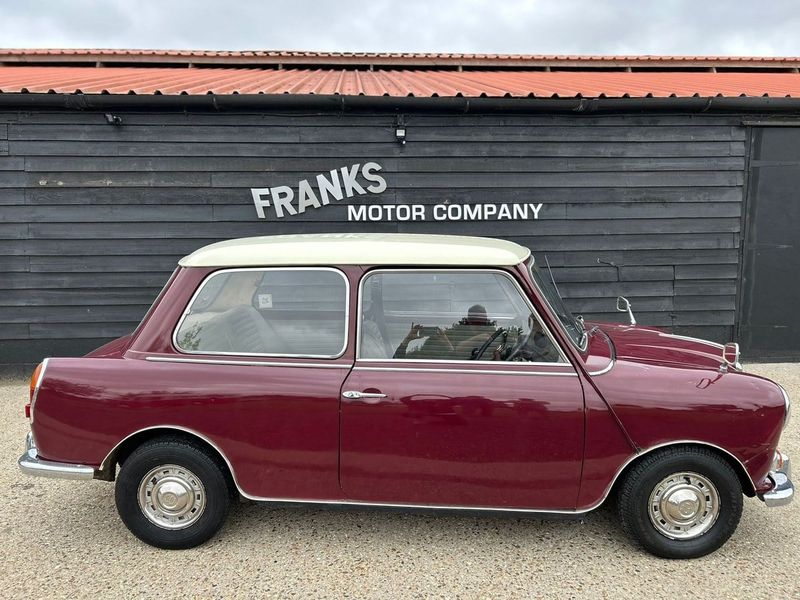
Wolseley’s “Mini with manners” landed in 1961, literally extending Alec Issigonis’ engineering with more formal Wolseley styling and trim. The Hornet shared its basic structure with the Mini but added an 8.5-inch longer tail for real luggage space and a more traditional three-box look.
In March 1963 the Mk II arrived with the 998cc A-series engine lifting power to 38 bhp and nudging top speed to the high-70s mph in period tests. From 1964, the range gained Hydrolastic suspension, improving ride quality.
Mk I (848cc): 34 bhp @ 5,500 rpm; period top speed 72 mph.
Mk II / Mk III (998cc): 38 bhp @ 5,250 rpm; period top speed 77–78 mph; 0–60 mph around 24 s in contemporary tests.
Version | Engine | Power | 0–60 mph | Top speed |
Mk I (1961–1962) | 848 cc A-series | 34 bhp | 31 s | 72 mph |
Mk II (1963–1966) | 998 cc A-series | 38 bhp | 24 s | 77–78 mph |
Mk III (1966–1969) | 998 cc A-series | 38 bhp | 24 s | 77–78 mph |
The Hornet had an approximate length of 10 ft 9 in (3.29–3.31 m), measuring around 4 ft 7 in wide (1.40–1.41 m), with a total height of 4 ft 5 in (1.34 m). Kerb weight was a diminutive 13 cwt.
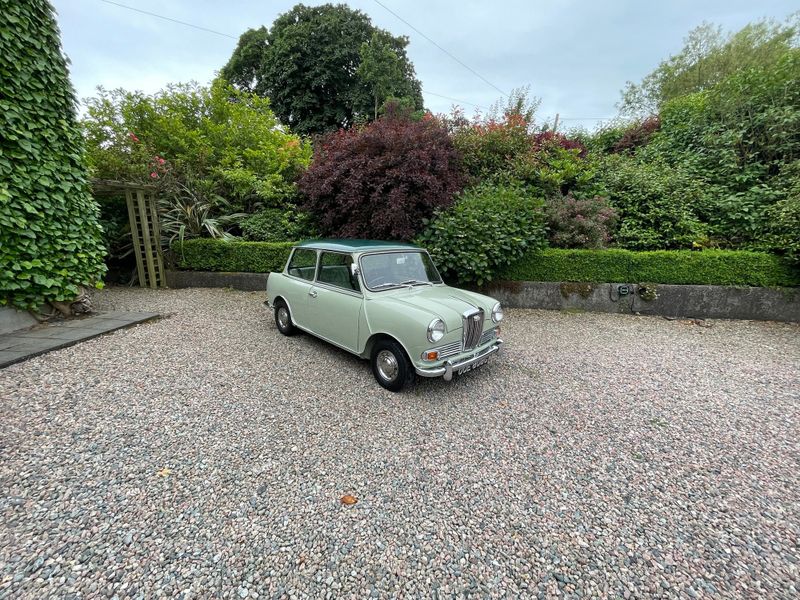
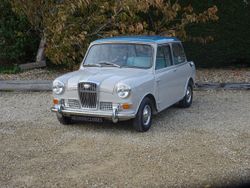
The Hornet retained the Mini’s compact stance but added a coachbuilt-style tail with a longer boot, modest fins and a unique nose including a chromed, upright grille with illuminated Wolseley badge. Two-tone paint and bright side trim were popular, reinforcing its “posh Mini” brief.


Compared with a standard Mini, the Hornet’s cabin was distinctly upscale, offering leather seats, a wood-veneer facia, extra sound insulation and richer trim patterns. The Mk III gained dashboard-mounted fresh-air vents and revised seat/door panel designs, bringing a quieter and more refined ambience.


Obviously, the Wolseley Hornet offers little in the way of modern safety, but for its size and age it can still be made reassuring to drive. Built around a strong steel monocoque, it was built before the days of airbags, crumple zones or electronic driver aids, and early cars used drum brakes all round.
Most enthusiasts now upgrade to front discs, inertia-reel seatbelts, and improved lighting — simple changes that make a big difference on today’s roads. The Hydrolastic suspension fitted to later models helps ride stability, while the car’s low weight and modest performance make it easy to control at sensible speeds. With careful maintenance and a few safety-minded updates, the Hornet can be enjoyed confidently, provided drivers remember it remains a product of 1960s engineering rather than a modern crash-tested car.
Wolseley Hornet Variants & Generations
There were only minor modifications across the three iterations of Hornet, which started with the 1961–1962 Mk I with a modest 848cc engine. The Mk II (1963–1966) featured a more powerful 998cc engine and detail updates, while the Mk III (1966–1969) introduced wind-up windows, improved ventilation, and even an optional automatic gearbox.
Tendances des prix
Vente la plus récente
5 995 £
1968 Wolseley Hornet

Actuellement en vente
4
0 enchères en direct
4 annonces


Total vendu
12
Prix de vente le plus élevé
26 500 €
Prix moyen
8 138 €
Prix le plus bas
5 500 €
FAQs
Mechanically similar and riding on the same floorpan, Hornets gained an extended boot, Wolseley grille and badging, wood-and-leather interior trim and wind-up windows on later versions.
Period tests showed 77–78 mph top speeds on 998cc cars and 72 mph for 848cc versions, with 0–60 mph taking roughly 24 seconds on 998cc models.
28,455 across all versions between 1961 and 1969.
Look for the same issues you’d find on a Mini of the era: corrosion, suspension problems (Hydrolastic serviceability can be an issue on post-1964 models) and general A-series engine wear.
Hornets flew out of the factory on 10-inch steel wheels; early cars on cross-ply 5.20-10, radials commonly fitted from mid-1964.