
Descrição
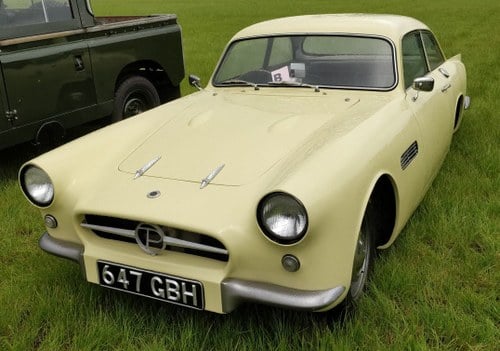
1959 Peerless GT. 2Litre
Good condition and MOT July 2021
Sympathetic and comprehensive body off restoration by Peerless Register member in 2014.
Very rare car, said to be one of only 12-15 currently on the road in the UK.
Potentially Goodwood/ Hill climb eligible.
A video of the car can be seen on YouTube with a search of 'Peerless GT 1959 For Sale', the picture being of a steering wheel.... youtube. com/ watch?v=8h0ycwzktjE&t=71s
The Slough built Peerless GT derives its name from the premises at which it was originally
manufactured where redundant World War 1 American army lorries were once prepared for re-sale.
James (Jimmy) Byrnes, a successful hotel owner from the Midlands, was an avid motor racing enthusiast who decided that he wanted a racing car built to his own specification. The car was to be for his own use on the racetrack, with a view to possibly supplying fellow club racers if the project proved to be a success. He approached Bernie Rodger (an experienced racing engine tuner and "special" builder) with a proposition to build such a car.
Mr Rodger had an excellent pedigree, which included bodywork design and race engine tuning. However, it wasn't long before the idea of a pure racing car had been set aside in favour of a more commercial venture. Byrnes and Rodger had decided that money could be made in the low volume production of a readily available, low cost sports GT.
For Jimmy Byrnes, it had been a natural choice to consider using Triumph TR mechanical components, as more or less the entire management board of Standard Triumph were regular customers at his new restaurant.
Bernie Rodger began to design a chassis around the TR3 components using a state of the art multi-tube construction in 16-gauge 1" x 1. 5" rectangular steel tube. An aluminium body was attached to the first chassis produced very early in 1957 and the completed car was subjected to exhaustive testing. This initial design exceeded everyone's wildest expectations with a top speed in the order of 120 miles an hour and a 0-60 time of less than 10 seconds. Suitably impressed with his achievement, Byrnes proudly presented the car to his former army friend John Gordon who at that time owned a used Rolls Royce car dealership.
John Gordon opinion was that, although remarkable, the car was too small, and that he believed the market needed a larger more practical 2+2 car. This led to several revised ideas, one of which being the widening of the vehicle's track, which in turn enabled Bernie Rodger to utilise a de Dion rear axle within his space frame design.
With John Gordon now firmly 'on board', a second alloy bodied four-seater prototype was built and exhibited at the 1957 Paris Motor Show where it was subjected to close scrutiny by some of the Standard Triumph Board.
Standard Triumph agreed to supply all the components needed to start full production.
Peerless Motors. A schedule of the parts required 'per car' was submitted to Standard Triumph for costing, and very reasonable prices emerged.
The space frame chassis and de Dion rear axle tube were subcontracted to a local company on the Slough trading estate. Chassis production came together quite quickly, but however the body, was not so simple to produce. Steel and aluminium were completely out of the question as the tooling costs involved were well outside the price bracket. So, British Resin Products were invited to Slough to present their case for a complete G. R. P. (glass reinforced plastic) body. In 1957, GRP was a relatively unknown quantity but the tooling costs were found to be acceptable.
Almost on their doorstep the family-run firm of James Whitson Ltd. appeared on a list of Southern England moulding companies. After detailed analysis Pat Whittet (the Managing Director) quoted a price per body which included mounting onto the chassis, upholstering, painting and glazing. After some haggling, the deal was finalised. The moulds were made with some minor detail modifications for the prototype car 333 CBH.
Following assembly of all the mechanical components onto the rectangular steel tube space frame, the complete chassis was driven the ten miles to the body shop with necessary adjustments being carried out on arrival. The total time between rolling chassis arrival and completion of the roadworthy product was ten days.
The Prototype Peerless 333 CBH:
Interest generated from the Paris Motor Show alone had suggested that the sales potential could be at least 1500 cars a year. The first three production Peerless models came off the line toward the end of May 1958. Press releases throughout the world acclaimed the Peerless as the "Sports car for the family man".
Another publicity idea emerged in the form of an two entries in the 1958 Le Mans Race, one confirmed with one reserve. The result of this race surpassed all expectation. After 24 hours of almost continuous rain causing all the favoured runners to either break down or crash, the Peerless, driven by Peter Jopp and Percy Crab, covered 3300 km, finished 16th overall, and 4th in it's class. While the results officially declared it as 'not classified' (as it was 71 laps behind the winner Graham Hill ) it was still a great achievement.
“The lone Peerless saloon did a similar job, (had a plan in keeping with their ability) its Triumph TR3 mechanical components hardly likely to cause concern and, although it finished, it was unfortunately too slow to be officially classified as a finish. “
Dennis Jenkinson (Motor Sport Magazine 1958)
A wonderful boost to sales followed and it was apparent that the available space at Peerless Motors was becoming insufficient to set up full production. They were allocated a stand at Earls Court in 1958 where they displayed a red model with steel wheels and a stripped LHD chassis with wire wheels. The Peerless was highly acclaimed by the press for its standard of finish and the simple layout of the de Dion rear suspension, considered by some to be the most technically interesting feature of the show.
John Bolster had tested the prototype for Auto Sport Magazine, and the following year he carried out a more comprehensive test of a production car. Although heavier than the Triumph and Morgan two seater cars with the same power unit, the Peerless was quicker off the mark. This was no doubt due to the de Dion axle, which virtually eliminated wheelspin. The Peerless also accelerated better at the top end of the scale because of the more streamlined body which gave the impressive top speed of 107 mph on test.
The list price of a Peerless in 1958 was £990 + £500 purchase tax, yet a Triumph TR3 could be bought for less than £1000 (including tax).
647 GBH.. was one of the early batch of cars to be produced and was sold to Leslie Helier Cody of Holland Street Kensington on 16th January 1959, undoubtedly following an order made at the Earls Court Motor Show three months before and some 12 minutes walk away from his home.
Leslie Helier Cody was the son of Samuel Franklin Leslie Cody a member of No 41 Squadron Royal Flying Corp during WW1, who was killed in action on 23 January 1917 while in combat with four enemy aeroplanes east of Boesinghe in Belgium. He was also the grandson of the world famous ‘Col’ S. F. Cody who was a circus performer and aeroplane maker who had died four years before his son, on the morning of 7th August in 1913, when demonstrating one of his own aeroplanes.
One of his early prototypes, the Cody No. 5B (The Military Trials Bi-plane No 2), was handed over to London's Science Museum in November 1913 where it is displayed to this day.
Present Owner:
I first saw 647 GBH at a local car show some time ago where it was being shown by the owner, a former Peerless/ Warwick Club registrar. I have always had an interest in the marque and eventually an opportunity to buy the car arose.
The original green log-book confirms that the car had three owners in the first three years, Leslie Helier Cody, Henry Stanley Watson and Henry Day, after which it remained in single ownership to Joyce Marjorie Holmes Shead until the Eighties. It was then bought, but not registered, and put into storage in Kent.
Alan, from Sussex, bought it from the storage in 2003 but the 20+ years of inactivity had taken its toll in its overall condition.
The car's chassis number (GT2/ 00111) and engine number (TS. 401/ 92E) match the green log book, giving its initial registration as 16th January 1959.
Alan, a long-time Peerless/ Warwick owner, is very familiar with Peerless restoration and undertook a comprehensive long-term body-off, chassis restoration (not replacement). The car was finally back on the road in 2014, not in its original grey which Alan described as ' undercoat grey', but an alternative Peerless colour.
Originality was Alan's aim, so the car is now as it would have been from new except for the addition of side bonnet-vents and a Kenlowe engine cooling fan. These were included following his experience with previous cars. He knew the TR engine, in this setting, was marginal on its cooling capability and this was a precautionary upgrade.
Last year I was invited to take the car to a Goodwood Breakfast Club, where it was shown on the grid and was the subject of a great deal of interest.
The car is currently in very good, but not concours condition and insured on an agreed value basis at £35, 000.
Contact: Please contact Alan Dobson with Sensible Offers or to discuss the car in greater detail.