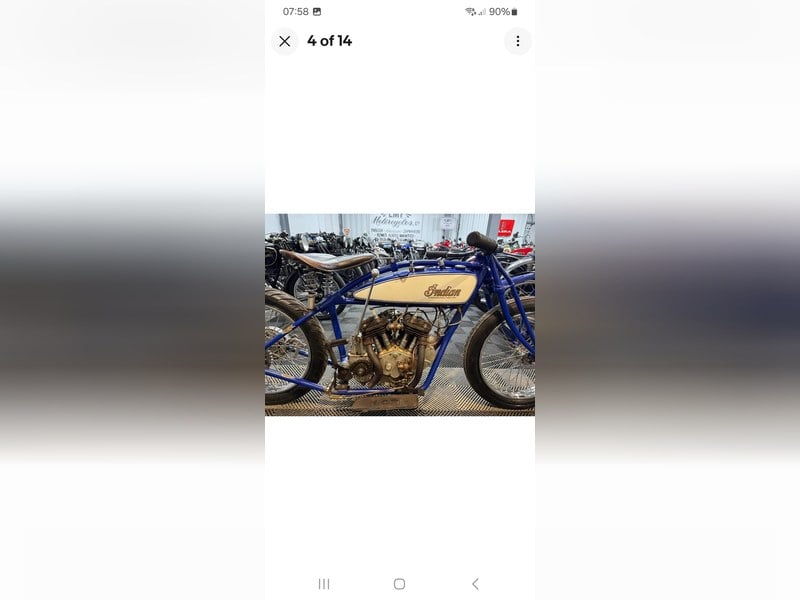
Descripción
Esta motocicleta es el Lote 347 que será subastado por Bonhams en The Autumn Stafford Sale (The Classic Motorcycle Mechanics Show) el 12 de octubre; por favor consulte el sitio web de Bonhams Motocicletas para obtener todos los detalles.
Horarios de la subasta:
Los lotes 201 - 408 se venderán a partir de las 11:00 h del domingo 12 de octubre de 2025.
Visita pública:
Disponible el 11 y 12 de octubre de 2025 desde las 09:00 hasta las 17:00, en The Staffordshire County Showground (The Classic Motorcycle Mechanics Show).
Lote 347
c. 1915 Indian Little Twin 'TT Replica'
Nº de matriculación: WC 1495
Nº de chasis: 51G 770
Nº de motor: 51G 770
• Modelo relativamente raro 'Little Twin'
• Piezas de ciclo cambiadas en su periodo para replicar al corredor TT de 1914
• Mecánicamente reconstruido: motor, caja de cambios, magneto, carburador
Oscar Hedstrom y Oliver Hendee, ambos activos en el mundo de las carreras de bicicletas, se unieron para fundar la Hendee Manufacturing Company y construyeron su primera motocicleta Indian prototipo en 1901. Esa primera máquina estaba impulsada por un motor de un solo cilindro, 15. 85 ci (260 cc) de cilindrada, un motor 'F-head' (entrada sobre escape) que formaba parte del bastidor en forma de rombo; en el caso de Indian ladeaba hacia atrás para actuar como el tubo de asiento. Una característica avanzada en los días pioneros de la motociclismo, la transmisión por cadena fue utilizada por Indian desde el principio. El sencillo de Indian demostró ser enormemente exitoso y se produjo de modo sustancial sin cambios hasta alrededor de 1905, cuando se introdujeron una horquilla delantera con muelle y un control de acelerador e ignición por puño giratorio.
No es de extrañar que el motor single-cylinder de Indian haya servido de base para el primero de los potentes v-twins de gran capacidad por los que la marca es más recordada. El primer v-twin de Indian, 38. 61 ci (633 cc), apareció en 1907 con un motor claramente derivado del del 'F-head' de un solo cilindro, aunque las válvulas de admisión mecánicas, introducidas para 1908, fueron una mejora temprana. El cilindro trasero del twin continuó formando parte del bastidor hasta 1909, cuando se adoptó el bastidor en forma de lazo al estilo Harley. Este nuevo bastidor con su geometría de dirección alterada se había desarrollado en los coches de carreras de Jake De Rosier, dotando al twin de una maniobrabilidad mucho mejor a alta velocidad. La primera producción de la Springfield company (en contraposición a la de carreras) de su 'Big Twin' debutó ese mismo año, con una cilindrada de 60. 32 ci (988 cc). Para entonces, el motor del 'Little Twin' había aumentado su capacidad a 42 ci (682 cc); esto figura en varias fuentes como 4 o 5 caballos de potencia, aunque según la clasificación RAC en realidad es de 6 hp. En esta forma, el motor más pequeño de Indian 'F-head' duró hasta la era Powerplus y se catalogó por última vez para 1918.
Este 'Little Twin' de Indian tiene la caja de cambios de cigüeñal contrapesado de tres velocidades introducida para 1915. Hemos sido informados por el vendedor de que la máquina se beneficia de un motor reconstruido: nuevo conjunto de biela, nuevos pistones, nuevas válvulas/ guías/ muelles, nuevas varillas de empuje y nuevos tornillos de culata. La caja de cambios, el embrague, el magneto y el carburador (de un Scout de 600 de la década de 1930) también han sido reconstruidos, con todo el esfuerzo para mantener el encantador patinado de originalidad de la máquina. Según nuestro vendedor, las piezas de ciclo fueron cambiadas en su periodo para replicar al corredor TT de 1914. La máquina solo ha tenido un uso limitado desde la finalización de la reconstrucción y requerirá una nueva puesta a punto antes de un uso serio. El archivo de historia contiene un documento V5C actual, un manual de instrucciones del magneto y numerosos recibos de piezas y servicios. Cabe señalar que el V5C registra la capacidad del motor como 540 cc. Los posibles postores deben asegurarse por sí mismos de la capacidad del motor de esta máquina. Las motocicletas Indian de este periodo tempranas no llevaban números de chasis; sin embargo, es práctica común que los bastidores sean grabados retroactivamente para fines de registro en el Reino Unido. En este caso, el bastidor lleva el número 51G 770.
Todos los lotes se venden 'tal como están/ donde están' y los postores deben asegurarse por sí mismos de la procedencia, el estado, la edad, la integridad y la originalidad antes de pujar. Visite el sitio web de Bonhams Motocicletas para toda la información pertinente de la subasta.