Citroën DS: Models and Specs
1955–1975 · 1911cc–2347cc inline-four · Front-engine, front-wheel drive · Saloon/Estate/Cabriolet
Overview
It’s easy to forget how astonishing the Citroën DS seemed at the time of its launch. Few vehicles in history have redefined the principles of motoring as effectively as the DS did when it was unveiled at the 1955 Paris Motor Show to an uncomprehending public. It didn’t just look like it had been delivered by a flying saucer - the DS arrived with hydropneumatic self-levelling suspension, power-assisted disc brakes, power steering and a monocoque body of extraordinary aerodynamic efficiency. In the austere post-war Britain of drum brakes and solid axles, this was the space age with a tax disc. Within Citroën's range, the DS represented the flagship of a brand that had always equated engineering ambition with brand identity. The suspension reads the road and adjusts in real time, the progressive braking system has no conventional pedal travel, and the silhouette was memorably described in 1957 by Roland Barthes as a great Gothic cathedral. Over 1.45 million examples were built across twenty years, making the DS one of the most commercially successful flagship cars of the 20th century.
Price
- Starting price
- 749 €
- Average price
- 27.688 €
- Price range
- 749 € - 240.000 €
Specifications
- Production years
- 1955–1975
- Body styles
- Saloon; Estate; Cabriolet
- Layout / drive
- Front-engine, front-wheel drive
- Engine family
- 1911cc/1985cc/2175cc/2347cc
- Transmission types
- Four/five-speed manual; three-speed automatic
Citroën DS in Detail
The DS's origins extend back a full eighteen years from its launch, through clandestine development at Citroën under the codename Project VGD in 1938. Originally conceived as a successor to the Traction Avant, stylist Flaminio Bertoni and chief engineer André Lefebvre developed the hydropneumatic suspension system from the 1954 Citroën 15/6H’s rear axle into a fully integrated four-wheel system. The DS consequently enjoyed ride and handling capabilities that wouldn’t be matched by mainstream production cars for decades.
At its 1955 Paris Motor Show launch, 743 orders were placed in the first fifteen minutes, with the day's total reaching 12,000. The original DS19 used a 1911cc inline-four producing 75bhp, though this rather archaic unit traced its lineage back to the Traction Avant. In 1961, a revised twin-barrel carburettor brought output to 85bhp and took the top speed past 90, while the parallel ID range (launched in 1956 at a lower price point) used the same body and suspension but replaced the DS's full hydraulic system with a simplified version alongside manual steering, a standard braking circuit and a lower engine tune.
In 1965, the DS19 was replaced by the larger-engined DS20 (1985cc) and DS21 (2175cc), offering meaningfully more performance. The DS21 Injection Electronique of 1969 was one of the first production cars in the world to use Bosch D-Jetronic electronic fuel injection, producing 139bhp. The final DS23 of 1972 raised displacement to 2347cc, with the injected version producing 130bhp.
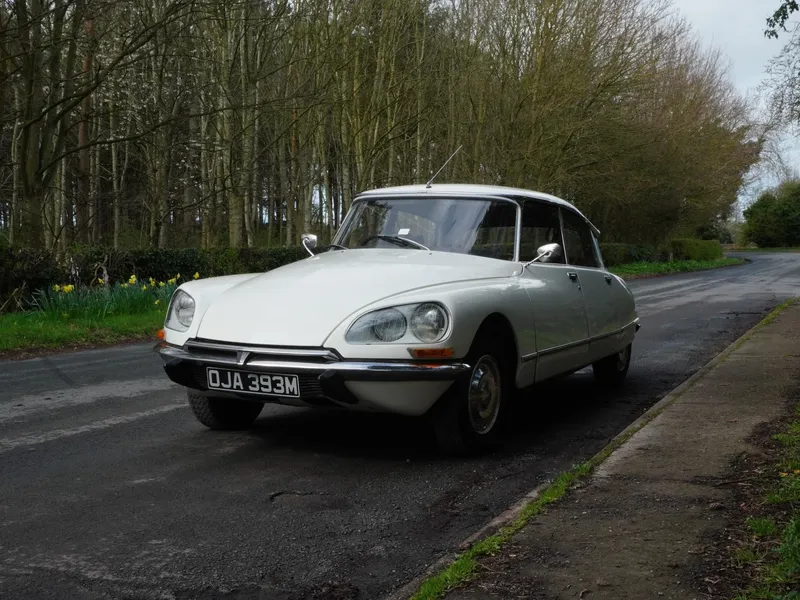
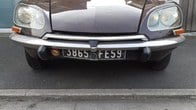
A major restyling exercise in the late Sixties introduced a completely new front end with four headlights beneath a glass canopy, the inner pair ingeniously swivelling with the steering to illuminate bends. Production ended in April 1975 when the final car rolled off the line at Citroën's Quai de Javel plant in Paris. The DS was also built in Belgium, the UK, South Africa, Australia and what was then Rhodesia.
The DS's identity is defined by the relationship between its engine, gearing and hydropneumatic chassis. Early DS19s were notably undergeared relative to their modest output, but as engine displacement grew through the DS20, DS21 and DS23, performance improved substantially. Performance figures vary widely due to changes in engine displacement, carburation/fuel injection and transmission choice.
Metric | Figure |
Engine family / displacement range | Citroën inline-four/1911cc (DS19) - 2347cc (DS23) |
Power range | 75 bhp (DS19 at launch) - 130 bhp DIN (DS23 EFI) |
0–60 mph range | 23.2 sec (DS19, 1958) - 10.4 sec (DS23, 1973) |
Top speed range | 90 mph (DS19, 1958) - 119.5 mph (DS23, 1973) |
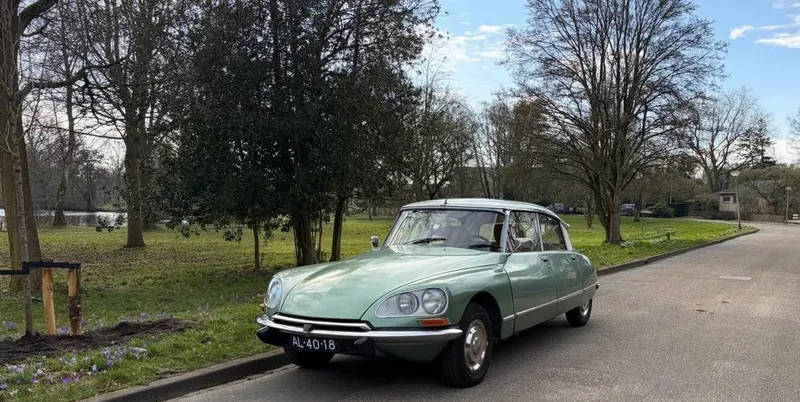
The Citroën DS sports one of the most immediately recognisable silhouettes in automotive history. A long, low front tapers to a near-fastback tail, with a glasshouse that rises to a high point over the front passengers before sweeping sharply rearward. The body is widest at the door sills and narrows at both ends, lending the car its famous "teardrop from above" profile. The surface treatment is deliberately minimal with smooth flanks, no visible shut lines at the doors and a windscreen raked at an angle that was considered radical in 1955 - and which remains striking today.
Inside, the single-spoke steering wheel was subsequently widely adopted but seemed genuinely novel at launch, framing instruments clustered in a central nacelle. The seats were long and generously cushioned, designed to absorb road imperfections in concert with the suspension. The overall cabin effect is of extraordinary spaciousness relative to the car's exterior footprint, thanks to the FWD layout eliminating the transmission tunnel and a floor structure uncompromised by conventional suspension.


The DS’s hydropneumatic architecture, body structure and FWD layout remained constant from 1955 to 1975, but there were a few model variants along the way.
DS Berline. The flagship saloon with full hydraulic specification featured power steering, high-pressure single-piston disc brakes and Citromatic or manual transmission.
ID/DSpecial/DSuper. A more economy-focused model with simplified hydraulics, conventional manual steering and revised braking arrangements.
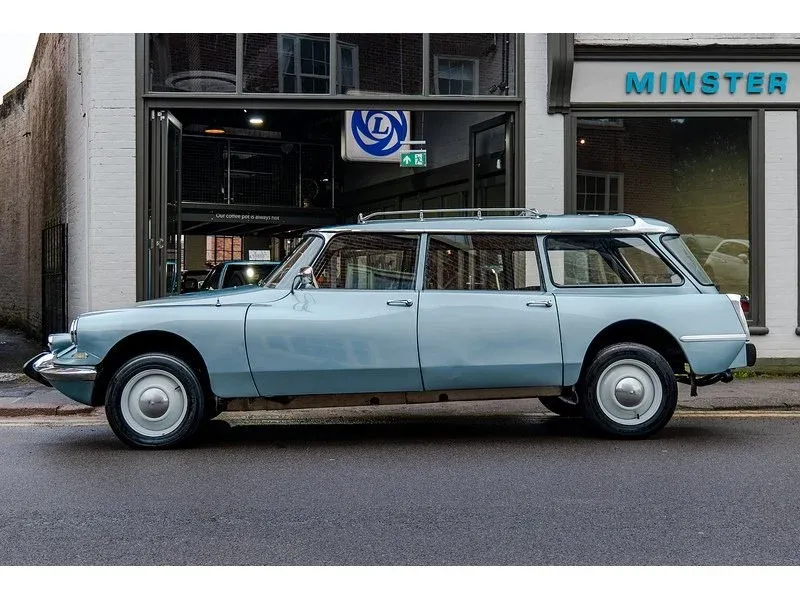
Break/Safari. An extended estate body with optional seven-seat configuration, unique rear structure, and a distinct practical ownership character.
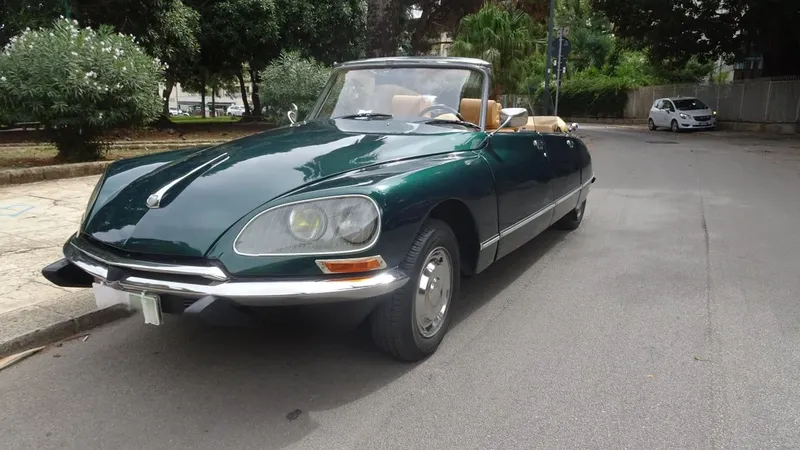
Cabriolet. This featured a coachbuilt open body by Henri Chapron, with approximately 1,365 examples produced, representing the rarest and most collectable variant of the DS family.
The Citroën DS predates all modern active and passive safety legislation, but it was ahead of its era in several safety respects. It was among the first cars in the world to offer power-assisted disc brakes on the front axle as standard. The hydropneumatic suspension also confers a stability advantage under emergency manoeuvring that contemporary cars with solid axles couldn’t hope to match.
Pros
The only mass-production car to launch with power-assisted front disc brakes in 1955, making it safer to drive than many contemporaries
With over 1.4 million DSs built across twenty years, this historically significant car is within reach of realistic classic budgets, with plentiful parts availability
This is an ownership proposition with cultural and collector kudos that very few classics of any era can match
Cons
Hydraulic suspension spheres must be maintained regularly and the car must be driven; a SORNed DS will deteriorate more quickly than one in regular use
Without the engine running, the car drops to its sills and can’t be jacked up, so roadside breakdowns require specialist recovery knowledge
Finding an unrestored and unmolested example with a clean hydraulic history involves patience and necessitates a specialist inspection before buying
Price trends
Vendita più recente
22.850 £
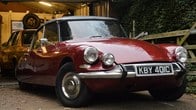
1965 Citroen DS 19 Second Generation Saloon
12 giu 2019
Attualmente in vendita
112
2 aste live
110 annunci

Venduto
289
Prezzo di vendita più alto
240.000 €
Prezzo medio
27.688 €
Prezzo più basso
749 €
FAQs
Don’t be put off by the DS’s perceived complexity. All routine maintenance can be carried out on a DIY basis, and regular use actually benefits components like the hydraulic system. Inactivity degrades the suspension spheres, the LHM fluid and the rubber seals. Buy a car with a recent active history, not one that’s been stored.
The DS has the full hydraulic specification with power-assisted steering, the high-pressure single-piston disc brake system and the semi-automatic Citromatic transmission option. The ID uses the same body and hydropneumatic suspension but with conventional manual steering, a standard braking circuit and a lower engine tune.
Mechanical and hydraulic parts are well supported thanks to a specialist network that has actually expanded since the Millennium, with suppliers across Europe. Interior retrimming materials including leather and headlinings are available as quality reproductions. The main cost variable is bodywork, since panel availability is limited for certain sections, and rust repairs to the sills/door frames/suspension mounts may require specialist fabrication.
Parts aren’t inherently expensive when sourced through specialist networks, but costs rise sharply if an unqualified mechanic works on the hydraulic system. Budget for annual specialist servicing and periodic suspension sphere repressurisation or replacement. Beyond that, a well-maintained DS shouldn’t prove much more expensive to run than any other complex classic of its era.