Beskrivning
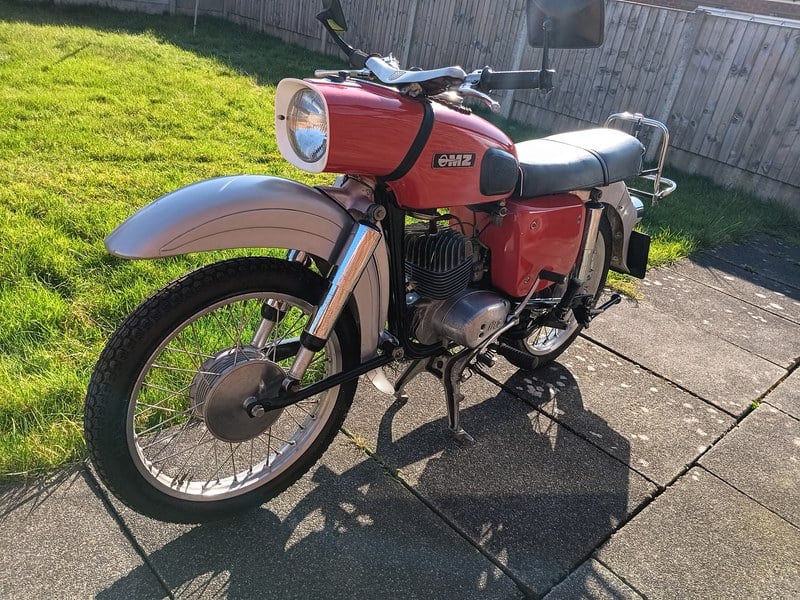
While looking for a winter project, I came across this abandoned project of a bright green 250 MZ with twin front headlights. The paint used was Kawasaki Ninja bright green and it was attraction at first sight. I immediately re-named it “Kermit”! I had to get it transported to my shed and found out the previous owner had had it for about twelve years. The paintwork was really good, as was the chrome and finish on the engine and gear case. New tyres had already been fitted, and it looked like it would not be too difficult to finish. It dawned on me that since the machine was first registered in 1984, it would be 40 years old in 2024, so it could be registered as ‘Historic’, and no tax or MoT would be required. Except that ’40 years. old’ would start from April 2025 according to the DVLA, so there would be a slightly longer wait before road testing could begin. Time was therefore spent on checking the brakes and bearings and being more patient than I usually am. I also replaced all the light bulbs with LED versions as part of my quest to be seen by motorists, no matter which motorcycle I might be riding at the time.
I have owned various MZ machines in the past and have fond memories of their robustness, and ease of use. Even the little 175cc version was enjoyable with peppy performance, and the 251 and 301 versions had more than enough performance to raise a smile while riding within legal speed limits. I think ‘Kermit’ has the potential to raise a smile wherever it gets parked and help to start conversations with potential friends. I have owned and ridden other MZ motorcycles in my past, including the MZ 301 and wondered why the previous owner had put MZ 250 stickers on the side panels and not MZ 251. I now know that the ETZ range was introduced in 1981 to replace the TS models. My machine is the Luxus (deluxe form) of the ETZ range which had a Brembo front disc brake instead of the standard drum, a tachometer and oil injection instead of the pre-mix system. From July 1989, the ETZ 251 replaced the ETZ 250 and had minor changes in specification, similarly the 300 and 301 models, which had confused me earlier.
The starting procedure for the ETZ 250 requires two kicks with ignition switched off and the starting enrichment lever on, followed by ignition on and starting lever off and NO throttle and it starts first kick. If the throttle is opened, even a fraction, a ‘mule like’ kick back will occur.
Kermit came with Metzler ME22 tyres fitted instead of the standard Pneumant tyres, which apparently caused strange sliding behaviour in the wet, the fully enclosed rear chain case is fitted, which is a good thing, as are the front fork gaiters and there is no side-stand, which was an optional extra. The silencer system has been replaced but I cannot recognise what the fitted system is, and my only comment is that it looks ‘racy’ and is not noisy. My initial thoughts were that the footrests are a bit too far forward and high. The overall feel is of a small machine, but I can get used to this and the drive is very smooth and unhesitating.
My first proving ride was to see how well the bike rode and try it on a few local hills as well as looking for some photogenic locations. The MZ has a much shorter wheelbase than most of my stable and the rider has to relax and let the bike track its own furrow, otherwise it can feel skittish. The sound of the exhaust has that ‘ring-a-ding’ quality about it reminding the rider that it is a two stroke. However, the performance is very good, even for a 250, with reasonable acceleration and gentle manners when travelling at about 50mph along our narrow lanes. The climbing ability was impressive on a steep hill, especially when I changed down a gear and allowed it to accelerate briskly. Descending the hill reminded me that MZs try to go faster downhill, even on a closed throttle, because the motor is set to fire occasionally on the over-run, just like a diesel van, so it is worth touching the brakes a few times to keep the speed in check. My style of riding usually involves low to medium revs and making steady progress. Using more revs meant much brisker acceleration and emphasised that the riding position was not confidence inspiring, in that I was too far back and my feet were too far forward. However, Kermit really started to fly! I was proceeding with much more verve than usual and catching up with the other traffic at a rate of knots, without exceeding the legal limit. I took Kermit to see the MZ doctor who surmised that the smoke was not engine oil smoke, but rather, gearbox oil smoke, because he could smell sulpher and why couldn’t I? He also checked my setting of the oil pump but reckoned that maybe, the oil seal between the transmission and crankcase needed replacement - maybe a specialist could do this work? I also checked the gear oil level and topped up the oil in the tank. Kermit appears to not be using or burning very much transmission oil so I now feel that the cost, time, and trouble in getting the seal replaced may not be worth the effort.
Kermit still smokes, a bit on. starting and warming up, despite all my health warnings! Starting is straightforward and explained above but it is still necessary to allow the engine to warm up thoroughly before twisting the throttle and expecting a lightening get-away. Once warmed, the engine spins easily and rapidly and the acceleration is rapid. Even on the few steepish local hills, being in a lower gear and the machine climbs really well. It helps to keep the revs in the band indicated on the tachometer, between 3000 and 6000 rpm. If the revs are allowed to drop below 3000 rpm then there is a moment of sluggishness and I wonder if this is due to the performance pipe on the silencer? The suspension is firm and reacts to the many potholes and road irregularities.
I am beginning to understand what made MZs so popular to ride in the days of Motorcycle Sport magazine. They are relatively cheap and affordable, so if anything major goes wrong, they can be dispensed with. Otherwise, most jobs on the machine can be done with simple tools and the effects of any adjustments tested immediately. I am impressed with the performance of the motor, especially in the ‘power band’ of 3000 to 6000 rpm but below the 3000 rpm, the motor is letting the rider know to change down. I have not ridden Kermit ‘flat out’ and have kept it at about 60 mph, which is fast enough for me and the bike still feels stable and controllable.
I am not sure if Kermit is a ‘keeper’ as I still have a preference for a vintage, girder-forked, drum-braked machine of about 250 to 350cc with drum brakes. I have taken longer journeys on Kermit and feel more composed and comfortable, but maybe I am destined to ride ancient motorcycles. Kermit has taken a fancy to a small Harley-Davison called "Miss Piggy" and has asked to stay in my garage to go and meet Miss P occasionally, so if he does not sell, then he will be kept for 'a fast belt to the local cafes.' I have also lowered the price to the bottom price I can accept.
I still have much admiration for the original builder who put so much effort into painting, plating and assembling Kermit so that I can enjoy his project bike and have continued making small adjustments to suit me.
January 2026: I stupidly got a different project for this winter and have done very little with Kermit. I have totally had it with tyre kickers who come round, admire the bike and tell me their life stories and experience with MZs, while ignoring me and my my offers to lower the price if they want to buy Kermit. I have lowered the price to almost scrap value and have used a crankcase seal revival oil in the gearbox, which I am told will revive the dried out old seal and the smoke problem will fade away.