Ford Cortina: Models and Specs
1962–1982 · 1.2-litre–2.3-litre inline-four/V6 · Front-engine, rear-wheel drive · Saloon/estate
Overview
Has there ever been a more iconic family car in this country than the Ford Cortina? Britain's most consistently successful family car of the 1960s and 1970s was a practical, spacious mid-sized saloon and estate that dominated sales charts for large stretches of its 20-year production life. Where the preceding Anglia had targeted economy motoring, and the subsequent Sierra pursued modernity (with questionable results in its early years), the Cortina's job was to deliver space and reliability across a wide enough range to serve company car managers and enthusiasts alike. Within Ford of Britain's range, the Cortina occupied the mid-segment between the Escort and the Consul/Granada, and it retained that position through five distinct generations. No other British Ford nameplate has ever matched its longevity at the top of the sales charts, or probably ever will.
Price
- Starting price
- 1 740 €
- Average price
- 16 141 €
- Price range
- 1 740 € - 63 808 €
Specifications
- Production years
- 1962–1982
- Body styles
- 2-door saloon, 4-door saloon, 5-door estate
- Layout
- Front-engine, rear-wheel drive
- Engine family
- Ford/Pinto inline-four; Ford Cologne V6
- Transmission types
- 3-speed manual; 4-speed manual; 3-speed automatic
Ford Cortina in Detail
The Cortina project began in 1960 under the rather unlikely internal codename of "Archbishop," with Ford of Britain setting a brief that placed interior space and low kerb weight above all other priorities. The car that emerged weighed substantially less than its nearest British rivals, thanks to a combination of a simplified underbody architecture and reduced body panel gauge. This engineering economy made the Cortina sharp on price and lively in performance, albeit at the cost of structural problems in later life.
Launched in October 1962 as the Ford Consul Cortina, the Mk1 featured an engine range from the 1,198cc Kent unit up to the twin-choke 1,498cc GT. Commercial success was immediate, and by 1967, the Cortina was the UK's best-selling car. The 1966 Mk2 introduced a wider, heavier body on the same basic floorpan.
The 1970 Mk3 was the first Cortina developed on a shared pan-European platform, and the engine range was replaced entirely: the defining addition was the single-overhead-cam 2.0-litre Pinto engine, which remained in production across Ford’s European range for nearly three decades.
The Mk4 followed in 1976 on the TC2 platform with updated squared-off bodywork and modest chassis revisions, joined by the 2.3-litre Cologne V6. The Mk5 "Cortina 80" arrived in 1979 as a facelift rather than a new generation, with restyled lighting and improved corrosion protection, belatedly acknowledging that structural rust had been a persistent issue on the Mk3 and Mk4.
Production ended in July 1982 when the Cortina was replaced by the Sierra - a car so different in design concept that many fleet buyers initially refused to order it. The Cortina's 20-year run had yielded over 4.3 million cars in the UK alone.
The Cortina's performance identity changed meaningfully across its production life. The Mk1 and Mk2 era was defined by Ford's Kent and Crossflow inline-four family of modest, rev-friendly engines. From Mk3 onwards, the Pinto 2.0-litre SOHC repositioned the Cortina as a genuinely fast family car, with the optional 2.3-litre Cologne V6 adding marginally better refinement.
Specification | Detail |
Engine families | Ford Kent/Crossflow inline-four; Ford Pinto SOHC; Ford Cologne V6 |
Displacement range | 1,198cc (Kent base) – 2,294cc (Cologne V6) |
Power range | 48bhp (1.2-litre Kent, Mk1 base) – 116bhp (2.3-litre V6, Mk5) |
Top speed range | 80mph (1.2-litre Kent base) – 109mph (2.3-litre V6, Mk4/Mk5) |
The Cortina has no unifying visual signature, but the body was always shaped around the cabin rather than the other way around. Interior volume per square metre of exterior footprint was the defining design metric, and every generation delivers more head, leg and shoulder room than its exterior dimensions might suggest.
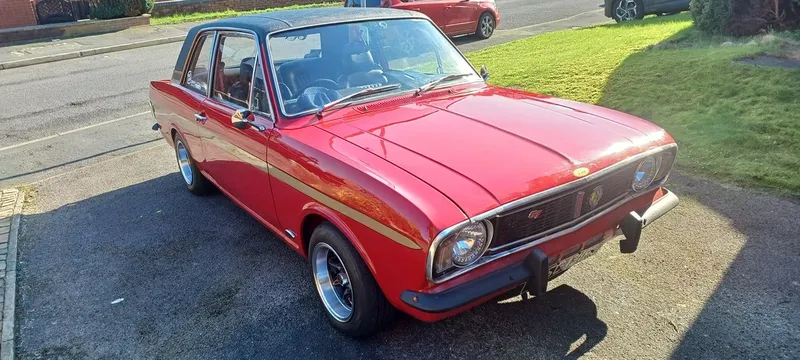
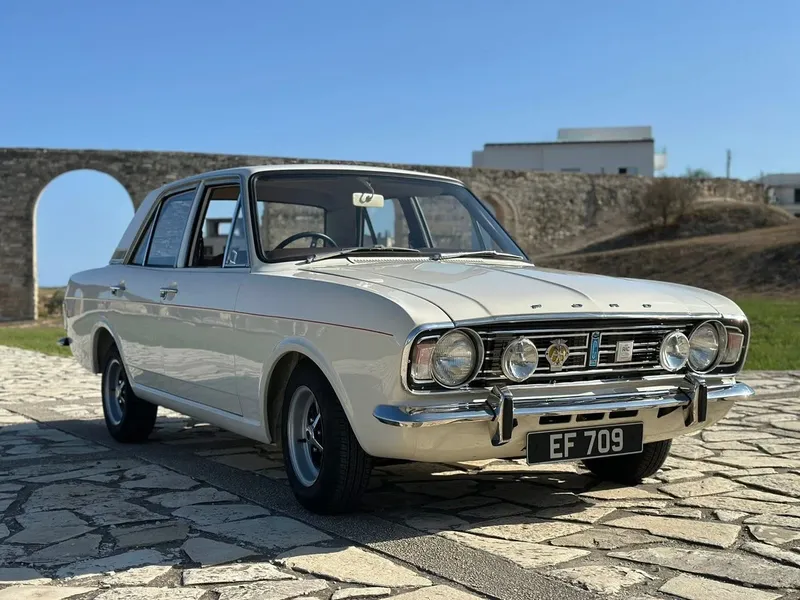
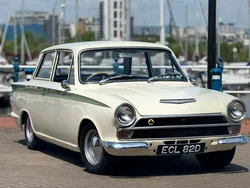
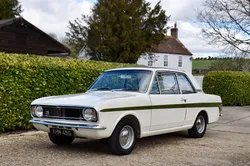
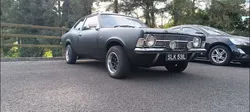
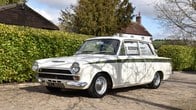
The Mk1 and Mk2 share a clean, upright saloon stance with a shallow glasshouse, prominent horizontal chrome detailing and thin A-pillars. The Mk3 broke entirely with this language, adding pronounced inward-curving flanks, a steeply raked fastback tail and a wraparound rear screen. Its "Coke-bottle" profile became the most immediately recognisable shape in the Cortina’s history.
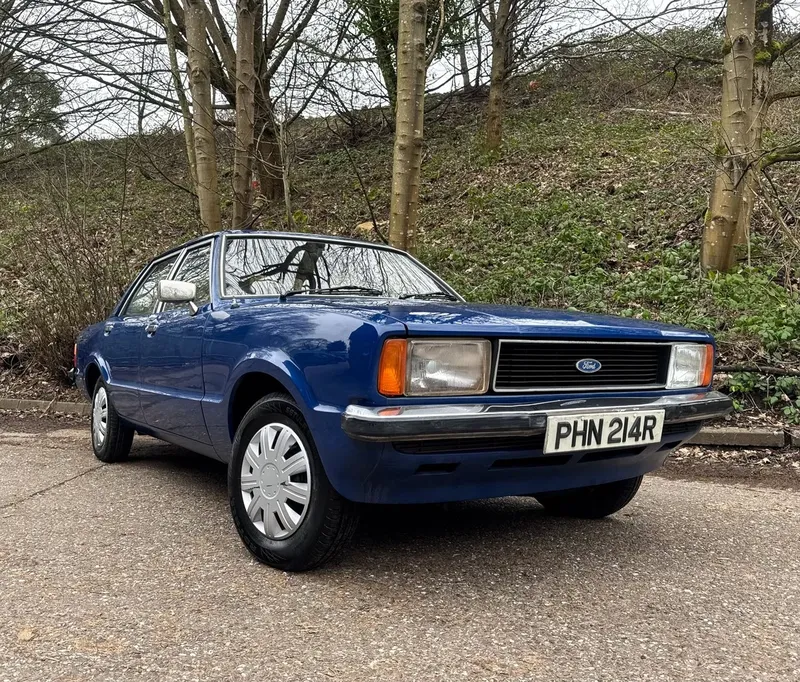
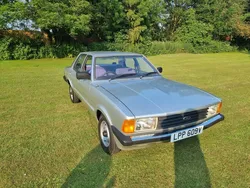
The Mk4 and Mk5 returned to a squarer, more upright profile with flush-fitting glass and cleaner surfacing. They retained the Cortina's traditional cabin philosophy: wide, flat seats, good headroom and instrument layouts designed for legibility rather than drama.


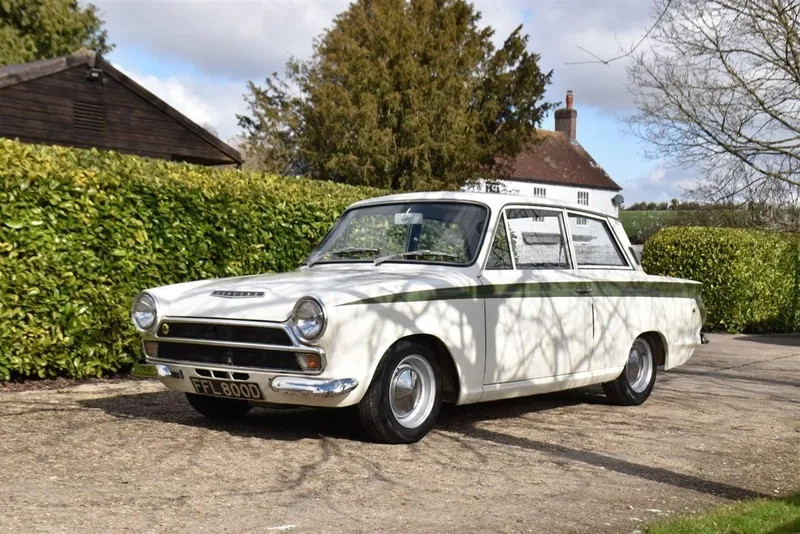
Mk1 (1962–1966). The original lightweight family saloon. Kent engine family; MacPherson strut front; 2-door and 4-door saloon; GT performance variant.
Mk2 (1966–1970). Wider and longer body on Mk1 floorpan. New Crossflow engine from 1967; estate from 1966; GT and 1600E variants.
Mk3 (1970–1976). Pan-European TC1 platform shared with Ford Taunus. Double-wishbone front suspension, Pinto 2.0-litre and Cologne V6; estate from launch; Coke-bottle styling.
Mk4 / Mk5 (1976–1982): TC2 evolution with squared-off body. 2.3-litre V6 added; Mk5 "Cortina 80" facelift with claimed improved corrosion protection; final production July 1982.
Note: The Lotus Cortina is a separate model, not a variant under Mk1 or Mk2 generation pages. See the Lotus Cortina model page for more details on this performance saloon.
The Cortina was manufactured entirely within the pre-electronics era of passive safety, and production ended in July 1982, six months before compulsory seat belt wearing was introduced in the UK. However, front seat belts became standard equipment on UK-registered Cortinas during the Mk3 era, while rear belts were available as an option but weren’t universally fitted. Braking on Mk1 and Mk2 base models was by drums on all four corners; front disc brakes were standard on GT variants and across the full Mk3–Mk5 range.
Pros
Mechanical parts availability is wider than the Cortina brand alone, and substantially broader than comparably aged rivals
Mk3 and Mk4 body pressings and mechanical components are interchangeable with the German-market Ford Taunus (TC1 and TC2 platforms), doubling the source base for body panels and trim
The Cortina's position as Britain's best-selling car across much of 1967–1981 created a club and specialist network that covers all five generations with documented parts sourcing, chassis register support and restoration expertise
Cons
GT badges on Mk1 and Mk2 cars are commonly faked; the only definitive authentication is the VIN, where code 77 (2-door GT) or 78 (4-door GT) must follow the initial two-letter prefix
Mk3 and Mk4 floor pan and sill corrosion was so bad that Ford publicly addressed it with "improved corrosion protection" on the Mk5; structural rust on Mk3 and Mk4 bodies requires specialist assessment before purchase
The 2.0-litre Pinto SOHC requires a cambelt change every 30,000 miles; many surviving cars carry no documented belt service history, representing an immediate known liability that should be budgeted for at the outset
Ford Cortina for Sale
The Cortina spans a wide buying range: concours-quality Mk1 and Mk2 GTs through to usable Mk3 and Mk4 saloons. View the latest Cortina listings on Car & Classic here.
Price trends
Venda mais recente
7500 £
1982 Ford Cortina Mark 5 Estate

Atualmente à venda
52
1 leilão ao vivo
51 anúncios


Total vendidos
166
Preço de venda mais alto
63 808 €
Preço médio
16 141 €
Preço mais baixo
1740 €
FAQs
The Ford Sierra replaced the Cortina in August 1982. The Sierra used aerodynamic "jelly mould" styling and an entirely new platform, but the transition was so radical that many fleet buyers initially resisted the Sierra's design, preferring the Cortina's familiar upright proportions. Within three years, however, the Sierra had matched and then exceeded the Cortina's sales position in the UK fleet market.
The Mk1 GT in two-door saloon form commands the highest collector values, while the Mk2 1600E (with its Lotus Cortina-derived suspension, walnut veneer dashboard and Rostyle wheels) was the luxury-sporting derivative. Mk3, Mk4 and Mk5 cars are affordable entry classics with a growing following, particularly a Life On Mars-spec Mk3 GXL.
From 1970 onwards, the Mk3, Mk4 and Mk5 Cortina and the contemporary Ford Taunus were the same car built on the same platforms for different markets; the Cortina for the UK and selected export markets, the Taunus for Germany and continental Europe. Body pressings and mechanical components are directly interchangeable.
On Mk1 and Mk2 Cortinas, the VIN codes following the initial two-letter prefix identify the body and specification: code 77 confirms a 2-door GT, and code 78 confirms a 4-door GT. Registration documents from the period did not reliably record body variants, making VIN authentication the mandatory starting point for any GT purchase.