Mini Moke: Models and Specs
1964–1993 · A-Series inline-4 · Transverse front-engine, front-wheel drive · Open utility/recreational
Overview
If you thought the original Mini was a minimalist mode of transport, the Moke would like a word. Born from the same drawing board as the Mini saloon, and created by Sir Alec Issigonis and engineer John Sheppard, this extraordinary creation was originally conceived as a lightweight military runabout. A lack of ground clearance put paid to that notion, before the Moke was rebranded as a civilian leisure vehicle. Rather like its fully clothed sibling, the Moke’s influence was profound. During its 29-year production run, it was built on three continents, appeared in four James Bond films and achieved approximately 50,000 sales. In many respects, the Moke is barely a car. It has no doors, no roof, no standard weather protection - and no pretensions, either. It’s an open steel tub powered by the same reliable A-Series engine featured across the wider BMC/BL family, reduced to the minimum number of components possible while still remaining taxable. That simplicity is simultaneously its greatest strength as a classic ownership proposition, and the reason it was never a commercial success in the rain-sodden UK.
Price
- Starting price
- 1.475 €
- Average price
- 23.864 €
- Price range
- 1.475 € - 39.057 €
Specifications
- Production years
- 1964–1993 (original); 2013–present (modern revival, unrelated platform)
- Total production
- 49,937 original Mokes across all phases
- Body styles
- Open utility/recreational
- Layout / drive
- Transverse front-engine, front-wheel drive
- Engine family
- BMC/BL A-Series inline-4: 848cc, 998cc, 1,098cc, 1,275cc
Mini Moke in Detail
The Moke programme began as an attempt to produce a parachute-deployable military vehicle using standard Mini components. Both the British Army and the US Army rejected it, finding the Mini's 10-inch wheels and 133 mm ground clearance unsuitable for field conditions.
The story might have ended there, but BMC's response was to reposition the car as a civilian light utility vehicle. Launched in August 1964 and costing £405, it was instead marketed on character rather than capability. British production ran until 1968, producing 14,518 units, the vast majority of which were exported to places where drizzle is a novelty.
The car's commercial breakthrough came in Australia, where BMC established a manufacturing plant in Sydney in 1966 that would eventually produce 26,142 Mokes until 1981. As Australian production wound down, the programme transferred to British Leyland's Portuguese subsidiary, where 10,000 further Mokes were produced between 1980 and 1993; a major 1986 engineering revision standardised a roll-cage, 12-inch wheels and the A+ engine. Finally, Cagiva acquired the tooling and name from Rover Group in 1990, producing a final 1,500 units in Italy.
The engineering premise remained unchanged across the decades, with a steel monocoque flanked by detachable front and rear sub-frames, a transverse A-Series engine sharing its sump with the gearbox, rubber cone suspension at all four corners and drum brakes throughout. The body's simplicity also meant repairs were achievable without specialist tooling.
The Moke's cultural footprint exceeded its sales figures by an enormous margin. Beyond its appearances in The Prisoner and various Bond movies, it became the taxi of choice in Mustique, the Seychelles and many Caribbean islands.
With a kerb weight under 700 kg and an open body generating no downforce, even the original 34 bhp 848cc engine felt more engaging than printed figures may suggest. Australian models pushed displacement upward through 998cc and 1,098cc to the 1,275cc unit that became the definitive Moke engine, effectively doubling usable power throughout the model's lifetime. The 1,275cc Californian still isn’t fast but it feels far more capable than the timid British original.
No manufacturer data was ever formally published for the Moke, but the figures below are representative of the different engine ranges.
Engine family | Power range | 0–60 mph | Top speed |
A-Series 848cc | 34 bhp | 27 sec | 65 mph |
A-Series 998cc / A+ | 38–41 bhp | 24–25 sec | 70–72 mph |
A-Series 1,098cc | 45 bhp | 22 sec | 75 mph |
A-Series 1,275cc | 58 bhp | 18 sec | 85 mph |
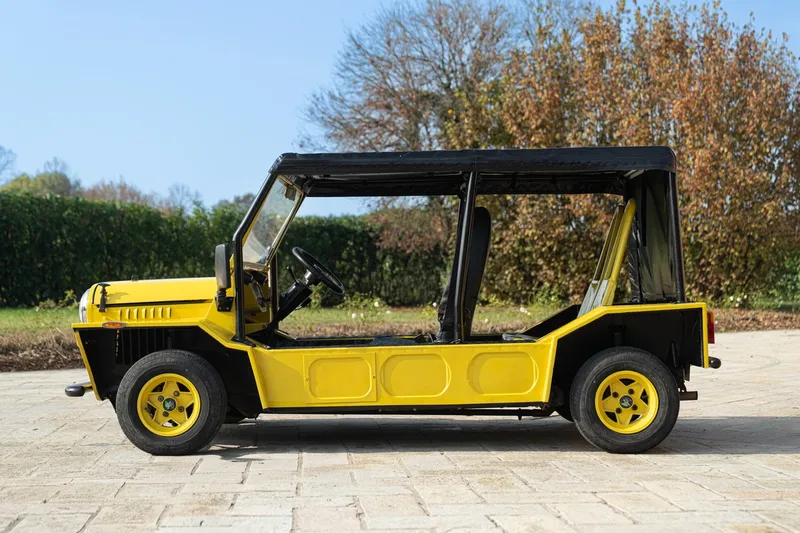
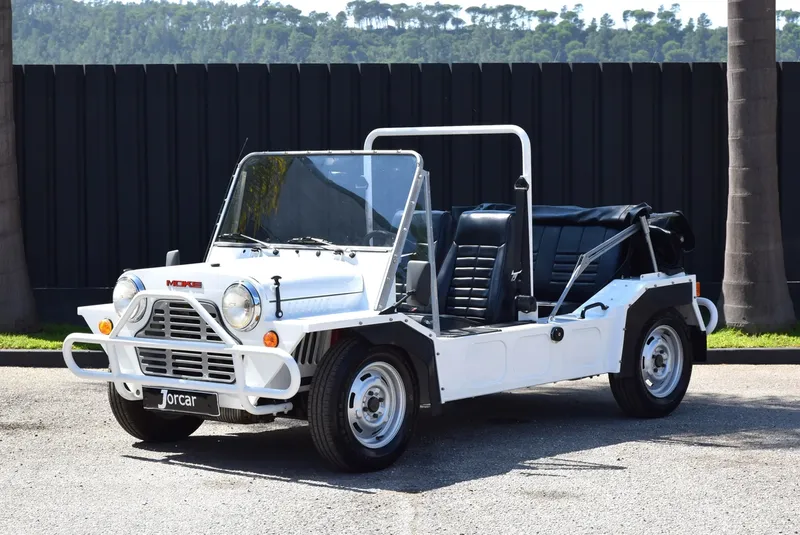
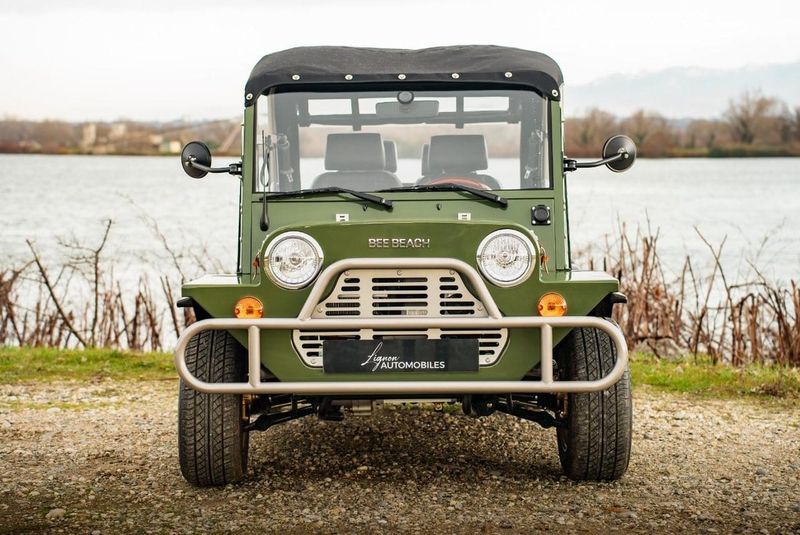
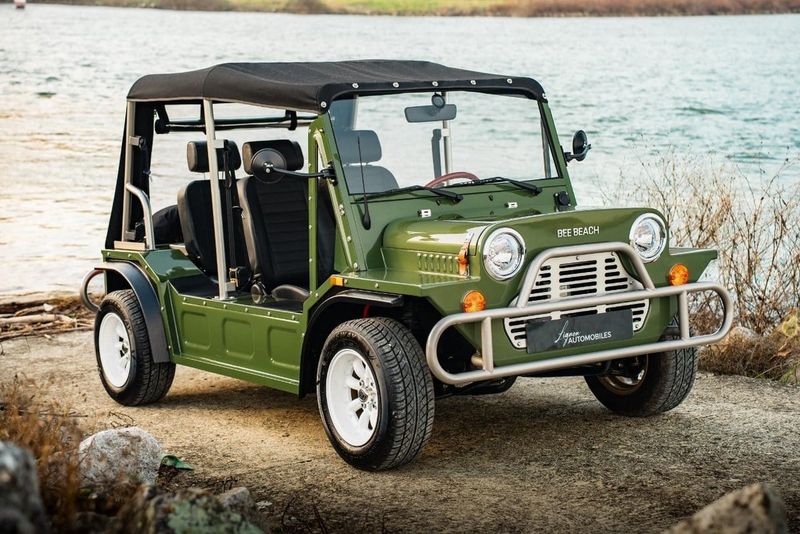
The Moke is unmistakable from every angle. It’s a flat-floored, door-free open tub sitting on small wheels, with two pontoon sidebox structures framing the cabin. This design has never been replicated and never needed updating. The windscreen unbolts entirely when not needed, while the canvas hood is an accessory rather than a structural component.
The cabin philosophy follows the same logic: nothing is present if it doesn’t need to be. Expect a bare metal floor, basic vinyl or rubber surfaces, a minimal instrument binnacle and seats ranging from tubular deckchair frames to padded bucket items which were more comfortable but never exactly cosseting.


The Moke's production history divides into three geographically and mechanically distinct chapters:
British phase (1964–1968). Austin and Morris badged, 848cc engines driving 10-inch wheels. The rarest and most collectible examples, with only 14,518 built, most of which were exported.
Australian phase (1966–1981). BMC/Leyland/Moke badged, with engines ranging from 998cc to 1,275cc, 13-inch wheels from 1968, with 26,142 built.
Portuguese/Cagiva phase (1980–1993). Leyland/Austin Rover/Cagiva badged, powered by a 998cc A+ engine. The most mechanically refined Moke, especially after 1986 engineering revisions. 10,000–11,500 built.
You can’t expect much in the way of safety from a post-war design which doesn’t even have doors. The British and early Australian phases had no seatbelts and no rollover protection, though lap belts were progressively introduced as local regulations demanded and the 1986 Portuguese revision introduced a full roll-cage as standard.
Pros:
Mechanically identical to the classic Mini, so parts and expertise are universally available
Extremely light kerb weight makes even modest engines feel responsive
Simple construction means body repairs require no specialist tooling
No electronics to fail, slashing potential running costs
Cons:
Zero crash protection on any pre-1986 examples
Open construction accelerates corrosion of floor pans, sills and subframe mountings
Drum brakes throughout means stopping distances are substantial by any measure
Unsuitable for regular use in wet climates - i.e. ours
Price trends
Vendita più recente
7750 £
1966 Mini Moke

Attualmente in vendita
22
0 aste live
22 annunci




Venduto
55
Prezzo di vendita più alto
39.057 €
Prezzo medio
23.864 €
Prezzo più basso
1475 €
FAQs
We wouldn’t recommend it. The open construction provides no weather protection, the lack of doors and top speeds of 65–85 mph make motorway use borderline masochistic, and drum brakes require significantly greater stopping distances than any modern vehicle.
Running costs are low by classic car standards, partly because there’s nothing to go wrong or fall off. Mechanical servicing draws entirely on the classic Mini parts ecosystem, which remains one of the best-supported in the vintage car world. Body-specific parts require specialist Moke supplier sourcing, but the Moke club network globally is active and well-organised.
An Australian 1,275cc Californian (1977–1981) is the most widely available example, with the best engine and the most well-judged combination of period character and mechanical confidence. British Mk I and Mk II examples are the most historically significant and therefore command a price premium, though Portuguese 1986-revision Mokes offer the most mechanically sorted experience at the lowest entry price.
In name only. The current MOKE produced under the MOKE International brand uses a Chery-sourced platform and shares no mechanical, structural or design DNA with the original Mini-based Moke. Buyers and collectors treat them as entirely separate vehicles, and a Chery model won’t impress Mini fans.