Morris Minor: Models and Specs
1948–1971 · 918cc–1,098cc side-valve/A-Series inline-four · Front-engine, RWD · 2-door saloon, 4-door saloon, Tourer, Traveller
Overview
The Morris Minor is one of the most significant British cars ever made. Designed by Alec Issigonis long before he sketched the Mini on a napkin, the Minor was the first British car to sell over one million units. More significantly, it was the car that put post-war Britain back on the road thanks to an accessible price, straightforward maintenance, and a wide range of body styles broad enough to suit almost every family's needs. The Minor sat at the entry level of the Morris hierarchy (below the Oxford and the Six) but it quickly outgrew that lowly status thanks to public affection. Issigonis designed it with a wider track and lower centre of gravity than almost any comparable car of its era, giving it handling characteristics that earned it a reputation for stability and driver involvement despite modest engine outputs. Six decades after it was founded, the Morris Minor Owners Club remains one of the largest single-model owner clubs in Britain. This was the first mass-produced British car with unitary construction, rack-and-pinion steering and torsion bar front suspension, making it technically superior to its contemporaries at launch.
Price
- Starting price
- € 650
- Average price
- € 8.569
- Price range
- € 650 - € 24.995
Specifications
- Production Years
- 1948–1971
- Body Styles
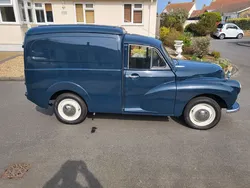
- 2/4-door saloon; convertible; Traveller; van; pick-up
- Layout
- Front-engine, rear-wheel drive
- Engine Family
- 918cc inline-four; 803cc/948cc/1,098cc A-Series
- Transmission Types
- 4-speed manual
Morris Minor in Detail
The Minor began life as the rather less flatteringly titled Mosquito, which was an Issigonis design study from 1943 that proposed a small and lightweight family car with a flat-four engine, rack-and-pinion steering and torsion bar independent front suspension. By the time it reached production, the flat-four had been replaced by the existing Morris 918cc side-valve unit, but the rest of Issigonis's unconventional engineering package survived intact.
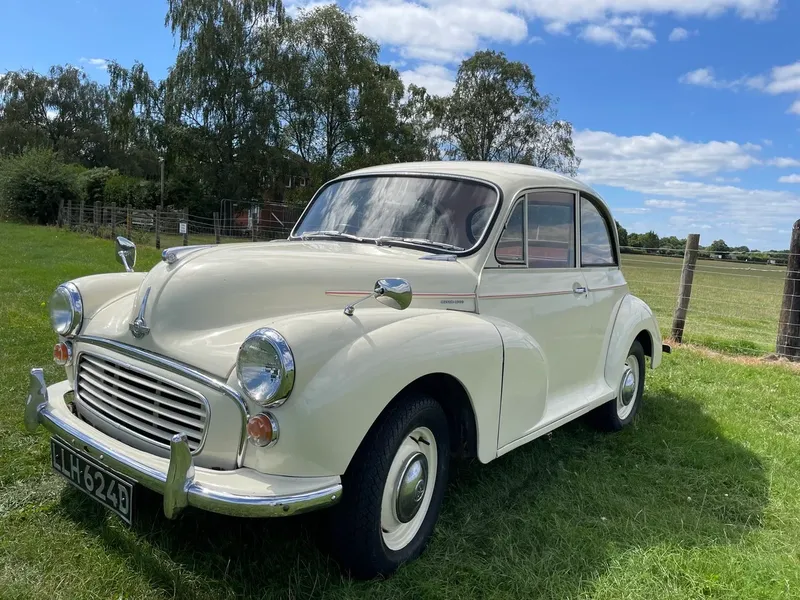
The body was widened by four inches late into the development process after Issigonis had the prototype cut in half lengthways and a strip inserted to improve interior space and visual proportion. This is still visible as the flat section on the production car's bonnet.
The Minor debuted at Earls Court in September 1948 as a two-door saloon and tourer, priced at £358. A four-door saloon followed in 1950, extending the Minor's family appeal, and the wood-framed Traveller estate was introduced in 1953. The Minor's reach extended internationally: completely knocked-down kits were assembled throughout the Commonwealth, making it one of the most global British cars of its era.
The most significant mechanical change of the Minor's life arrived in 1952 following the BMC merger: the original side-valve 918cc Morris engine was replaced by the Austin-designed 803cc A-Series OHV unit which reduced power but introduced a more modern and easily maintained engine architecture. The A-Series would grow through 948cc (1956) and 1,098cc (1962) iterations, gradually raising the car's performance and refinement.
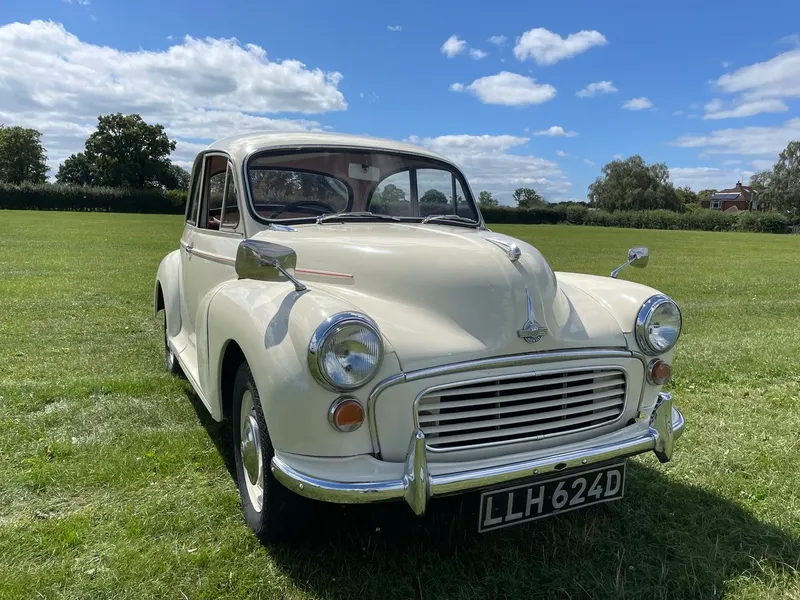
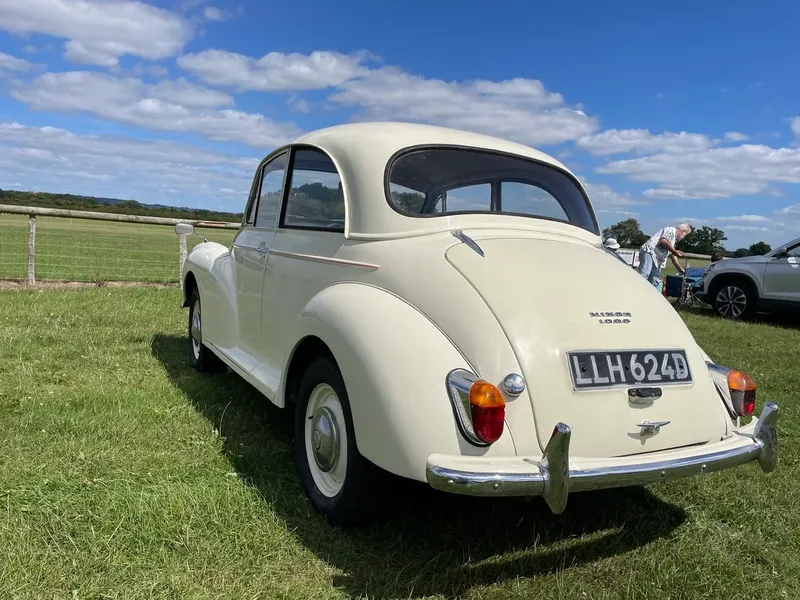
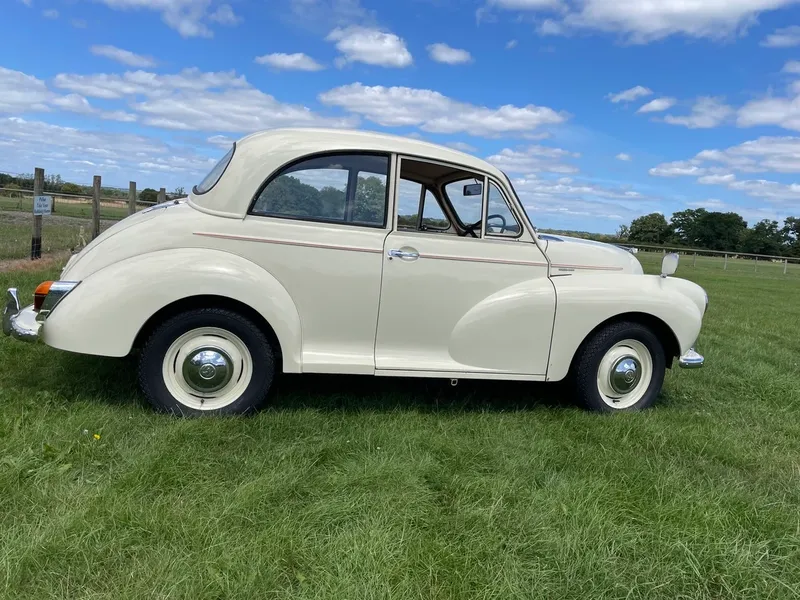
The Minor 1000 name, introduced with the 948cc engine in 1956, replaced the split windscreen and rear window of the early cars with a single curved pane. Combined with the stronger gearbox fitted at the same time, this was the point at which the Minor became the car most owners today recognise. Production of the saloon and Tourer ended in 1969 but the Traveller continued until 1971, closing a production run of 23 years and 1,619,857 units.
The Morris Minor's A-Series engine family transformed its usability across its production life as the original 918cc side-valve's 52.5-second 0–60 mph time gave way progressively to the 1,098cc engine's 26.5-second figure. It wouldn’t give a modern Lamborghini driver palpitations at the traffic lights, but the transformation made later Minor 1000 cars usable even in modern traffic conditions.
Series MM | Series II | Minor 1000 (948cc) | Minor 1000 (1098cc) | |
Engine | 918cc side-valve I4 | 803cc A-Series OHV I4 | 948cc A-Series OHV I4 | 1,098cc A-Series OHV I4 |
Power | 27.5 bhp | 30 bhp | 37 bhp | 48 bhp |
0–60 mph | 52.5 sec | 55 sec | 31.3 sec | 26.5 sec |
Top Speed | 64 mph | 62 mph | 75 mph | 77 mph |
Transmission | 4-speed manual | 4-speed manual | 4-speed manual | 4-speed manual |
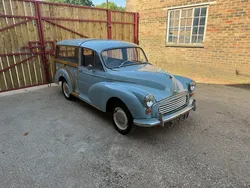
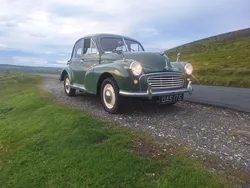
The Morris Minor is one of the most immediately recognisable shapes in the history of the British motor industry. A rounded, bulbous profile with prominent separate front wings precedes large windows, creating a face that generations of owners have affectionately described as a smile. Issigonis's wide track gives the car a planted stance that belies its compact dimensions, with a high roofline relative to body length, large windows and minimal overhang. The Traveller's ash wood frame, forming the rear half of the body, is a conscious reference to pre-war coachbuilding tradition.
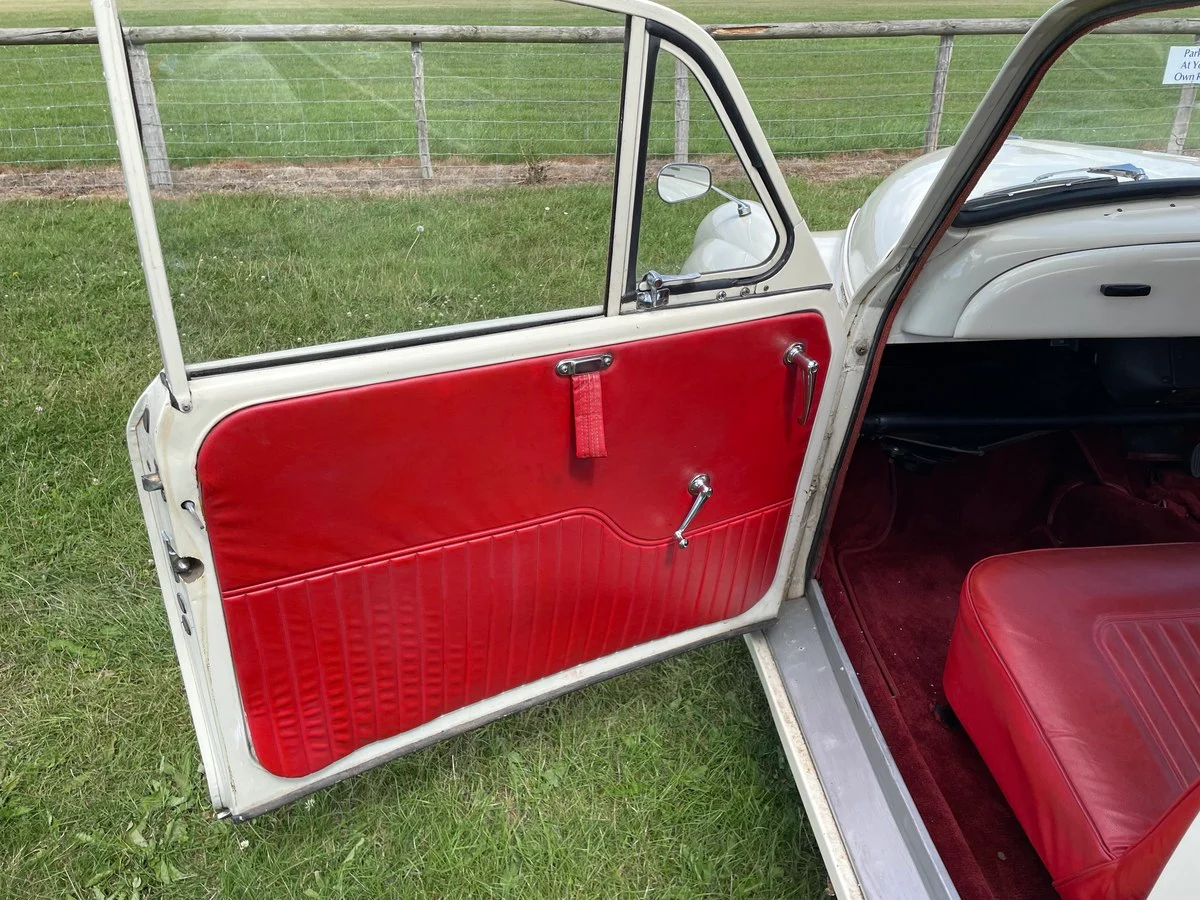
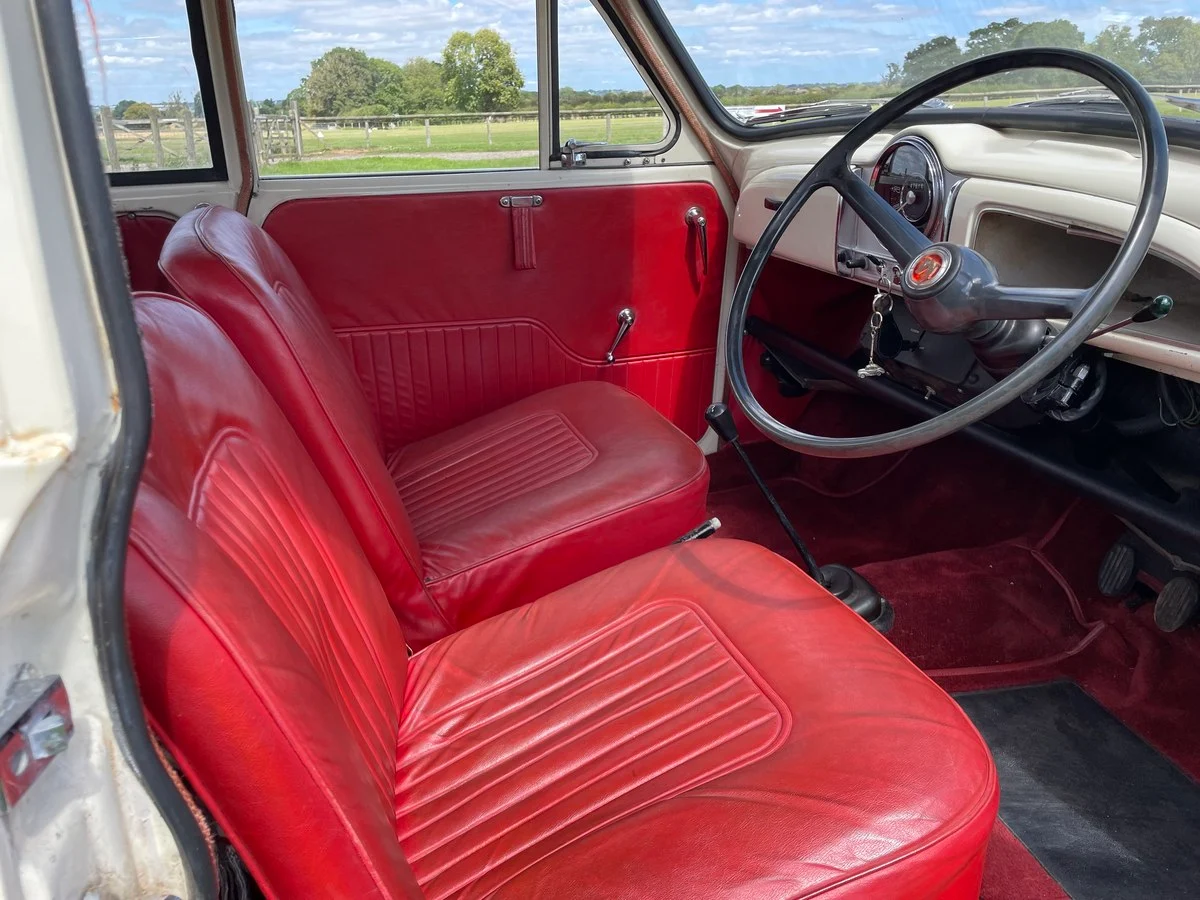
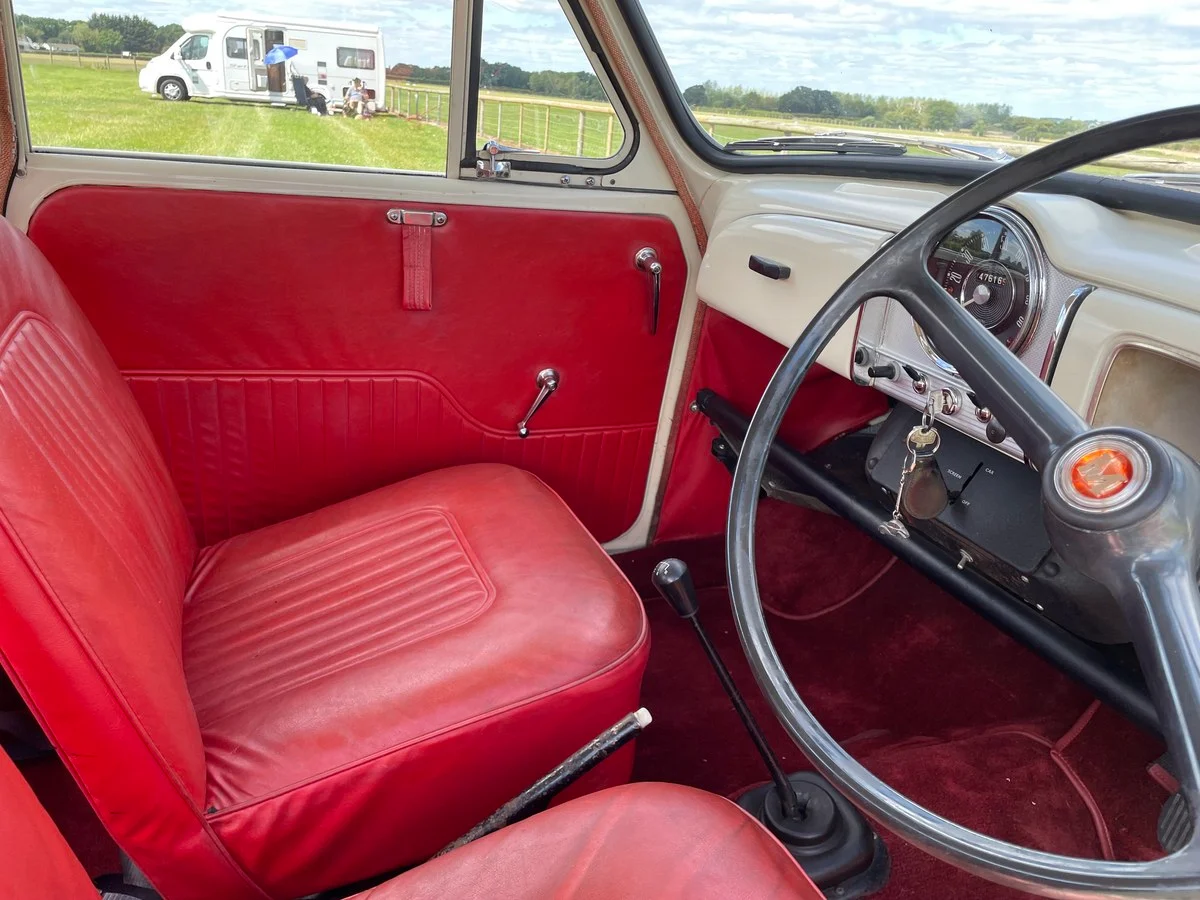
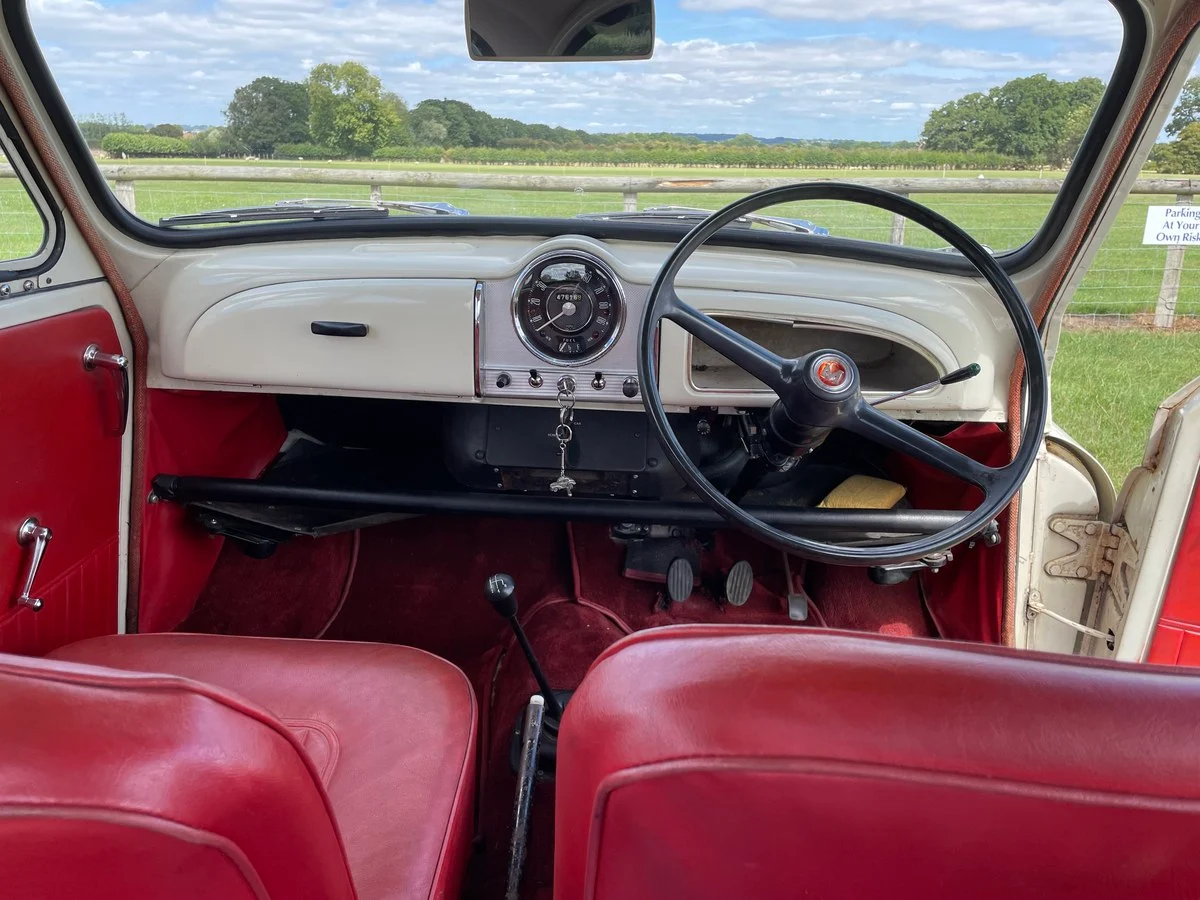
Inside, the cabin reflected Issigonis's conviction that interior space and visibility mattered more than ornamentation. The Minor offers generous headroom and a commanding view outward through its large glass area, while the dashboard is simple and functional. A single binnacle ahead of the driver carries essential instruments, and the controls are light and direct. The cabin didn’t change fundamentally across the production run.
The Morris Minor had no separate generations, but significant revisions are summarised below:
Series MM (1948–1953). Original side-valve 918cc engine; split windscreen; two-door saloon and Tourer only at launch; four-door saloon arrived in 1950
Series II (1952–1956). The BMC merger brought an 803cc A-Series OHV engine; Traveller introduced in 1953 amid mechanical rationalisation across BMC range
Minor 1000 (1956–1971). Had a 948cc A-Series engine; single-piece curved windscreen replaced split screen; 1,098cc engine installed from 1962
The Morris Minor was produced entirely between 1948 and 1971, decades before any mandatory occupant protection legislation in the UK or Europe. Seat belts weren’t standard fitment in early production but later cars were built with mounting points to allow owner-fitted lap belts. Driving a Minor in modern road conditions is something of a test of character, particularly given the yawning performance of 803 and 918cc models.
Pros
The A-Series engine's near-universal adoption across BMC makes the Minor one of the best-supported classic cars in Britain for parts
Handling surprised contemporary road testers with a wide track and torsion bar front suspension granting unusual balance and stability
The first British car to sell a million units, with the factory "Million" edition of 1961 celebrating the achievement
Cons
Performance in some models is unacceptably slow by modern standards, in town or on country roads
Unitary construction means chassis rail and crossmember rot is structural rather than cosmetic
The Traveller's ash wood frame is a known long-term ownership commitment: rot in the structural timber compromises the body's integrity
Morris Minor for Sale
The Morris Minor remains one of Britain's most accessible and best-supported entry-level classics, with a wide range of body styles and specifications available from project cars to concours-quality restorations. Browse current Morris Minor cars for sale on Car & Classic.
Prijsontwikkeling
Meest recente verkoop
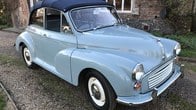
£ 16.500
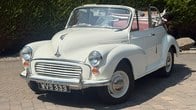
1970 Morris Minor 1000 Convertible
Momenteel te koop
112
3 live veilingen
109 advertenties



Totaal verkocht
351
Hoogste verkoopprijs
€ 24.995
Gemiddelde prijs
€ 8.569
Laagste prijs
€ 650
FAQs
A post-1962 Minor 1000 in 1,098cc specification is consistently recommended as the strongest starting point. The larger A-Series engine produces 48 bhp and has a 77 mph top speed, making it the most usable specification on modern roads. Two-door saloons in structurally sound condition represent the best value, though the Traveller commands a premium and carries the additional responsibility of the ash wood frame.
The Minor is light, direct and easy to place on the road, so it’s less intimidating than many classics for newer drivers. The 1,098cc engine is adequate for B-road use and light A-road driving, but sustained motorway use is inadvisable given the 77 mph top speed ceiling; older engines simply can’t cope with modern traffic conditions. Running costs are low since parts are cheap, and routine maintenance can be performed by any competent mechanic or capable DIYer.
The Traveller is a wood-framed estate variant, and the rear half of its body uses a structural framework of seasoned ash. It shares the saloon's floor pan, engine and running gear, but the wood must be inspected regularly for rot, while deteriorated sections require specialist repair rather than straightforward panel replacement. The Traveller commands a consistent market premium over equivalent saloons due to its visual appeal and relative scarcity as a survivor.
The most immediate visual identifier is the windscreen. Series MM cars (and Series II cars up to 1956) have a two-piece split windscreen divided by a central pillar, whereas the Minor 1000 from 1956 onwards has a single curved one-piece screen. The split rear window similarly became a single pane with the 1000 update. Under the bonnet, the side-valve engine of the Series MM is identifiable by its flat, low-profile appearance compared to the upright A-Series OHV unit of the Series II and Minor 1000.