
Beschreibung
McLaren's aim with the Senna was to offer the purest connection between car and driver ever delivered in a road car
The car's powertrain forwent any form of electric assistance and instead used a modified version of the company’s 4. 0-litre, twin-turbocharged V-8 engine
At 789bhp, it was the most powerful engine ever installed in a McLaren road car at the time
0–62 mph in 2. 8 seconds, 0–124 mph in just 6. 8 seconds and a dry weight of just 1, 200kg
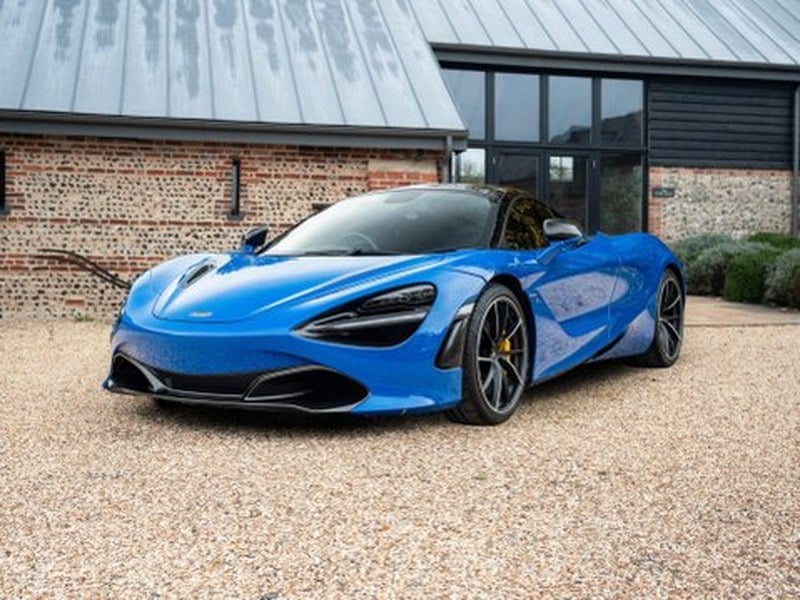
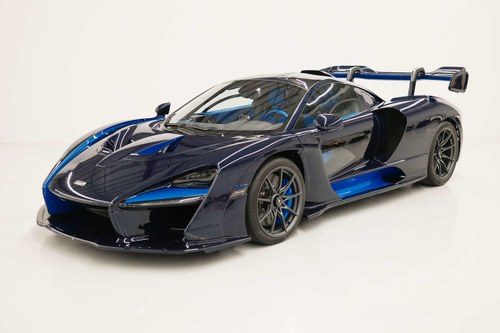
Finished in Midnight Blue with Paris Blue accents and an amazing blue and black interior
This is car Number 414 of 500 and has covered just 15km from new
The Senna joined the P1 and F1 as Number 3 in McLaren’s ‘Ultimate Series’ when it was unveiled at the 2018 Geneva Motor Show. Named after the late Ayrton Senna and dedicated to his three Formula 1 World Championships with McLaren between 1988 and 1993, the car was designed with one single purpose in mind: to be the most track-focused road car McLaren had ever built. It’s ‘raison d’etre’ was to provide the purest connection between car and driver in the pursuit of the quickest lap times.
In contrast to the P1, the Senna’s powertrain forwent any form of electric assistance and instead used a modified version of the company’s 4. 0-litre twin-turbocharged V-8 engine. Codenamed M840TR, it’s the most powerful engine ever installed in a McLaren road car, with a peak output of 789 bhp. It features dry-sump lubrication, lightweight rotating parts and a pair of ultra-low inertia twin-scroll turbochargers equipped with electronic wastegates for instant throttle response. It breathes through a bespoke carbon-fibre intake plenum, which is fed cold air from the motorsport-inspired roof-mounted snorkel.
Despite the substantial power on offer, where the Senna really works its magic is with its chassis and its active aerodynamics, the latter unparalleled on any other road car. The front of the car is dominated by a massive raised splitter and large air intakes, which feature active ‘winglets’ to guide air either underneath the body, for aerodynamic downforce, or through the radiators and oil coolers when required. Warm air from the radiators is then channelled from behind the bonnet and over the roof of the car, deliberately missing the snorkel intake before being harnessed by the enormous active rear wing. The wing itself is controlled by hydraulics and moves constantly, either to act as an airbrake, increase downforce, or equally trim drag as part of an active Drag Reduction System (DRS). It is complemented at the rear by a large double diffuser and second fixed lower wing, which are fed exhausted air from the louvred engine cover. The result is that at 155 mph, the Senna can produce 800 kg of downforce, equating to a massive 40% increase over the McLaren P1.
The chassis is based upon the Monocell III and features lightweight materials and carbon fibre throughout for ultimate stiffness and lightness. The seats weigh under 8 lb each, the front wings under 1. 5 lb, and the massive rear wing less than 12 lb. The Senna also uses an upgraded version of McLaren’s ‘Race Active Chassis Control II’ system, which features an active double wishbone and hydraulic damper setup from the P1, allowing for variable ride height, damping, and stiffness modes according to the driver’s desired setup. Keeping all this performance in check are Formula 1–inspired carbon brakes developed by McLaren and Brembo, with discs that take seven months to make, each one with integrated cooling vanes and a thermal compound that is three times more conductive than conventional carbon-ceramic brakes. Indeed, so potent is the braking system that the Senna currently holds the record for braking performance for production cars: 124 mph to a standstill in just 100 metres.
Other performance statistics are equally impressive: 0–62 mph in 2. 8 seconds, 0–124 mph in just 6. 8 seconds, and a dry weight of just 1, 200 kg, which equates to a power-to-weight ratio of 658 bhp per ton. It thus eclipses even the P1 with its ground breaking 647 bhp per ton, while simultaneously offering significantly more downforce. No surprise, then, that the Senna would show the P1 a clean pair of Pirelli Trofeo Rs at just about any circuit, regardless of the conditions.
This amazing 'Senna' is effectively a new car having been ordered new in 2019 year and is showing just 15km on the odometer. Number 414 of 500 to be built, this is a very exciting opportunity.