
Description
H&H Classics Auction Sale Imperial War Museum, Duxford, 19 October 2022
No Reserve
Registration No: IOM-Reg
Chassis No: 26004
MOT: Exempt
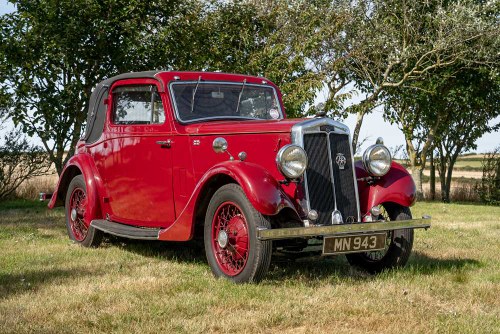
Attractive two-door, four-seater Fixed Head Coupe Coachwork by H. J. Mulliner
Subject to much restoration work in 2007
The beneficiary of approximately £2, 000 worth of improvements in 2020/ 21
One of just 1, 075 examples understood to have been manufactured and one of a much lower number provided with coachbuilt bodies
Offered from the late Robert Riding’s Estate at No Reserve, the vast majority of which has been left to charity with the RNLI as the largest beneficiary
Three of the four Lanchester brothers – Fred, George, and Frank - arguably built the first truly all-British car in 1895 and quickly established a pattern of memorable automotive innovation. Sadly, in common with many other British marques, their company nevertheless succumbed to financial trouble and was taken over by BSA in 1931, which had already absorbed Daimler some eighteen years earlier. As a result of the above, the Lanchester Light Six of 1935/ 1936 became an early example of badge engineering, being very similar to the BSA Light Six and sharing its body with the Lanchester 10.
The standard fare was a four-door, four-seat Saloon mounted on cross-braced chassis. However, some very attractive bespoke alternatives were produced by a range of independent coachbuilders. The newcomer was powered by a 1378cc six-cylinder overhead valve engine that was fed by a single SU carburetter. The unit drove via a fluid flywheel to a four-speed pre-selector gearbox and on to an underslung worm drive rear axle. The suspension was by semi-elliptic springs all around. The standard Saloon would have sold for around £340 in period and some 1, 075 examples of the model were made all told, making it a rare car in this day and age.
Chassis number 26004 was manufactured in 1935 and supplied to H. J. Mulliner who provided the attractive two-door, four-seater fixed head coupe coachwork the Lanchester is presented in. Purchased into the private collection of the late-Robert Furniss Riding in 2002, the collection is now offered from the collection at No Reserve, the vast majority of the estate having been left to charity with the RNLI as the largest beneficiary. Originally fitted with the 1378cc six-cylinder overhead valve engine, this unit has been replaced with a later introduced 11hp four-cylinder engine (of 1444cc) allied to the pre-selector transmission. Previously in the family ownership of Lanchester marque historian, Chris Clark, it was thought to have been retained in his family for some 38 years.
Presented in Red with a Black roof, the interior features Red leather interior upholstery, door-cards and carpeting, and a wool-cloth headling. The Lanchester was subject to much restoration work in 2007 comprising a complete re-wire; an electric fuel pump; renewed cooling system; exhaust system repairs; relined brakes; an overhauled distributor and much more. Recently provided with further improvements encompassing a refurbished water pump, radiator renovation, and coolant system flush; bodywork repairs; and a fuelling system overhaul totalling approximately £2, 000 through 2020-2021. Accompanied by a history file that contains a collection of invoices; model and technical information; an original spare parts catalogue and re-production maintenance manual; a previous V5C document; MOT certificates from between 1984 and 2002; sundry paperwork; and the Isle of Man registration document.
About Robert Furniss Riding:
Born in 1940, the only child of only children parents, Bob was educated at Stockport Grammar School then read natural sciences at Christ Church, Oxford. He joined William Deacon’s Bank, and had a stellar ascent through it and its subsequent iterations ending up as Group Treasurer of the Royal Bank of Scotland. He grasped the opportunity of early retirement in 1990 and moved to the Isle of Man where he had been left a house by an aunt. But Bob was far from being inactive, throwing himself into the local community and taking on the turn around of a local private bank as its Executive Chairman.
Sailing had been a preoccupation during his time in the City, but on coming to the Isle of Man, Bob switched his energies and focus to collecting “quality cars” – principally the products of Cricklewood, Derby and Crewe, but with some maverick exceptions such as Maserati and Caterham. Daimler’s and Lanchester’s also featured, and he had to move to a large country house to find garaging for the ever growing collection. His cars were regularly campaigned at rallies for the appropriate marque and were often deserved winners of various trophies. He also got involved in the relevant enthusiast clubs, usually ending up as Chairman – and his list of appointments included the Chairmanship of the Manx Classic Car Club and the Manx Motor Racing Club.
Bob was always a keen supporter of local charities, particularly maritime and those involving young people, and many will have cause to remember with gratitude his generosity and his apparently bottomless well of technical knowledge on “quality cars”, so freely shared. Bob left his Estate predominantly to Charity with the RNLI being the Residuary Beneficiary. Thus, in effect, the entire proceeds of sale of the car collection will be received by the RNLI.