Triumph Herald: Models and Specs
1959–1971 | 948–1,296 cc OHV four-cylinder | Front-engine, rear-wheel drive | Saloon, coupé, convertible, estate
Overview
Spanning three decades and four body styles, the Triumph Herald was all things to all people. It was originally developed as a replacement for the Standard 8 and 10, entering production in 1959 with a Michelotti body and an engineering brief that prioritised manufacturing flexibility and mechanical accessibility over outright performance. Its most structurally significant feature was a separate steel backbone chassis with bolt-on body panels, enabling Triumph to offer four distinct body styles from a single platform. It even permitted complete removal of the body for mechanical access in a way no unitary-construction contemporary could match. Clever engineering went beyond the Herald’s body structure, though. Its rack-and-pinion steering and independent rear suspension were advanced for 1959, with a turning circle of 25 feet matching the London black cab. Across 12 years and 548,291 units, the Herald was progressively developed through three engine displacements and four derivatives. The Herald sits within Triumph's small-car family alongside the Spitfire and the six-cylinder Vitesse, which reprised the Herald's chassis and body structure.
Price
- Starting price
- 1.440 €
- Average price
- 5.896 €
- Price range
- 1.440 € - 20.000 €
Specifications
- Production years
- 1959–1971
- Total production
- 548,291
- Body styles
- Saloon, coupé, convertible, estate
- Layout
- Front-engine, rear-wheel drive
- Engine family
- OHV four-cylinder, 948–1,296 cc
Triumph Herald in Detail
Standard-Triumph's decision to commission Michelotti (a relatively unknown Italian designer at the time) for the Herald's body came from necessity as much as ambition. Triumph lacked in-house styling capacity following a period of financial difficulty, but Michelotti delivered a body design with clean, upright surfaces that could be pressed in small batches and bolted to the separate chassis in any configuration. The bonnet, front wings and entire front end opened as a single clamshell unit, exposing the engine, suspension and steering in a way that made home maintenance straightforward without specialist tools.
The original 948cc engine was carried over from the Standard 10 and produced 34 bhp in single-carburettor form, with a twin-carburettor option producing 42.4 bhp available from launch. The Herald 1200 arrived in 1961 with a 1,147cc engine and the pioneering (on a small car) option of front disc brakes, making it measurably safer than the drum-only 948. The 1963 12/50 produced 51 bhp, adding a standard sunroof to the saloon body and front disc brakes as standard.
The 13/60 completed the model's development in 1967, introducing a 1,296cc engine, an all-synchromesh four-speed gearbox and a revised front end with a squared-off grille. The 13/60 is the most commonly encountered Herald in today’s classic car market, since it was built in all four body styles until production ended in 1971.
The Herald's performance figures are modest by any standard (or Standard-Triumph). The swing-axle independent rear suspension granted the Herald a better cornering feel than the live-axle contemporaries it competed against, but the geometry produced camber change under compression that required progressive corner entry rather than late braking. The all-synchromesh gearbox of the 13/60 transforms the driving experience relative to the earlier three-synchro unit.
Variant | Engine | Power | 0–60 mph | Top Speed | Gearbox |
Herald 948 (single carb) | 948 cc OHV | 34 bhp | 28.0 sec | 70 mph | 4-speed manual |
Herald 948 (twin carb) | 948 cc OHV | 42 bhp | 22.0 sec | 80 mph | 4-speed manual |
Herald 1200 (to Oct 1964) | 1,147 cc OHV | 39 bhp | 24.0 sec | 75 mph | 4-speed manual |
Herald 1200 (from Nov 1964) | 1,147 cc OHV | 48 bhp | 20.0 sec | 78 mph | 4-speed manual |
Herald 12/50 | 1,147 cc OHV | 51 bhp | 19.0 sec | 81 mph | 4-speed manual |
Herald 13/60 | 1,296 cc OHV | 61 bhp | 17.7 sec | 85 mph | 4-speed all-synchromesh |
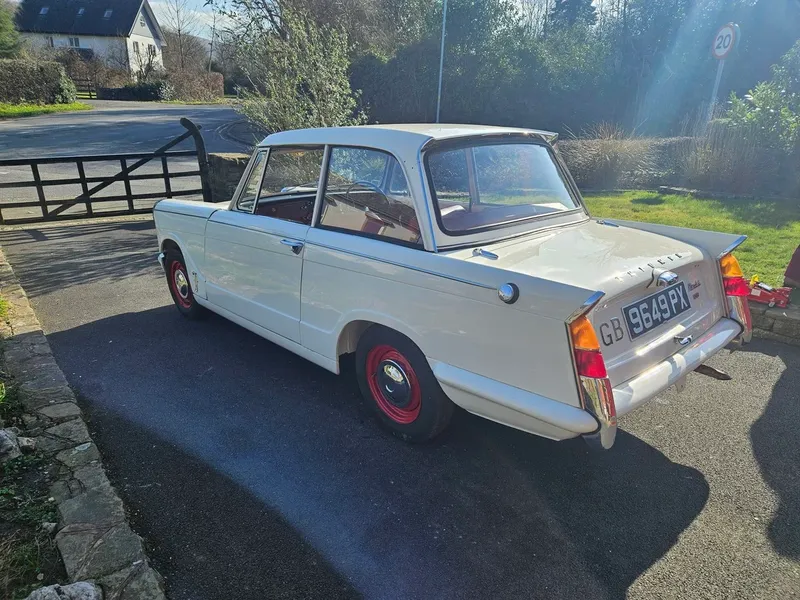
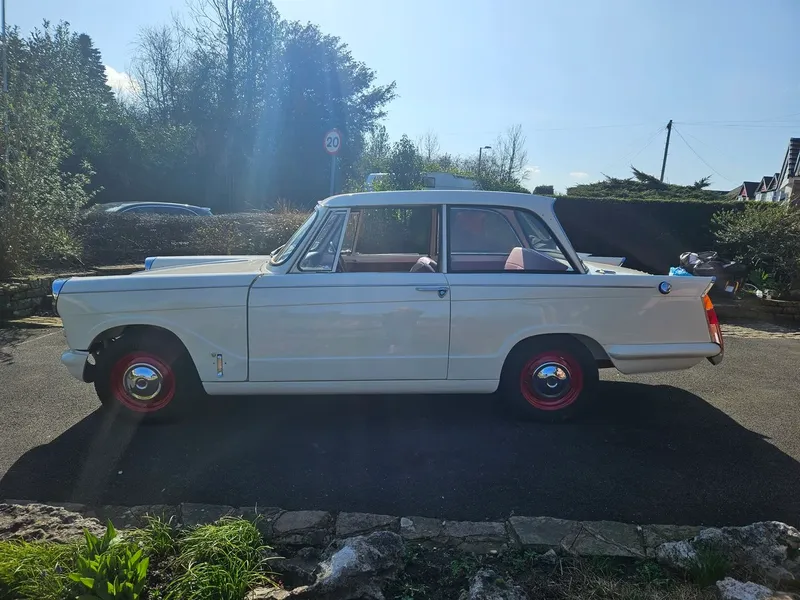
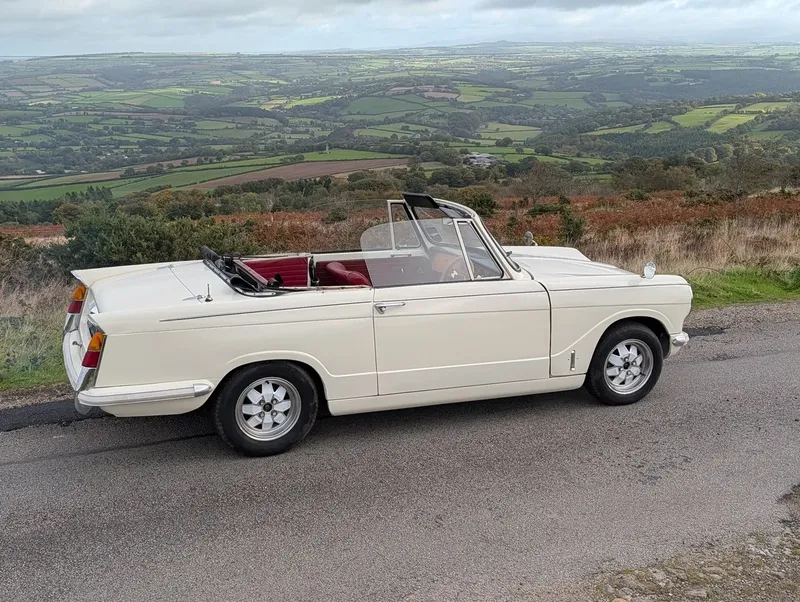
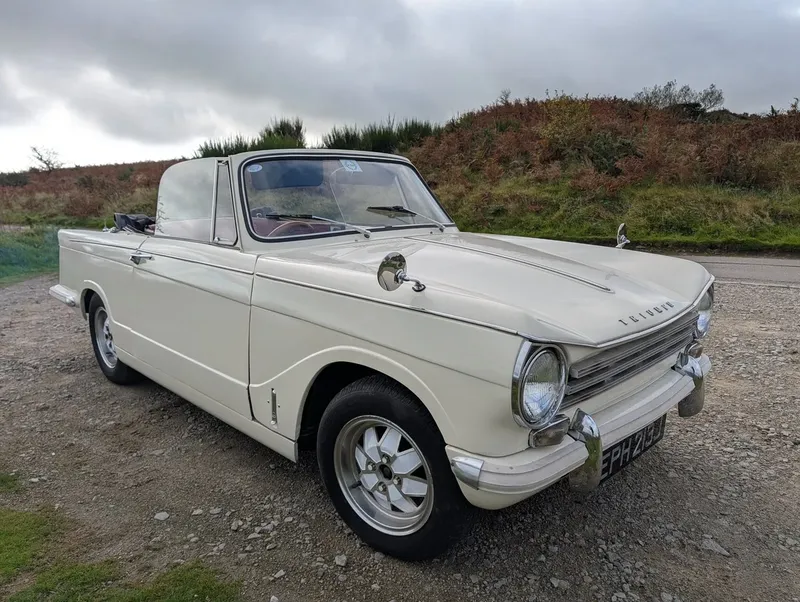
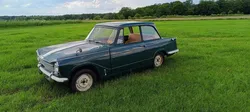
The Herald is immediately identifiable by its upright two-door body with pronounced wheel arch cutouts, a flat bonnet line and a front end that opens forward from a hinge at the firewall. Michelotti's design used flat glass panels throughout to reduce distortion and keep replacement costs low, resulting in a crisp and angular quality that aged slowly alongside rounder British contemporaries. The convertible variant has no B-pillar; the roof structure is entirely removed with the hood down, giving unobstructed visibility.
Inside, the Herald's cabin is functional but basic. The driver faces a simple instrument cluster with a speedometer and fuel gauge, augmented on coupé models by a temperature gauge. The dashboard is a single-pressed panel, replaceable in an afternoon, and the absence of complex structures behind it makes electrical work accessible to a competent amateur
The Herald does not have separate generations in the traditional sense, as it evolved through engine and equipment updates within a single continuous production run. The key development stages are:
Herald 948 (1959–1964). The original model had a single or twin carburettor 948cc engine in coupé, saloon and convertible body styles
Herald 1200 (1961–1970). A 1,147cc engine debuted with optional front disc brakes; estate body style added 1961 and revised power output from 1964
Herald 12/50 (1963–1967). Saloon version only, with a 51 bhp twin-carburettor 1,147cc engine plus standard sunroof and front disc brakes
Herald 13/60 (1967–1971). A 1,296cc engine upped power to 61 bhp with an all-synchromesh gearbox and revised front-end styling on all four body styles
The 948cc Herald's drum-only braking was the most significant safety limitation of the original car; the 1200's optional front disc brakes (standardised on the 12/50) addressed the principal stopping-distance deficiency. The swing-axle rear suspension produces rear wheel tuck-under under certain hard-cornering conditions and requires measured, progressive cornering inputs rather than the abrupt direction changes that a double-wishbone design tolerates more readily.
Pros
The clamshell front end exposes engine, suspension and steering as a single opening, making the Herald mechanically accessible for home maintenance
Body panels bolt on individually, so a damaged wing or door skin can be replaced without welding equipment or specialist bodywork knowledge
548,291 units produced across 12 years means a broad UK parts supply network
Cons
Front and rear chassis outriggers supporting the body are corrosion failure points; severe outrigger rot causes body sag, detectable as uneven door gaps
The swing-axle rear suspension produces rear wheel tuck-under under hard cornering
Pre-13/60 gearboxes have synchromesh on the top three ratios only; the absence of first-gear synchromesh requires a deliberate double-declutch
Triumph Herald for Sale
Heralds remain among the most accessible British classics in the current UK market, with the 13/60 representing the preferred starting point for new buyers. Find your preferred body style, engine and specification in our carousel.
Price trends
Venta más reciente
6995 £
1967 Triumph Herald Convertible

Actual en venta
19
1 subasta en marcha
18 anuncios


Total vendidos
85
Precio de venta más alto
20.000 €
Precio promedio
5896 €
Precio más bajo
1440 €
FAQs
Providing you accept the limitations of a 60-year-old 61 bhp car, the Herald is well suited to regular light use. Its mechanical simplicity means common maintenance can be carried out without specialist equipment. The 13/60's 85 mph top speed is sufficient for A-road and occasional dual-carriageway use, though the convertible's lack of a B-pillar means it’s not a car to use in heavy rain without careful preparation of door and hood seals.
The Herald's separate backbone chassis uses lateral extensions from the main chassis rail to support the body at its corners. These are the most corrosion-prone structural elements on any Herald, frequently affected on cars that have been stored outdoors or used in winter conditions. Severe outrigger rot causes the body to sag between mounting points, which presents as uneven door gaps and doors that fail to close correctly. Outrigger replacement requires the body to be lifted from the chassis and is well within the capability of a competent home restorer using new steel sections.
All three models share the Herald's separate backbone chassis and bolt-on body construction. The Spitfire uses a shortened version of the Herald floorpan with a two-seat open body, while the Vitesse uses the full Herald chassis and body structure but is powered by a straight-six engine in 1,596 or 2,000cc form, producing up to 95 bhp.
Parts availability for the Herald is strong for a car of its age. The Triumph Herald Owners' Club maintains a technical register and parts sourcing network in the UK. Running costs are low relative to most classics of the period: the OHV four-cylinder is simple to service, fuel consumption on the 13/60 averages approximately 34 mpg, and insurance as a historic vehicle qualifies for SORN and historic road tax exemption.