Description
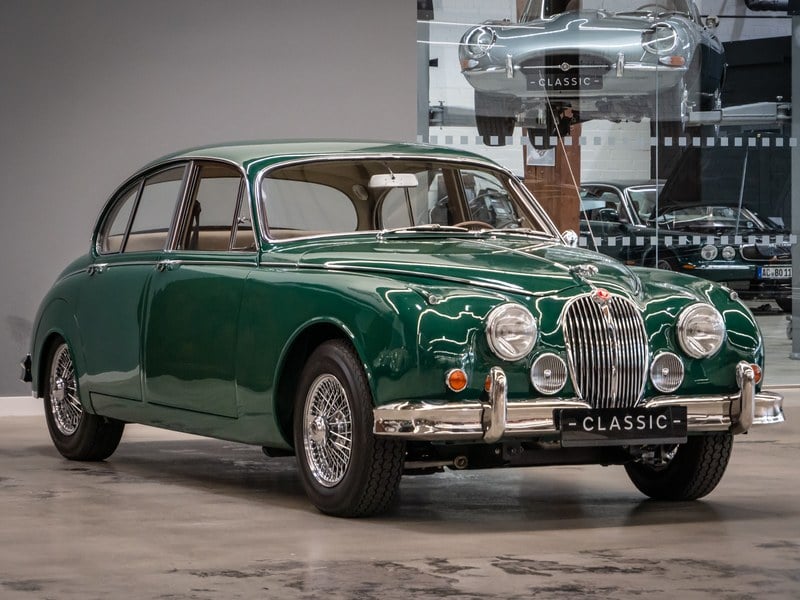
Voici ma Jaguar Mk 2. Je l'ai achetée il y a une dizaine d'années et elle est restée au sec depuis ! J'ai passé la plus grande partie de ma vie professionnelle dans le domaine des véhicules & Classic, principalement dans la réparation/ restauration, et j'ai acheté cette voiture en pensant la bricoler et l'utiliser quand je serais à la retraite. Pour moi, la peinture gris-argent opalescent (gunmetal) avec l'intérieur en cuir rouge et les roues en fil de fer est la meilleure combinaison pour une Mk 2. Ajoutez un moteur de 3, 4 litres, une boîte de vitesse manuelle à surmultipliée et une direction assistée et vous obtenez ce que beaucoup considèrent comme la spécification la plus désirable - et je ne serais certainement pas en désaccord ! C'est ce qui m'a attiré dans cette voiture. Certains diront que le 3. 8 est celui qu'il faut avoir, et c'est probablement vrai si vous voulez faire de la course ou braquer des banques ! Mais pour une utilisation normale, le consensus semble être que le 3. 4 est le plus polyvalent. Le 2. 4 est sous-motorisé, et les derniers modèles 240 et 340 étaient des modèles économiques conçus pour stimuler les ventes. Alors, qu'avons-nous exactement ici ? Je dirais que c'est une Mk 2 très soignée, présentable et utilisable. Mais elle n'est pas parfaite et elle ne va pas vous faire gagner des trophées aux concours - donc si c'est ce que vous recherchez, gagnez du temps et passez votre chemin maintenant. Pour ceux qui lisent encore, je vais vous dire ce que je peux. Il y a un peu d'histoire, principalement depuis la période où il a été restauré (milieu des années 90 je crois) jusqu'à environ 2010, ce qui, je suppose, est la date à laquelle il a été utilisé régulièrement pour la dernière fois. Il n'y a pas d'historique récent, à part quelques éléments dont je viens de m'occuper, pour la simple raison susmentionnée : je ne l'ai pas utilisé et je l'ai gardé au sec et à l'abri de la lumière. Mais dans l'histoire antérieure, il est fait référence à la restauration de la voiture par RS Coachworks de Reading. Cette entreprise était bien connue à l'époque pour ses restaurations de véhicules de collection Jaguar. D'après les anciens certificats de contrôle technique que j'ai, elle affichait environ 83 000 miles à l'époque - elle en affiche aujourd'hui environ 3 000, lors de son deuxième passage, ce qui signifie qu'elle a parcouru environ 20 000 miles depuis sa restauration. Il y a une liasse de factures pour des travaux ultérieurs, l'une d'entre elles faisant référence au remplacement de la traverse avant et de la patte d'oie, ainsi que d'autres factures pour des réparations et/ ou des entretiens divers. Il y a aussi une référence à la réfection des carburateurs par Burlen Fuel Systems (Google si vous ne connaissez pas), ce qui, avec l'allumage électronique, explique probablement en partie pourquoi la voiture fonctionne si bien. Je suppose que l'intérieur a été retaillé/ restauré à la même époque, car il est également en excellent état, avec juste un peu de patine suggérant un usage léger dans les années jusqu'à vous. Par ailleurs, l'historique mentionne également que la voiture a été équipée d'un moteur de 2, 4 litres à un moment donné - mais rassurez-vous, il s'agit bien d'un 3, 4 : le " 3, 5 litres " qui était moulé sur le côté de ces blocs est clairement visible, et il suffit de conduire la voiture pour dissiper tout doute persistant - aucun 2, 4 n'a jamais fonctionné comme ça ! La différence de performances dans le monde réel entre les 3. 4 et 3. 8 était assez minime. La voiture a subi quelques améliorations/ modifications judicieuses pour la rendre plus utilisable et plus fiable dans le monde moderne, mais il n'y a rien qui ne puisse être remis à l'état d'origine - bien que je ne puisse pas imaginer pourquoi quelqu'un voudrait le faire ! Ces modifications sont les suivantes : direction assistée électrique, ventilateur de refroidissement électrique automatique avec thermostat réglable, système d'échappement complet en acier inoxydable, allumage électronique Aldon avec bobine Lucas 'Gold', conversion de l'alternateur, ceintures de sécurité à enrouleur à l'avant et à l'arrière, pompe à carburant SU 'électronique' qui élimine les points gênants que l'on trouvait à l'origine, conversion des phares halogènes en phares halogènes, etc.
Conversion des phares halogènes. Tuyaux de frein tressés en acier inoxydable, et toutes les conduites rigides semblent être en cuivre/ kunifer résistant à la corrosion. Sur la route, la direction assistée électrique est très discrète, fonctionne silencieusement, et vous ne vous douteriez presque pas de sa présence, autre que le fait que vous n'avez pas besoin de bras comme Arnold Schwarzenegger pour tourner la direction à basse vitesse ! Pratique, une petite commande rotative permet de régler l'assistance, voire de la désactiver complètement une fois sur la route si vous le souhaitez. Le meilleur des deux mondes ? La voiture se conduit très bien, avec une bonne traction sur tous les rapports et à tous les régimes. La surmultiplication s'enclenche en douceur et permet de rouler en toute décontraction. Le moteur est très puissant et l'échappement en acier inoxydable émet un joli grondement de six cylindres droits à bas régime, qui se transforme en un râle guttural lors des accélérations à haut régime, ne laissant aucun doute à quiconque se trouve à portée de voix sur la présence d'un puissant moteur de XK sous le capot. Malgré cela, il n'est pas intrusif à vitesse de croisière et vous pouvez rouler sans un mugissement assourdissant. Tous les instruments fonctionnent et affichent des valeurs proches de celles que l'on attend, même s'ils ne sont pas toujours réputés pour leur précision !Après avoir sorti la voiture de sa période d'hibernation, les travaux suivants ont été effectués pour la remettre dans un état utilisable : Le système de carburant a été décapé et nettoyé. La pompe à carburant a été démontée, nettoyée et testée. Les carburateurs ont été démontés et nettoyés, le niveau des flotteurs a été vérifié et remis à zéro. Nettoyage de la cuvette du filtre en verre dans le compartiment moteur. Rinçage des conduites. Un filtre supplémentaire a été installé entre le réservoir et la pompe, afin d'éviter que des débris provenant du réservoir ne soient aspirés dans la pompe ou n'obstruent les conduites. D'après mon expérience, il n'est pas rare que des débris se trouvent dans le réservoir des vieilles voitures. Les freins ont été vérifiés et du liquide frais a été purgé dans le système. Toutes les plaquettes présentent une usure minimale. Le frein à main fonctionne très bien, ce qui n'est pas du tout une évidence sur une Mk 2 ! Tous les supports du sous-châssis de la suspension avant ont été remplacés : certains d'entre eux n'étaient plus en état, il était donc logique de remplacer les quatre pendant que j'y étais. Les jantes en fil de fer ont été remises à neuf.
Tous les principaux éléments électriques (légalement requis) ont été vérifiés et tous les défauts ont été corrigés. Un nouvel indicateur de niveau de carburant a été installé. De nouvelles bougies d'allumage ont été installées. Une nouvelle batterie robuste a été installée. Tous les niveaux de fluide ont été vérifiés et complétés si nécessaire. Comme indiqué, la voiture se présente très bien, je dirais, mais elle n'est pas parfaite, loin s'en faut. Sans documentation, je ne peux que deviner ce qui a été fait lors de la restauration, mais il suffit de dire qu'il s'agit d'une restauration ancienne qui montre des signes d'âge à certains endroits. La peinture est assez bonne en général, avec une bonne brillance uniforme. Mais de près, vous pouvez voir les signes de l'âge. Il y a quelques cloques ici et là, le plus souvent assez petites, sur les bords des panneaux ou sur les garnitures chromées, où l'humidité peut s'infiltrer avec le temps et provoquer un décollement de la peinture. Des exemples typiques figurent sur les photos. Il y a également quelques cloques dans le coin inférieur arrière de la porte arrière côté passager - également visibles sur les photos. Ce sont des défauts typiques d'une Mk 2. Dans ce cas, ils sont assez mineurs et ne sont pas visibles à plus de quelques mètres de distance. Compte tenu de l'ancienneté de la restauration, je pense qu'elle tient bien la route. Les chromes sont pour la plupart en bon état, mais pas parfaits. Il y a des piqûres sur certaines pièces, principalement les suspects habituels (plinthes de feux arrière, garnitures d'écran, etc). Dans l'ensemble, c'est présentable. Les jantes en fil de fer ont été remises à neuf, comme indiqué, et sont équipées de pneus Vredestein Sprint Classic 185 HR 15 assortis et correctement dimensionnés, dont la bande de roulement semble à peu près complète. La roue de secours est également une Vredestein, et la trousse à outils complète d'origine est nichée à l'intérieur. Le dessous de la voiture semble solide et ne présente aucune trace de rouille importante. Il est vrai qu'elle a eu sa part de soudure au cours de sa vie - vous ne trouverez pas beaucoup de voitures britanniques d'origine qui ne l'ont pas fait - mais elle semble solide aujourd'hui. Comme mentionné, la traverse avant et la patte d'oie ont manifestement été remplacées. Les seuils et les points d'appui semblent solides. La voiture est mécaniquement saine. Les travaux susmentionnés sur les systèmes de carburant et d'allumage ont abouti à un moteur qui fonctionne très bien et qui démarre sur simple pression d'un bouton, qu'il soit chaud ou froid. Il ne fume pas et ne fait pas de bruit, il sonne comme un bon moteur de XK devrait le faire. Il ne surchauffe pas. Il y a quelques gouttes d'huile en dessous - certaines provenant de la zone autour de l'arrière du moteur, et aussi du carter du différentiel. Encore une fois, c'est assez typique de ces voitures - à moins que vous n'en achetiez une qui a été récemment reconstruite, vous aurez probablement quelques fuites - ce sont des Jags de soixante ans ! La boîte de vitesse est à quatre rapports avec overdrive sur le dessus. Tout fonctionne comme il se doit, à condition de comprendre que vous ne pouvez pas précipiter les changements de vitesse avec ces boîtes. L'intérieur est très agréable à vivre ! Manifestement retaillé, il présente aujourd'hui une belle patine - pas neuve, mais pas non plus très usée ou fatiguée. Pour moi, c'est l'intérieur idéal, car il n'est pas si parfait que vous ayez peur de l'utiliser, mais il est encore assez bon pour être un endroit très agréable où s'asseoir. Il est équipé des sièges avant inclinables en option et de tables de pique-nique rabattables. Le placage de bois est tout simplement magnifique, avec un brillant profond et homogène - j'ose dire qu'il est aussi bon que tous ceux que vous trouverez, même dans des voitures récemment restaurées, et certainement meilleur que les placages fatigués, ternes et écaillés que vous trouverez dans de nombreuses voitures de ce niveau de prix. Le cuir, lui aussi, est de très bonne qualité, avec juste un peu de patine, mais pas d'usure importante. Pour moi, l'intérieur d'une Mk 2 est le cœur de la voiture, il peut faire ou défaire une voiture et il faut des artisans qualifiés et plusieurs milliers de livres pour en décorer une à ce niveau. C'est donc quelque chose que vous devriez toujours considérer lorsque vous cherchez à acheter l'un de ces modèles emblématiques. Veuillez garder à l'esprit, lorsque vous comparez les prix, que le numéro chéri 'PRY 136' sur cette voiture est transférable, et vaut probablement au moins £2K. Le dossier d'historique et le V5 sont présents, ainsi qu'un manuel et quelques autres éléments. Enregistrée historiquement, elle est donc exempte de taxe et de contrôle technique.