How The Classic Vehicle Industry is Changing – HCVA Heritage Matters

April 28, 2026
Photography by Gun Hill Studios
Over 150 people attended the Historic & Classic Vehicles Alliance (HCVA)’s sixth Heritage Matters Insight Day, entitled ‘Unlocking Barriers to Success’. The day’s discussions explored how the classic vehicle industry is changing, and how businesses in this sector can adapt to the modern world, shifting market trends, and an evolving customer profile.
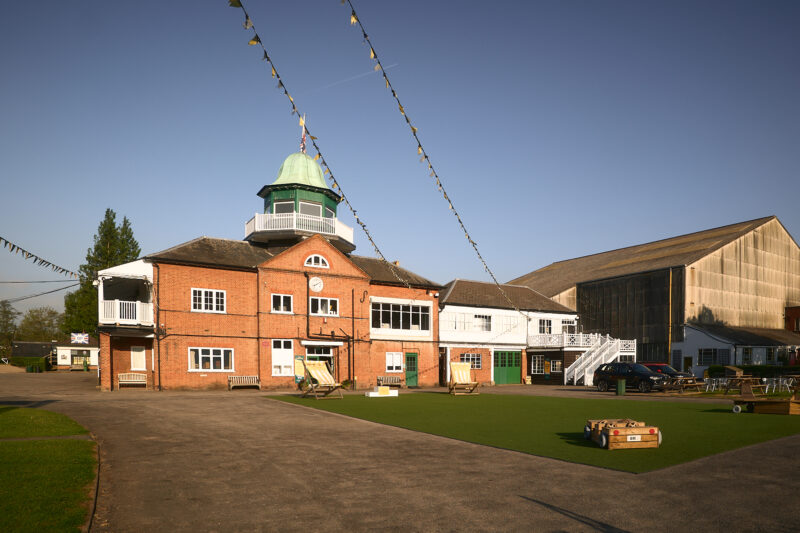
The event was held at Brooklands Museum in Surrey, the world’s first purpose-built banked motor racing circuit, which hosted the inaugural British Grand Prix in 1916 and saw numerous early speed and endurance records set. The site also played a key role in British aviation history, hosting the first public flying display in 1909 and becoming a major aircraft manufacturing centre throughout much of the twentieth century.
Today, Brooklands is a thriving museum with 180,000 annual visitors and around 15,000 active members. Motoring activity returned in 2017, 110 years since Brooklands first opened, and the Heritage Skills Academy (HSA) operates a major training site on the premises.
A fitting place then to hold a conference on the future of the historic vehicle sector.
HCVA Heritage Matters – Unblocking Barriers to Success: Quick Summary
– Vehicle ownership is more relevant in the historic sector in a world of impermanence.
– Diversification is key for businesses in the historic vehicle sector, understanding customers’ evolving wants and needs.
– It’s the employers’ responsibility to create opportunities for young people to enter the sector.
– The classic vehicle hobby is becoming more inclusive and intergenerational.
– People have less free time and expect a curated ownership experience.
– Britain’s ‘Historic’ fleet is growing, thereby attracting more attention from policymakers.
– Successive governments are fixated on electrification, but they should also consider sustainable fossil fuel alternatives.
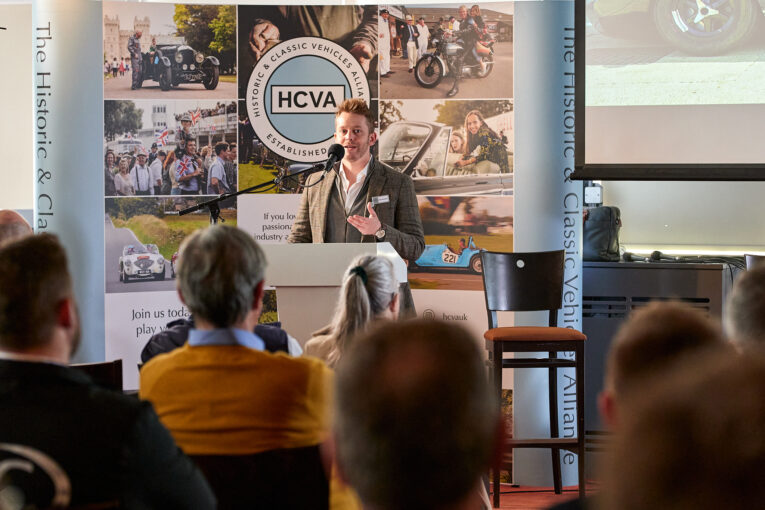
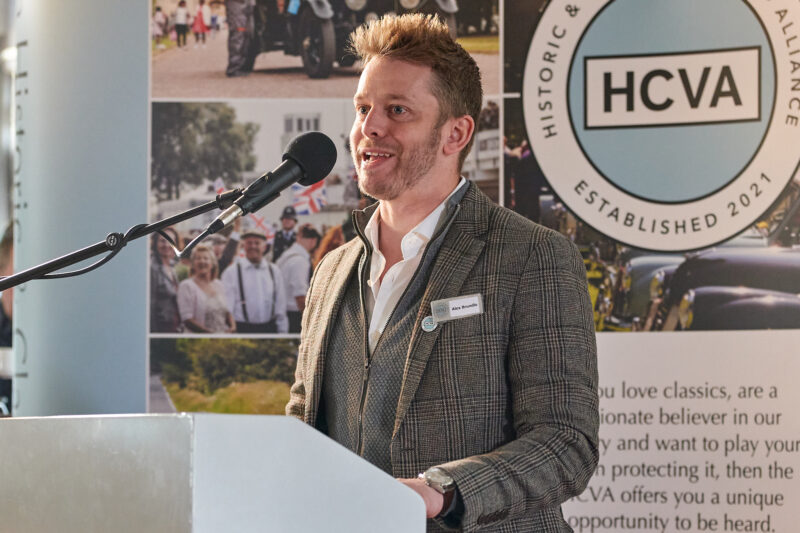
Alex Brundle: Classic car Ownership as a Proof of Concept for Improving a Society
British racing driver and broadcaster Alex Brundle delivered a keynote speech, offering a unique perspective on his generation’s (Millennials’) participation in historic motorsport, the opportunities and barriers young people face to entering the industry, and the positive role the historic vehicle sector plays in our society.
He began by noting that vehicle ownership is more relevant in historic motorsport than in any other form of motor racing. When competing in modern machines, it’s usually the case that the cars are managed by a team, and drivers’ involvement typically starts and ends the minute they get into and step out of the car. In historic racing, owners typically drive and maintain their own cars. They know every detail intimately, from their carburettor jetting to their tyre pressures.
Brundle spoke of the “Millennial crisis with lack of ownership”, suggesting that the historic motorsport world has much to offer young people, enabling them to engage with a broader community through shared passion.
Millennials typically don’t own their home, their mobile phone, or indeed their cars. This subscription-based culture we live in, in Brundle’s view, contributes to young people’s retreat into the digital world. To many, “their Instagram feed is the only piece of real estate they will ever own”, Brundle said.
A sad reality, perhaps, but it was encouraging to hear delegates explain throughout the day how employing young people and offering apprenticeships have worked out so well for both their businesses. The onus is on employers to create these opportunities with the help of organisations such as StarterMotor and the Heritage Skills Academy, both of which spoke at the event.
Britain boasts some of the world’s finest apprentice programmes in this field, and also some of the most diverse motorsport opportunities, with everything from Goodwood to grass-roots banger racing.
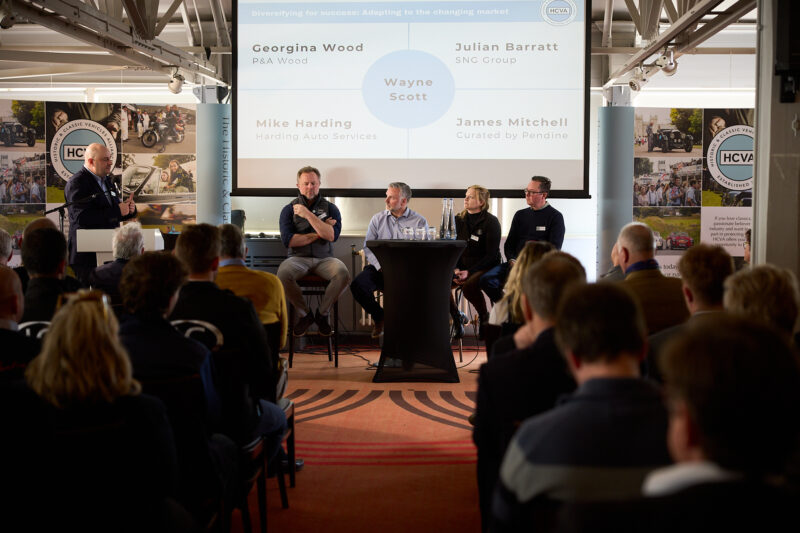
Diversifying for Success: Adapting for a Changing Market
The panel:
- Georgina Wood – P&A Wood
- Mike Harding – Harding Auto Services
- Julian Barratt – SNG Group
- James Mitchell – Pendine
The first panel discussion explored how businesses have had to adapt (and will continue to adapt) to remain competitive in an ever-changing market. The key theme that arose in this conversation was that the classic car owner profile continues to evolve.
Generally, it was agreed that customers demand more from their cars, both in terms of reliability and usability. People seek a curated ownership experience. This includes seeking help with shipping and registration when buying a car. Buyers expect advice based on their intended usage, including events prospective vehicles would be eligible for. During servicing, owners increasingly opt for sympathetic upgrades to improve reliability. “They expect their vehicles to work”, Mike Harding added.
James Mitchell made some particularly pertinent remarks about the profile of classic car buyers. “The use factor has changed”, he noted. Selling a car now involves guiding the customer through what car is right for them and how to use it. People don’t necessarily know how to get into events; they expect a professional seller to help guide them through sign-up, mechanical preparation, and logistics. A positive change the panel touched upon is that events are becoming more inclusive. What began as a typically male pursuit has become increasingly diverse, family-oriented and intergenerational.
Inevitably, the current state of the classic car market reared its head. It should come as no surprise that the market for pre-war and early post-war classics continues to shrink. As much as nostalgia and changing trends play their part, we can also assume this generational shift is driven by usability. ‘80s, ‘90s and ‘00s cars are by far the most usable classics. Many can serve as daily drivers, so perhaps it’s no surprise that, with cheaper insurance premiums and many now creeping up to the VED and MOT exemption threshold, cars of this era are starting to gain momentum in the marketplace.
Speaking on earlier classics, Mitchell noted that market correction has allowed some to acquire a dream car that would previously have been out of reach. Logically, falling prices may also trigger a trickle-down effect, potentially leading more young enthusiasts to choose an older classic over a newer model because it offers better value. Businesses need to bring on new people who understand the language of modern classics and this generation of enthusiasts.
DVLA Data Trends: The Changing Historic Fleet
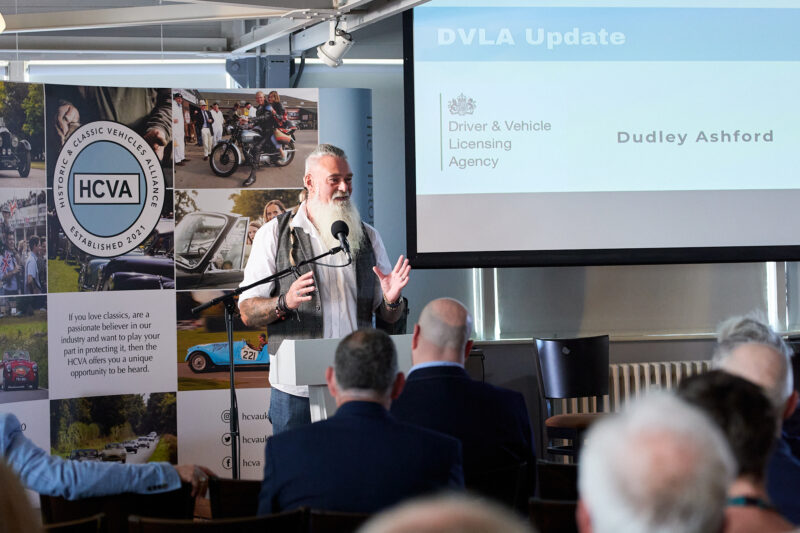
One of the most thought-provoking topics discussed at the sixth Heritage Matters conference was the evolving nature of Britain’s historic fleet. The UK is unusual in that it operates a forty-year rolling exemption from road tax (VED) and also waives the requirement to undergo MOT testing. This system has proved controversial at times, while hugely advantageous to the historic vehicle sector and to motorists looking to save some money by running older vehicles.
While it’s obvious when you think about it, what many probably don’t consider is that the forty-year rule is causing the nation’s historic fleet to grow rapidly per annum. Not only does the age span increase, but so does the number of surviving vehicles produced each successive year. The HCVA presented data stating that global car production tripled between the 1950s and 1980s. That means far more cars were produced in the era now entering exemption than in previous decades. As we start exempting ‘90s cars in the coming years, we’ll find that the survival rates were generally much better, with fewer issues like corrosion taking these vehicles off the road.
Suddenly, we find ourselves with an exceedingly large historic fleet, and it’s hard to imagine policymakers won’t be taking note when it comes to topping up the road tax coffers. From a driver’s perspective, the exemption of ‘90s cars from VED and MOT will unlock a whole host of thrifty daily drivers. While there’s currently no reason to believe the DVLA are looking to change the rules, some speculate that there may be a cut-off on the forty-year rolling exemption rule on the horizon.
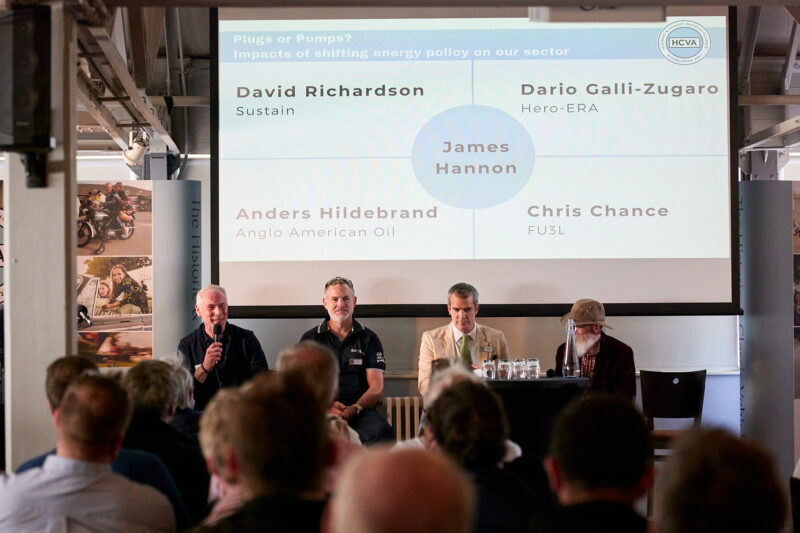
Plugs of Pumps?
The panel:
- Dave Richardson – Sustain
- Dario Galli-Zugaro – Hero-ERA
- Dr Mark Dibben
- Chris Chance – FU3L
The final panel discussion for this sixth HCVA Heritage Matters Insight Day focused on sustainable fuels. The United States’ war with Iran has once again prompted the West to reconsider where it sources its energy.
Successive UK governments have pushed hard for electrification, but this single-track approach simply isn’t realistic at the scale the country needs. In reality, the future is likely to feature a diverse energy ecosystem in which EVs run alongside hydrogen, fossil fuels, and sustainable fuels. The latter will be particularly important for keeping older vehicles on the road. After all, it’s far more ecologically friendly to prolong the life of a vehicle than to build a new one.
The electrification of classics is a growing movement, and while there will be an audience for these cars, the majority of enthusiasts will (understandably) be reluctant to sacrifice internal combustion. It’s engines and their unique character that make so many of these cars special.
It doesn’t take a PHD in chemical engineering to see that sustainable fuels make a lot of sense. Unlike fossil fuels, which release additional CO2 into the atmosphere that was safely locked away underground, sustainable fuels recycle their carbon, which was captured from the atmosphere during production.
The HCVA is actively lobbying the UK government to recognise and support sustainable fuels as a logical solution for reducing the carbon footprint of the existing internal combustion engine fleet, particularly classic cars.
HCVA Heritage Matters Insight Day: Conclusion
Events like this demonstrate that the HCVA continues to tackle the most pressing challenges facing our sector, welcoming ideas from its members and serving as a conduit between key industry stakeholders and government policymakers.
The latest HCVA Heritage Matters Insight Day addressed a broader range of subjects than the last. It furthered the discussion on attracting the next generation while also exploring the changing classic vehicle market, taking a deep dive into the DVLA’s data, and hearing the latest developments on the future of Britain’s fuel ecosystem. Events like this prove that we don’t face these challenges alone, and that this is an exciting time to be part of the historic vehicle sector.
We thank the HCVA, CEO Dale Keller, Operations Manager Shân Stokes, compère Wayne Scott, Brooklands Museum, and Gunhill Studios for delivering another excellent Heritage Matters Insight Day.