Classic Vehicle MOT and Road Tax (VED) Guide – UK 2025

October 28, 2025
As if we needed more reasons to recommend driving a classic, the DVLA road tax (Vehicle Excise Duty) and MOT exemption rule for vehicles over forty years old is a significant boon. Looking after these older vehicles takes a good deal of extra effort, time and sometimes cost. So, it’s welcome to find that we classic drivers can make significant savings on car tax and MOT.
At the time of writing, the standard yearly charge is £195 for most cars registered since April 2017. However, for slightly older vehicles and those that don’t meet the latest emissions standards, this figure can reach £760. The highest Vehicle Excise Duty for new cars registered after April 1, 2025, is an eye-watering first-year tax of £5,490.
If that doesn’t sound like much fun to you either, don’t worry, as a forty-plus-year-old classic won’t cost you a penny. There is, at present, no classic car road tax. You don’t even have to MOT it either, so that’s another ~£50 saving.
Sounds great, but registering a newly forty-year-old vehicle (or an older one still paying road tax) as ‘Historic’, can be a confusing task. In this handy Classic Vehicle MOT and road tax (VED) Guide, we break down DVLA vehicle excise duty and the process of registering your vehicle for road tax and MOT exemption.
Quick Summary:
– Vehicles over forty years old qualify for ‘Historic’ registration status on a rolling basis
– ‘Historic’ vehicles are exempt from paying DVLA road tax (VED)
– So long as they haven’t undergone ‘substantial changes’, ‘Historic’ vehicles are also exempt from MOT
– Even though there’s no classic car tax as such, you still need to tax your vehicle (there will be £0.00 to pay)
– Your vehicle must be maintained to a roadworthy standard, even if you opt out of MOT testing
What Does Road Tax (VED) and MOT Exemption Actually Mean?
It’s important to note that you still need to tax your vehicle; you just don’t pay anything. The process of taxing it is the same. This can be done online via the GOV site.
You will require a reference number from any of the following documents:
– A recent vehicle tax reminder or ‘last chance’ warning letter from DVLA
– Your vehicle log book (V5C) – it must be in your name
– The green ‘new keeper’ slip from a log book if you’ve just bought it
It can be a tall order for some classics, especially the older ones, to pass a modern MOT test. That’s why the rules state that vehicles registered as ‘Historic’ without ‘substantial changes’ are not required by law to undergo testing. This is totally up to the owner.
MOT testing is a fundamentally good idea to ensure your vehicle is in a safe, roadworthy condition. Car & Classic also recommends MOT testing your car if you’re trying to sell it, as this offers potential buyers an independent assessment of its current state. For those who do opt to MOT, ‘Historic’ vehicles do not have to undergo an emissions test; a visual smoke test will suffice.
If you choose not to MOT, it’s imperative to note that your vehicle still needs to be roadworthy. MOT exemption is not an excuse to drive a dangerous or faulty vehicle. You could be fined if you’re stopped by the Police and this is found to be the case.
Which Vehicles Qualify for Road Tax and MOT Exemption?
The rule works on a rolling basis: Vehicles that became tax-exempt in April 2025 had to have been built before January 1985. The same will apply in April 2026 for vehicles built before January 1986, and so on.
You do not need to get an MOT if your vehicle was built or first registered more than forty years ago, and no ‘substantial changes’ have been made to the vehicle in the last 30 years. According to the DVLA, ‘substantial changes’ include “replacing the chassis, body, axles or engine to change the way the vehicle works.” It’s up to you to report on this accurately.
How Can You Check if a Vehicle is Already Registered as Historic?
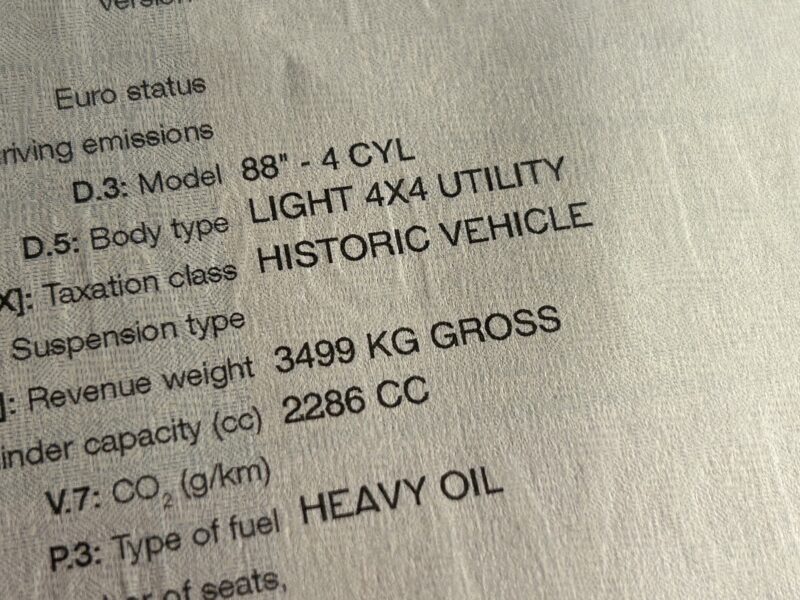
The first port of call is to check the V5C. On the inside fold, it should state ‘Historic’ under ‘Tax Class’. Note that this is only after the change has officially been made.
The GOV.UK system can appear misleading here. Regardless of whether your vehicle is MOT exempt or not, if you’ve chosen not to MOT it, the MOT check page will return a bright red banner stating “This vehicle’s MOT has expired. You can be fined up to £1000 for driving without a valid MOT.”
However, if you visit the page for checking DVLA road tax (VED), both the tax and MOT status should be highlighted in green, showing the date of the (£0.00) tax renewal and the words “No results returned” under MOT. This confirms that your vehicle is recorded as ‘Historic’.
How Do You Register a Vehicle as ‘Historic’
There isn’t yet an online system for registering your vehicle as tax and MOT exempt. If you’ve determined that it qualifies as ‘Historic’ based upon the above criteria, you need to submit some paperwork to the DVLA via a Post Office.
You can do this by presenting the following documents at a Post Office:
– Current logbook (V5C) in your name
– A vehicle tax reminder letter (V11), if you have one
– Evidence of a current MOT (if your vehicle needs one): a current MOT certificate or online print-out
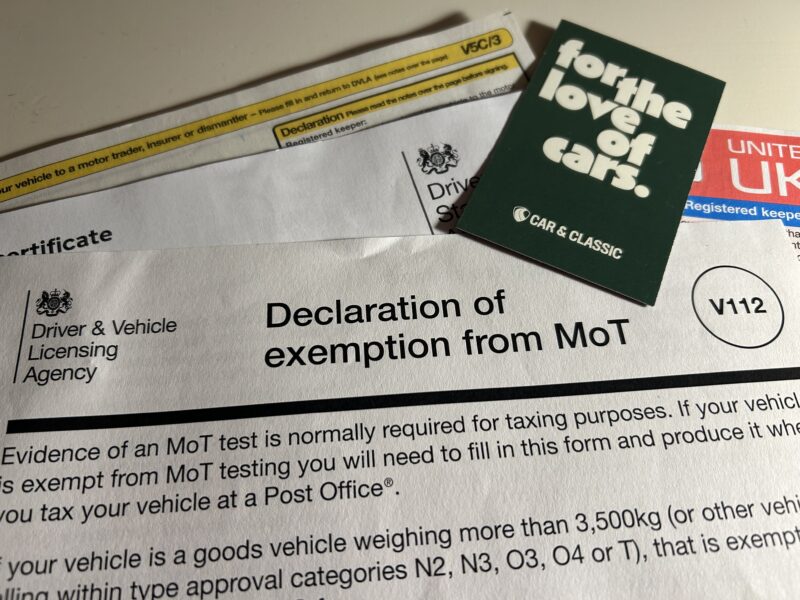
– Evidence of MOT exemption form (V112): download here
The Post Office attendant will take these documents from you and send them to the DVLA. Once your new V5C has been made, this will be returned to you by post. You must allow up to four weeks for this process and be sure to request a receipt to confirm that these documents have been posted.
FAQs:
Can I continue MOT testing my vehicle?
Yes, just because your vehicle has been declared exempt from MOT, that doesn’t mean you can’t continue to submit it for testing. MOT testing is a fundamentally good idea. It’s invaluable to have a professional check your vehicle’s safety on a yearly basis, so we would encourage you to continue MOT testing your vehicle if it’s within your means. A voluntary MOT is also a great thing to have if you’re looking to sell your ‘Historic’ vehicle.
I’ve bought a vehicle that qualifies for exemption, but the previous owner has submitted it for MOT testing. Do I have to continue with MOTs?
No, you do not have to MOT test the vehicle, so long as it meets the criteria for ‘Historic’ registration status. However, you do need to check that the vehicle is correctly registered as ‘Historic’ on your V5C or on the DVLA road tax online lookup. If that is the case, you don’t need to do anything after your MOT expires. When you taxed the vehicle for the first time, it should have been free if it was already registered correctly as ‘Historic’.
My vehicle is over forty years old but has ‘substantial changes’. Can it be tax exempt, even if I continue to MOT test?
No, a vehicle is only considered DVLA ‘Historic’ vehicle tax exempt if it meets all criteria to be classed as ‘Historic’. You’ll need to continue paying VED and submit your vehicle for annual MOT tests. This rule also automatically applies if your vehicle is registered with a ‘Q’ Plate.
I’ve submitted my documents to the DVLA via a Post Office. What happens now?
It can take up to four weeks for the DVLA to return your new V5C. If you have not received it within this timeframe, you must contact the DVLA as soon as possible.
I’ve lost my V5C. How do I get a new one?
You can apply to the DVLA for a new V5C. This service costs £25 and you can apply by clicking here.