Famous Firsts – The Morgan Runabout

July 26, 2024
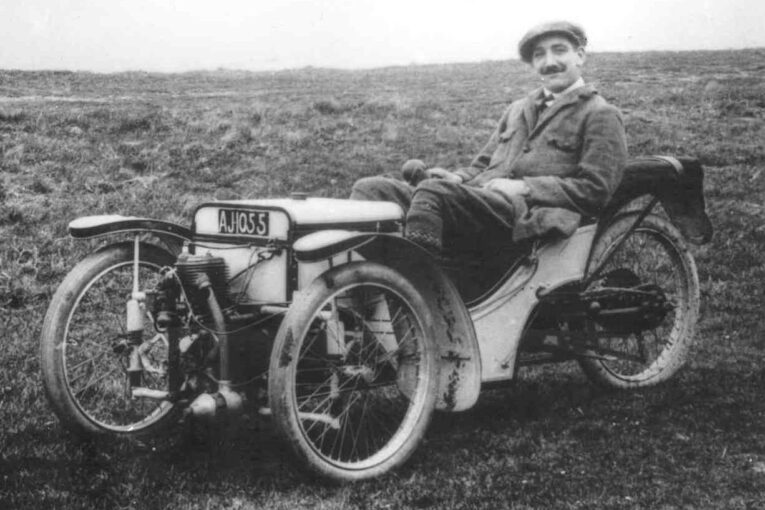
Much like the Runabout, the Morgan Motor Company itself is one of those great eccentricities of modern motoring. Founded in 1910, this is a story that really couldn’t have happened anywhere else other than in Edwardian Britain. It’s a story of stubborn, traditionalist, yet scrappy and innovative people indulging in a hobby on a grand scale. Those ethos are something Morgan has managed to hold onto for well over a century.
While today’s ash-framed, aluminium-bodied roadsters continue to dominate the company’s image, assembled in a clean yet incredibly traditional workspace – we’d recommend a Morgan Factory tour should you ever pop along to Malvern – the origins of the company date back to a man now immortalised as HFS.
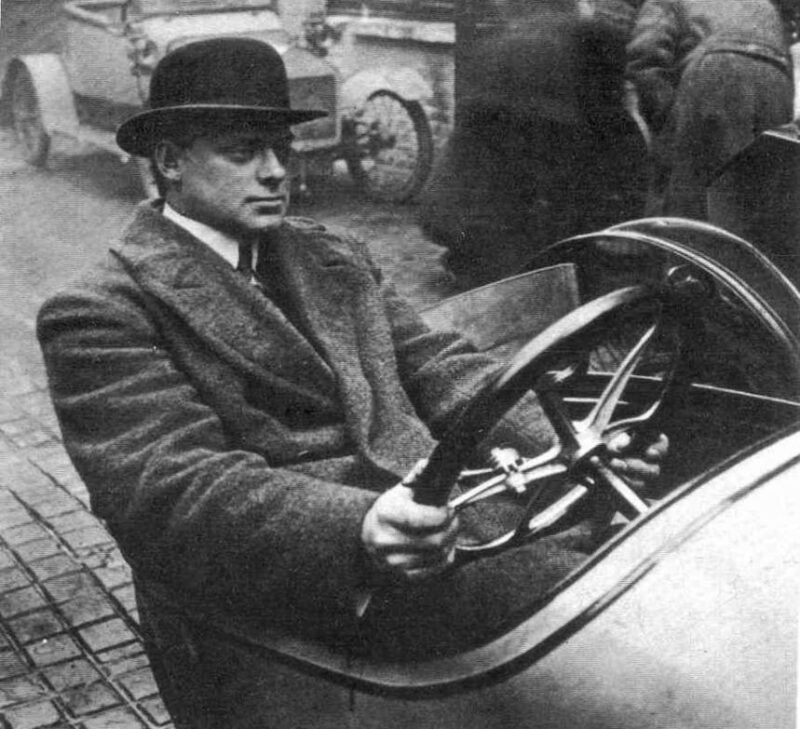
HFS Morgan at the wheel of a Sporting model Runabout, c.1913
Henry Frederick Stanley Morgan was an engineering apprentice for the Great Western Railway when he picked up the motoring bug, something that never really left him. In 1904, just as the motor car was beginning to sputter and pop its way across the country, he opted to quit his railway roots and get stuck into the new phenomenon.

 HFS Morgan driving the Runabout prototype outside Stoke Lacy rectory, June 1910
The Runabout was a three-wheeled single-seat cyclecar – and proved very fast on its feet too, which should sound like familiar territory regarding the Morgan name. HFS was so prone to over-engineering that he even gave it a coil-spring independent front suspension, something even mass car manufacturers were yet to offer in any great quantities.
1908’s Runabout may have carried a few likenesses to the modern Morgan trike, but put it in front of a modern driver today and they might be a little bewildered on where to start. Tiller-steered, and capable of reaching speeds of up to 50mph on the roads of Malvern Link, starting the thing was a fifteen-minute-or-more process, involving opening up the fuel tap, popping the engine a shot of oil, turning on the ignition, opening up the valve lifter…
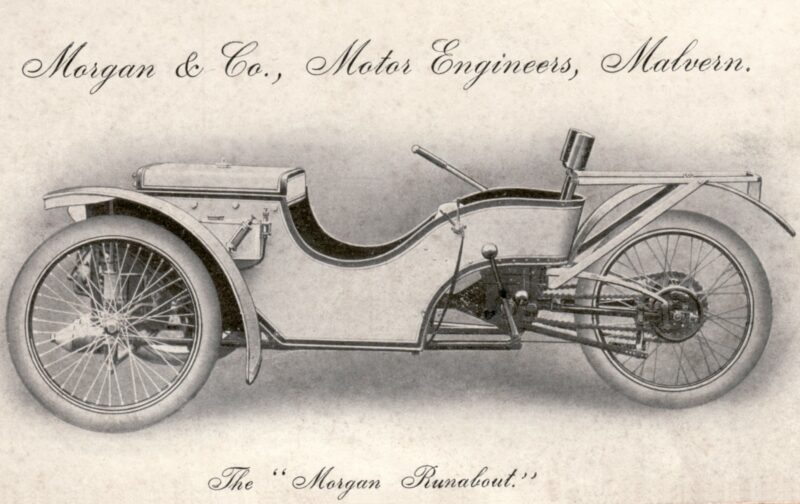
All of those rods and links made the little cyclecar resemble more of a framework than it did a fully-fledged motor, and even in its age would have looked like a curiously primitive machine. Cap it all off with an acetylene-powered headlamp and a boa-constrictor horn, and it’s little wonder it turned so many heads on the Edwardian Malvern hills, where people were expecting bluebells and tourers rather than eccentric Peugeot-powered speedsters.
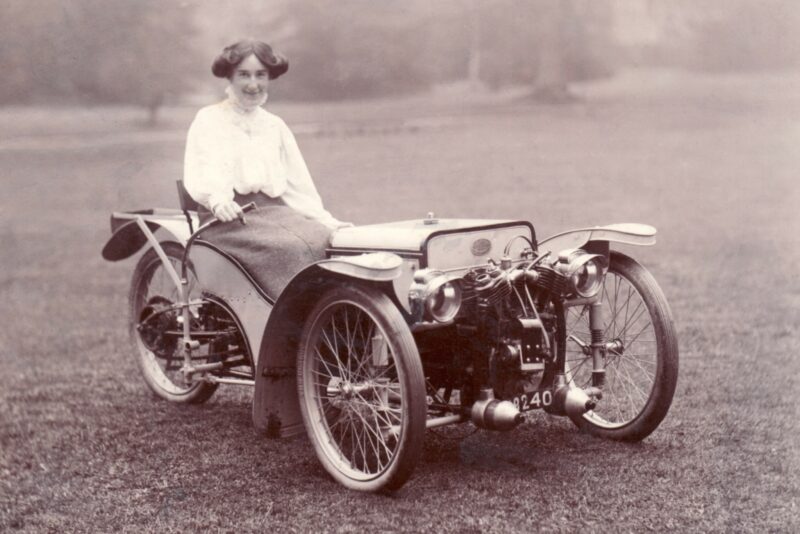
In those pioneering days, even with that arduous starting process, the Runabout seemed outright user-friendly, and to the curious well-to-do, also managed to be good, clean fun. The prototype gained a local rep for being remarkably easy to drive. Indeed, Dorothy Morgan – HFS’s sister – gained a name for driving it as readily as her brother, and soon became a professional competitor in the production model!
With a quick cash injection from his father, the evocatively named Prebendary George Morgan, HFS soon began a small production run of the Runabout – upgraded with some additional bodywork and a smaller JAP V-Twin engine. Things started slowly – from their debut at the 1910 Olympia Motor Show, they soon introduced a two-seater variant that would famously end up on display in Harrod’s Department store.
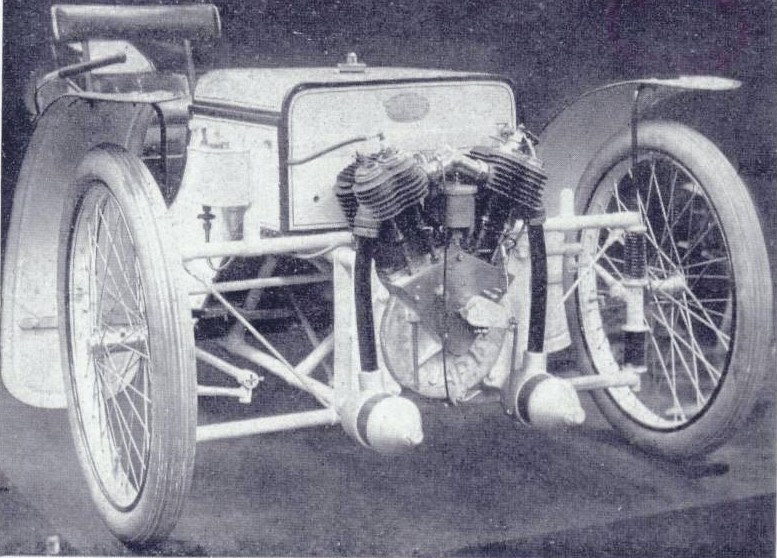 The 4hp, JAP-powered Runabout at the Olympia Show, November 1910
The Morgan Motor Company was finally registered as a private limited company in 1912, with HFS taking the managing director seat – while the still very evocatively named Prebendary became chairman. Things were heating up – but while we could go on for hours about the cars that followed, there’s no better way to end this story than turning back to the man himself’s exploits.
Having trained himself into quite the driver on his 1908 prototype, HFS became a bonafide motorsport master. Often with his wife alongside him, the eccentric engineer was soon a regular contender in his first production car.
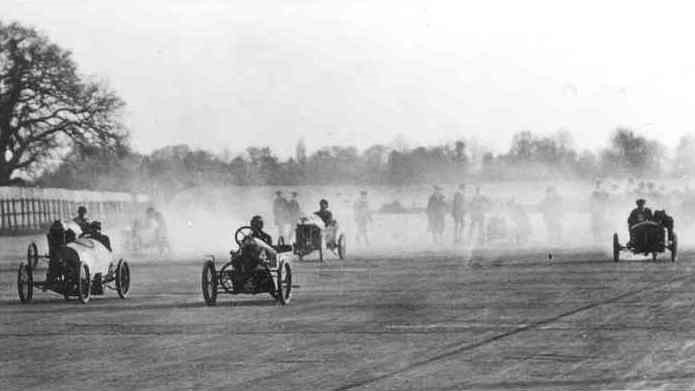
Cyclecar racing at Brooklands
1910 saw him fighting for the Light Car & Cyclecar Trophy for the longest distance travelled on the Brooklands circuit. That titchy little Morgan motor managed to cover 55 miles one year, and 60 the next. A few months later, he took on the first MCC London to Exeter winter trial and won gold. Then he was seen on the London to Edinburgh trial of April 1911, which saw him engaging in a speedy repair after hitting a wall. The man and his machines were rapidly becoming quite the celebrity.

It’s a bizarre image – a wealthy, motor-mania couple bounded into a little two-seater cyclecar, roaring along at 50mph on the old British network. But that bizarre imagery seems like a remarkable cornerstone of the Morgan Motor Company – a scrappy, yet sophisticated tale of stiff-upper-lip eccentricity.
While there are a few early Morgan Cyclecars out there, and we’ve got it on good authority they’re still a hell of a lot of fun, we’d probably recommend looking out for a more contemporary Morgan on Car & Classic – after all, fuel taps aren’t always what you want to fiddle with on a cold winter morning.
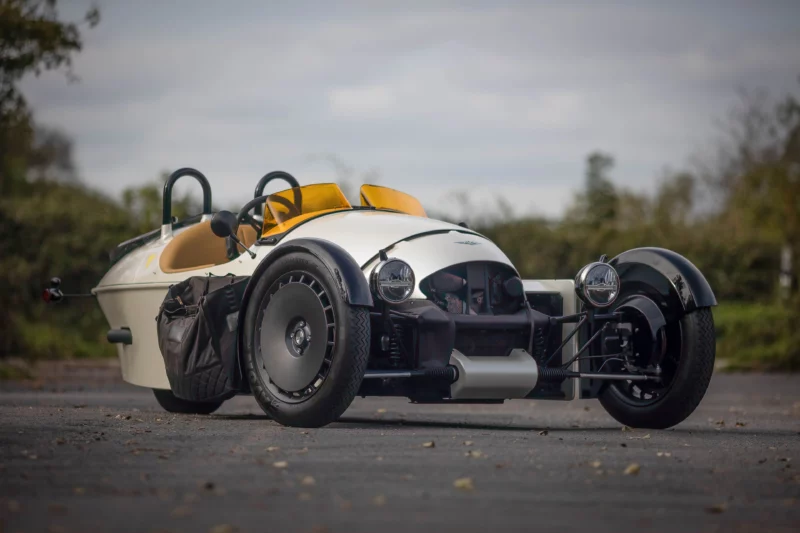
Even with all of that rod-and-lever handled madness confined to the past, you’ll still find much of that same character at the heart of, say, the current Super 3 (and yes, we do have one available) – quite how HFS would feel about a 130mph top speed, we may never know.
…Something tells me, though, that he’d be delighted.