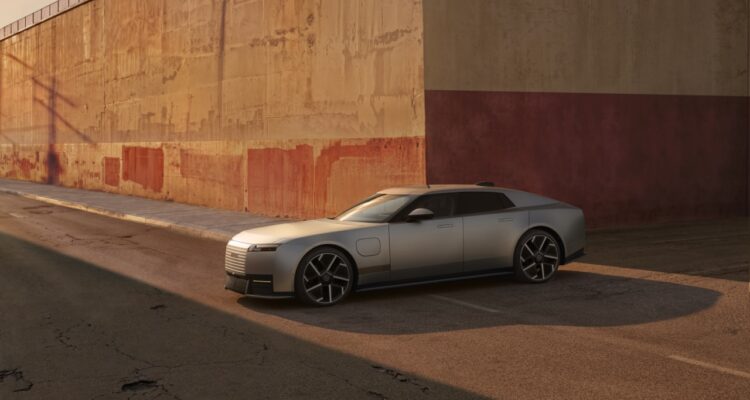
Fastest Cars in the World from 2000-2025

November 19, 2025
As the first quarter of the 21st century draws to a close, we take a look back at the cars that have defined the last 25 years; vehicles that have pushed the boundaries of performance to be crowned ‘the fastest cars in the world’.
We’re not talking about land speed record breakers with jet engines or top fuel dragsters; these are all road cars, with number plates that you can actually go out and buy.
So, why do manufacturers still pursue headline performance? You can only drive 70 miles per hour in the UK, and not much more than 80 in most of Europe, except on the de-restricted German Autobahns. Top-tier road cars have been able to go faster than that for over one hundred years!
But building the fastest car in the world is a way for enthusiasts to prove their engineering prowess. It’s also pretty satisfying to know that while you may be stuck in traffic, you’re driving the quickest car in the world. We’d liken it to buying a high-end dive watch. An Omega Seamaster 300 is capable of withstanding the pressures of diving 1,000 feet underwater, and yet most people who buy one are subjecting it to little more than the rigours of the local swimming pool. The same goes for owning a fast car; the satisfaction comes from knowing what it’s capable of, not what you do with it.
Without further ado, here are the fastest cars in the world from 2000 to 2025.
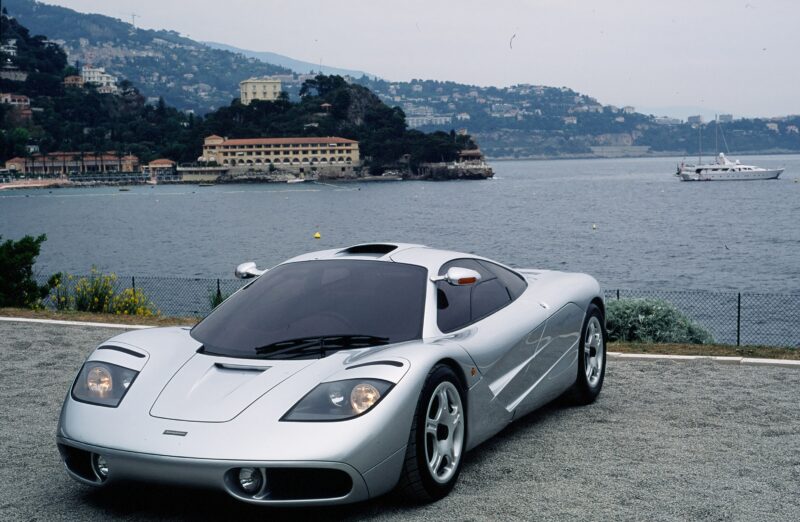
2000-2004 McLaren F1 – 240.1 mph (386.4 km/h)
The 200 mph barrier was first breached in 1927 by Henry Segrave driving the Sunbeam 1000 HP Mystery land speed record car. The first road car to achieve this was the Ferrari F40 in 1987; however, by the dawn of the millennium, manufacturers were chasing the 250-mile-per-hour mark, with the McLaren F1 leading the way.
Produced by McLaren from 1992 to 1998, the F1 boasted a unique three-abreast seating arrangement with a central driving position, providing optimal weight distribution, excellent visibility, and a driving experience inspired by the single-seater F1 cars that gave this special McLaren its name.
However, to understand what made the McLaren F1 the fastest car in the world for four years running, you have to take a peep under the bonnet where you’ll find BMW’s S70/2 6.1-litre naturally aspirated V12. 627 horsepower goes a long way in a car weighing in at just 1,138 kilograms. 0-60 mph is dispatched in just 3.2 seconds before accelerating away to its top speed of 240.1 mph.
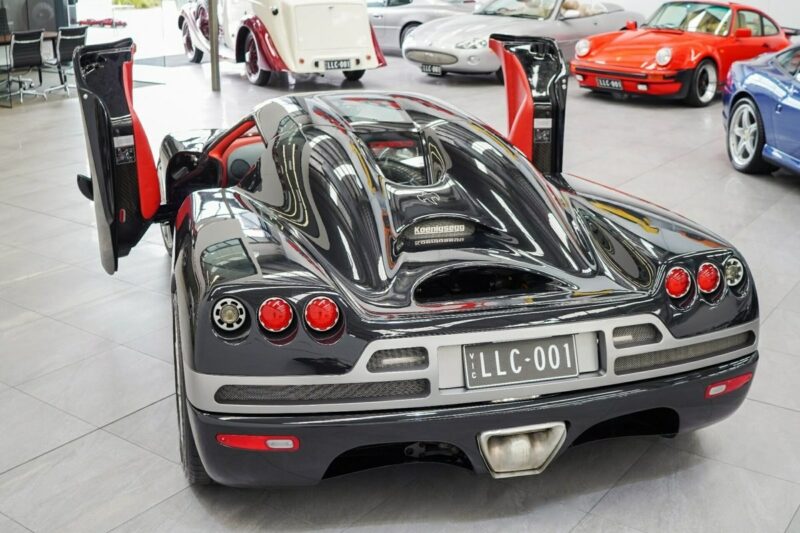
2005 Koenigsegg CCR – 241.01 mph (387.87 km/h)
Like Spinal Tap’s Marshall amplifiers that are “one louder”, the Koenigsegg CCR knocked the McLaren F1 off its pedestal to become the fastest car in the world by going one mile per hour faster on Italy’s Nardo test track. This was the car that put hitherto little-known Swedish firm Koenigsegg on the world stage.
Reviewers were wooed by the CCR’s raw performance and uncompromising handling. They were also stunned by its build quality, signature dihedral synchro-helix actuation doors, and the extensive use of carbon fibre. It made 806 hp from a supercharged 4.7-litre V8 engine; more than adequate to shift its diminutive kerb weight of just 1,230 kilograms.
Produced between 2004 and 2006, just fourteen CCRs were ever made.
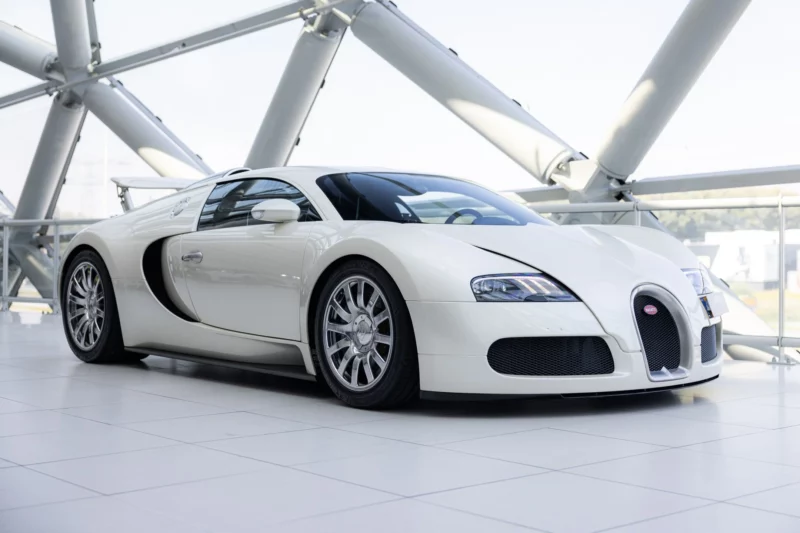
2005-2007 Bugatti Veyron 16.4 – 253.81 mph (408.47 km/h)
Undoubtedly the most well-known car to make this list, the Bugatti Veyron 16.4 became the fastest automobile in the world using a completely different approach to those that had gone before. The McLaren F1 and Koenigsegg CCR were raw, uncompromising hypercars, while the Veyron was a refined, quiet, comfortable grand tourer that just so happened to top out a an eye-watering 253.81 mph.
Designed under the late great Ferdinand Piëch, the 1,888-kilo Veyron was powered by an 8.0-litre quad-turbocharged 64-valve W16 engine producing 987 horsepower. It needed ten radiators to stay cool, a 7-speed dual-clutch automatic transmission specially developed by Ricardo, active aero, and a Haldex permanent four-wheel-drive system to transmit that immense performance to the road. The Veyron’s slippery monocoque was fashioned from super-light carbon fibre, while Michelin had to develop a brand new tyre to handle the immense rotational forces.
Top Gear proclaimed the Veyron its ‘Car Of The Year’ for 2005, with Jeremy Clarkson proclaiming it was “the greatest car we will ever see in our lifetime”. Twenty years on, it seems he could have been right.
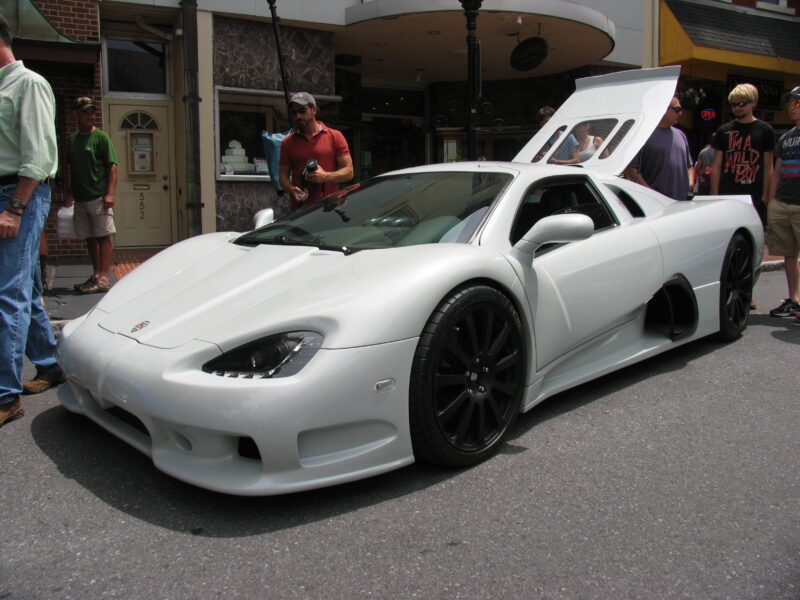
“SSC Ultimate Aero.jpg” by Jacob Frey 4A, is licensed under CC BY 2.0.
(Source: https://commons.wikimedia.org/wiki/File:SSC_Ultimate_Aero.jpg)
2007-2010 SSC Ultimate Aero TT – 256.14 mph (412.22 km/h)
While the Veyron would retain its title for two years, it was superseded as the world’s fastest car in 2007 by the SSC Ultimate Aero. This limited-production hypercar made 180 horsepower more than the Veyron with half the number of cylinders and romped on to a world-beating top speed of 256.14 mph.
SSC stands for Shelby Super Cars, although the American firm has no relation to Caroll Shelby’s eponymous speed shop. The Ultimate Aero TT made 1,180 horsepower from its twin-turbocharged 6.3-litre GM LS6 V8, which the driver controlled through an old-school six-speed manual gearbox. It weighed just 1,250 kilograms.
Just 24 examples of this incredible machine were ever made.
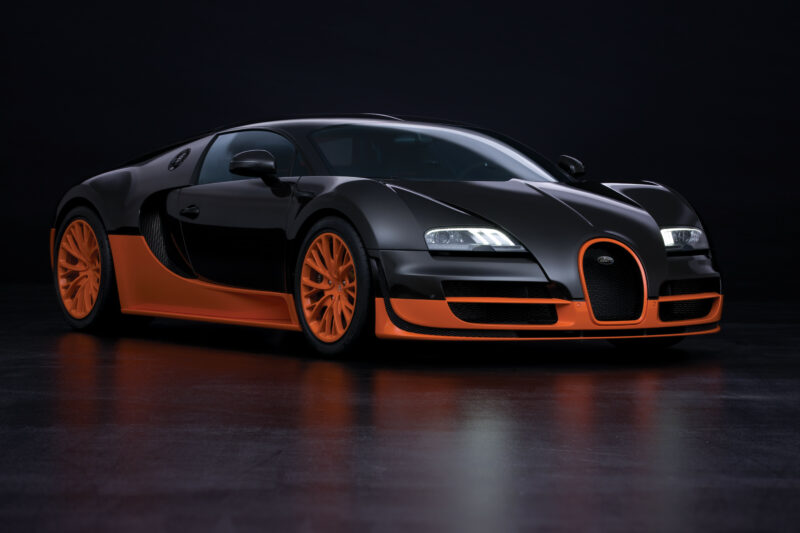
2010-2017 Bugatti Veyron Super Sport – 267.86 mph (431.07 km/h)
The Veyron may have been briefly usurped by the American SSC Ultimate Aero TT, but it was soon back in contention with the 1,184 horsepower Super Sport. Essentially a revised and slightly lighter (1,838 kg) and even more powerful version of the original 16.4, the Super Sport was seemingly developed for the sole purpose of reclaiming Bugatti’s title as the creator of the fastest car in the world.
An orange and black car set the record on June 26, 2010, at the Volkswagen Group’s Ehra-Lessien test track in Germany. A special ‘World Record Edition’ Super Sport was offered to celebrate the occasion, with a distinct exposed black carbon fiber and orange finish, identical to the car that set the land speed record.
Only 48 Bugatti Veyron 16.4 Super Sports were ultimately produced between 2010 and 2012, all of which were sold out before production even began in the autumn of 2010.
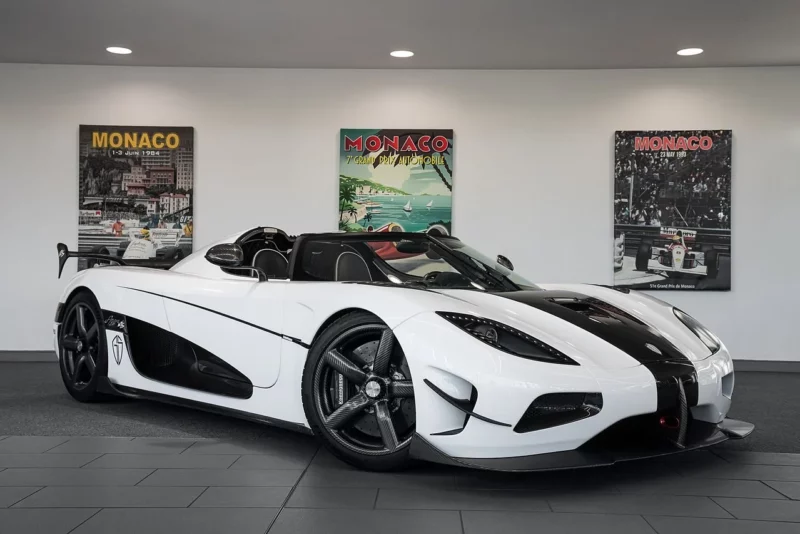
2017-2021 Koenigsegg Agera RS – 277.87 mph (447.19 km/h)
You didn’t think Koenigsegg was finished with the CCR, did you? For a second time, the Swedish firm used a V8 engine, now in 5.0-litre form, to depose the reigning world’s fastest car.
The Agera RS featured a lightweight carbon fibre chassis and wheels, along with a hydraulically actuated rear wing. It weighed a mere 1,395 kilograms and made 1,176 horsepower on regular pump petrol.
Reviewers found the Agera RS to be surprisingly civilised, in spite of its performance credentials. It had a hydraulic suspension lift system, climate control, and a digital audio system with Apple CarPlay. The Agera even had a detachable hard top. Anyone who’s ever owned a convertible of any sort will know they always feel faster with the roof down, so we can only imagine how unbelievably quick an open-topped Koenigsegg Agera RS must seem at those kinds of speeds.
25 examples were originally planned, but 27 Agera RS were ultimately built between 2015 and 2018.
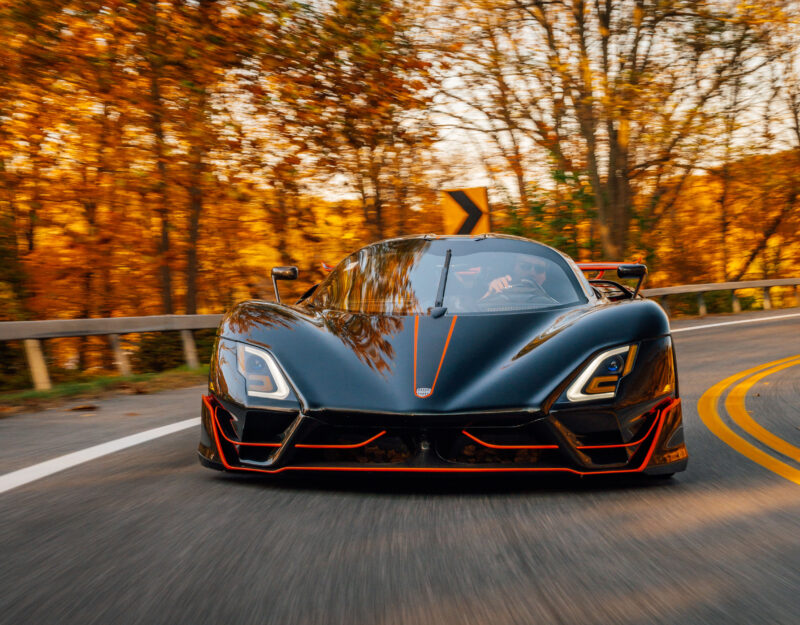
2021-2025 SSC Tuatara – 282 mph (455.3 km/h)
SSC revved up with the unashamedly-named Ultimate Aero TT, which came complete with Ford Focus headlights, but seriously found its feet with the Tuatara. Beautifully styled by Jason Castriota, the man behind the Ferrari 599 and Saab Aero-X, and with, wait for it, 1,750 horsepower from its 5.9-litre twin-turbo V8, the 1,247 kilo Tuatara is serious about speed.
Getting a car this quick and sophisticated into production has taken SSC time, and at times, more money than it had in the bank. But if you’ve got a little over £1.5 million to hand, you can now order one of the 100 road cars. Dig a little deeper, and you could bag one of the 25 track-focused Aggressor models.

2025 Yangwag U9 Xtreme – 308.33 mph (496.21 km/h)
Hypercars are all about statistics, and when it comes to the figures, nothing matches Yangwang’s U9 Xtreme. We’re in serious Top Trump clean-up territory here. This electric hypercar’s four motors each generate 734 horsepower to deliver a combined output of 2,937 horsepower, or 1,200 horsepower per tonne. Yes, really.
The Xtreme is the ultimate iteration of Chinese car maker BYD’s bid for global domination. It combines aerospace technology with a highly sophisticated platform that transmits power at maximum speed to the motors. Then there’s the active suspension, which is so complicated that we’ll just leave it at ‘wow.’
Just 30 will be built. Bag one and you’ll have the fastest car in the world, one that can lap the dreaded Nürburgring in under seven minutes. Yikes.
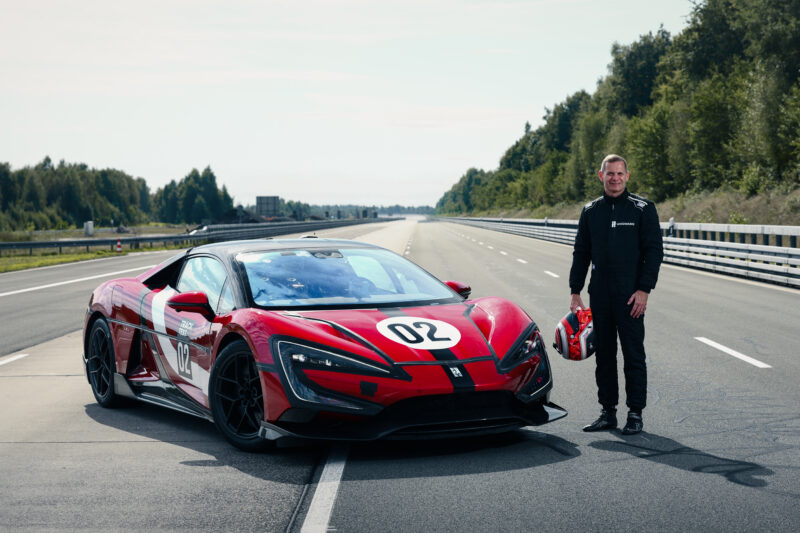
With the 300 mph mark breached for the first time by a hitherto little-known Chinese manufacturer, the West’s carmakers need to wake up to the fact that Chinese firms are doing much more than just catching up; they’re overtaking.
With the Yangwag U9 Xtreme, China now builds the fastest car in the world and, by default, the fastest electric car as well. It’s not just supercars either. Fastest sedan in the world? That’ll be Beijing’s 217 mph Xiaomi SU7 Ultra. For a mere £55,000, the Xiaomi SU7 Ultra is a four-door family saloon with a 1,548 horsepower tri-motor all-wheel-drive system. With such powerful EV powertrains already in their grasp, we’re sure it’s only a matter of time until China also builds the fastest SUV in the world too…
We wonder what the next 25 years will hold. Will an internal combustion engine ever feature in the world’s fastest car again?