Have You Ever Heard of – the Argyll GT?

November 1, 2024
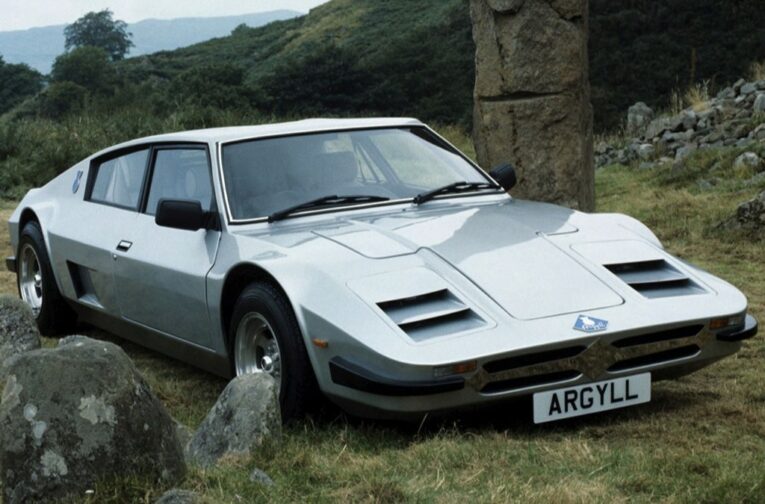
Your response to the news that there is a car called the Argyll GT likely falls into one of two camps. Perhaps you’re wondering why the designer of the triangular pattern so commonly applied to golfers’ jumpers decided to start making cars. Certainly, looking at the angular Argyll GT, you may sense a link. Alternatively, you may be fresh from your daily perusal of the Encyclopaedia of Automotive Manufacturers and be saying to yourself: “Goodness gracious, I never realised Britain’s biggest pre-war car manufacturer had started making cars again. In a Scottish laundry.”
There is a third option, of course. Which is that you already know, from the bare handful of articles written about the Argyll GT, that in the mid-1970s Bob Henderson, of early turbo-charging technology fame, conceived a four-seater GT to compete with the likes of the Ferrari 308 GT4, Lotus Esprit and Porsche 911, in that former laundry close to the shores of Loch Fyne in the Scottish Borders.
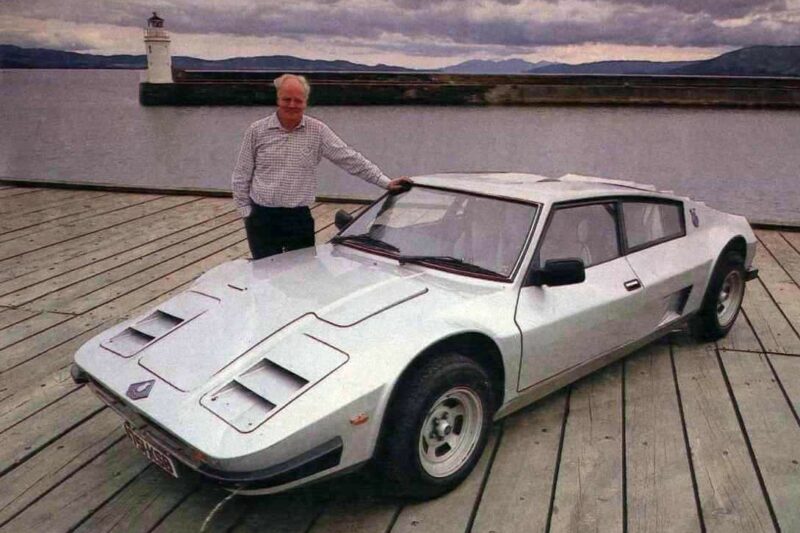
Bob Henderson standing proudly beside the Argyll GT
Bob was following a well-worn path. Before and since, plucky entrepreneurs and gifted engineers have tried to turn their ideas for new sports cars into reality. Some, like Colin Chapman and Lee Noble, have succeeded. Some, ok let’s be honest, a lot, haven’t. The world of motoring is richer for the valiant efforts of those behind cars like the DeLorean, Jensen SV-8 and Panther Solo, even if those involved certainly aren’t.
And yet, that success to failure ratio didn’t stop Bob Henderson. And rightly so. Before Saab pioneered the mass production of forced induction, in 1974 he wrote the bible on it, titled: “Theory and Practice of Turbocharging and Supercharging.” Known, quite rightly, as the Seer of Loch Gilp, where he lived most of his life, Henderson predicted in that book that turbocharging was the future of the petrol engine. You just have to look under the bonnet of any modern petrol car and you’ll see that he was right.
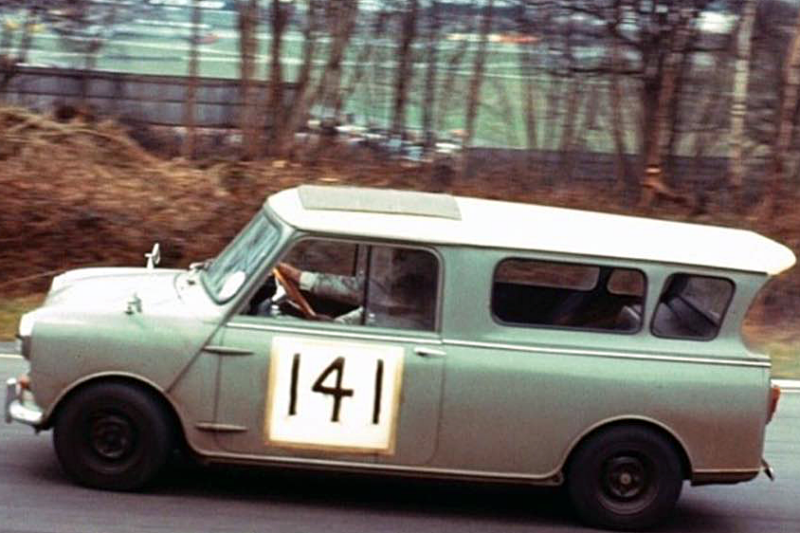
Bob thrashing his Minnow GT around Brands Hatch in ’64 (photo: Jeroen Booij archive)
His enthusiasm for turbocharging evolved from his experience running Minnow-Fish, his intriguingly-named carburettor company established in the 1950s. Minnow-Fish carburettors were hugely popular with home tuners and led Henderson to create the alliterative and Cooper-bating Minnow-Mini GT. In typical style, he based it on a Mini pick up rather than a saloon. Using only a single Minnow-Fish carburettor, the GT was as quick as a Cooper despite only having a 848cc engine. There was also a Minnow-Fish Avenger Highlander.
It was Bob’s interest in dialling up performance that naturally led him to turbos. His first steps were inauspicious, but perhaps typical of this leftfield thinker. He turbocharged an Austin Maxi. Next, more hopefully, he turbocharged a Saab 99. This was long before the Trollhattan Trolls did it.
Finally, in the mid-’70s, the stars aligned. Bob took his experience building that Mini GT and Avenger Highlander and his knowledge of turbos, and conceived what became the Argyll GT. The name, either inadvertently or deliberately, rejuvenated one of Britain’s long-lost pre-war marques. Or it was a homage to the rally stages and countryside around his home. Or perhaps we’re back in patterned jumper territory.
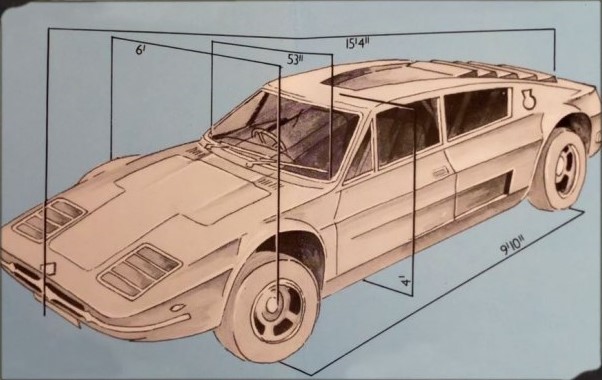
Whatever the case, it doesn’t really matter. The Argyll GT would amalgamate all the stuff Bob had learnt in a car quite unlike anything else on the market. Wherever possible, everything would be developed and designed in-house. The angular styling clothed a complex ‘bird cage’ chassis and clever independent suspension set-up intended to deliver near-perfect 50:50 weight distribution. Bob created most of it in the laundry, with only some components like the subframes bought off the shelf.
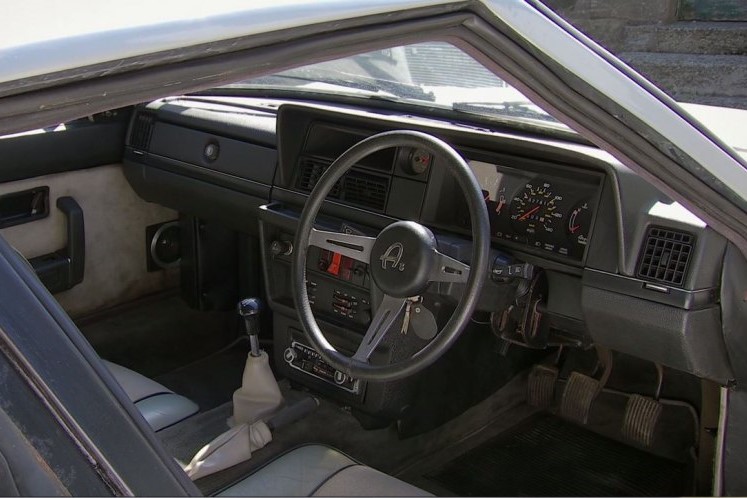
The shape was both unusual and audacious, with typically creative detailing. The shovel nose housed fixed louvered headlights while at the back there was an ‘optical trough’ – not unlike the one on a Lancia Gamma – to improve rear visibility. The lightweight fibreglass bodyshell kept weight down. It housed a spacious 2+2 cabin, which in later versions could be trimmed by Avon Coachworks in sumptuous Scottish leather (of course). When it came to the engine, the choice was extensive. Initial plans were built around a V6, but this evolved to include Lancia Beta engines and, of course, the Rover V8, in forced induction or naturally aspirated configurations.
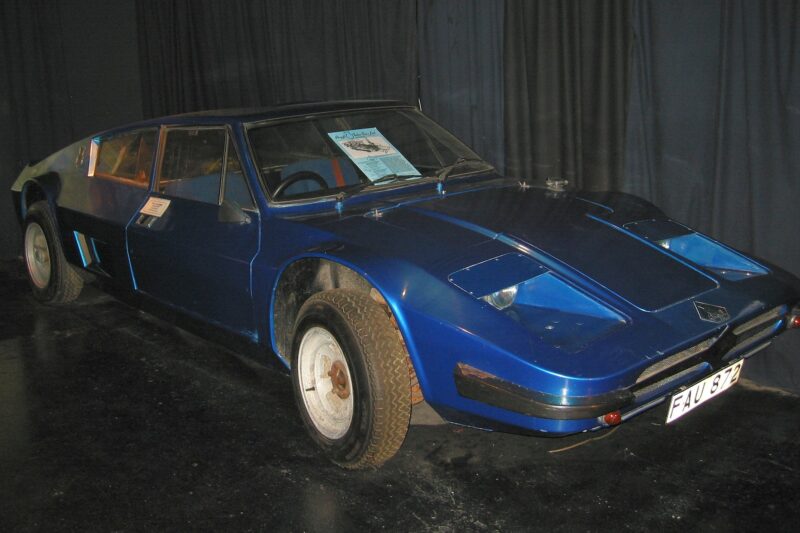
All this thinking and planning by one man in a laundry took a long time. The car was finally unveiled in October 1983. Not, as you might imagine, in London or Birmingham or perhaps even Geneva. But at Inverary Castle. Prices were set at £25,000 to £30,000 (£100,000 today). Significantly more than those Lotus, Ferrari and Porsche competitors, but then just 12 would be built each year. This was an exclusive product. Standard cars would use a blueprinted and turbocharged Douvrin V6 but buyers could pick from other engine options and trim their cars to their exact tastes.
The handful of reviewers who trekked up to Inverary Castle liked what they saw. They engaged with the plucky back story. They liked the innovation. They found the Argyll drove surprisingly well, with decent handling and a very pliant ride for such a sporting car. They were less enamoured with the price and the build quality, which felt more ‘Scottish laundry’ than Maranello coachworks. Probably because it was.
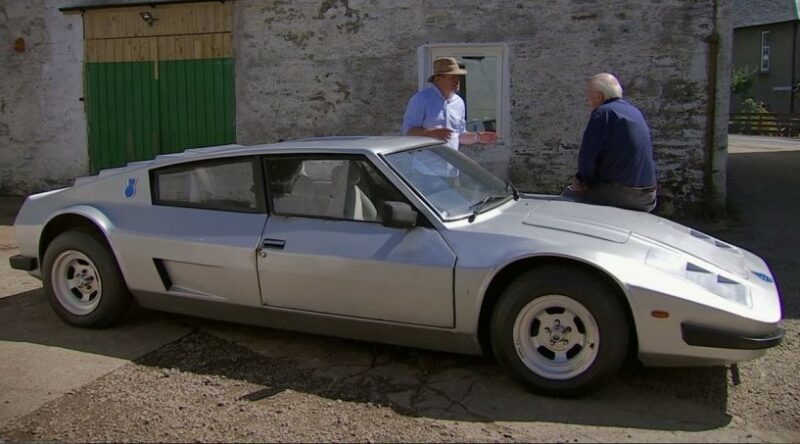
Nevertheless, the project rumbled on into the early 1990s, a trickle of cars apparently reaching customers with a variety of engines. The sense of Bob being a man always tinkering and improving, never quite happy with how things were, pervades the whole Argyll GT story. In recent years there were efforts to rejuvenate the entire project but nobody knows how many or if any Argylls ever reached customers. There are several photos of different coloured Argylls but they could easily be the same one. At least one car does exist. Bob Henderson, who sadly passed away in 2022, was always happy to chat but remained tight-lipped about production numbers. Such is the lack of information around the car that, if any did reach customers, their current or previous owners don’t talk much about it.
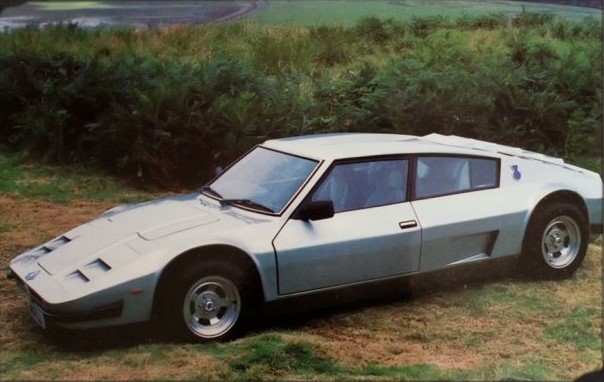
Ultimately, the Argyll GT is about one man’s pluck, ingenuity and vision. That it didn’t set the world on fire is irrelevant. That it existed at all, is. This is not the story of a patterned jumper, a pre-war car brand or even a failed GT, it’s the story of Bob Henderson, the Minnow maker, the Seer of Loch Gilp. RIP.