• Previously subject to a restoration • Beautiful interior • It is said to be one of only 4 from 1930 known to still exist. • Clutch recently rectified
Background
The Morris Isis was announced in the July of 1929 at the price of £385, it was an evolution of the previous Morris Six JA Series and borrowed the same engine and 3 speed gearbox. The cars body was all new however, borrowing from an American design to give it a look of a car from across the pond quite a popular style at the time.
William Morris went into partnership with the Budd Corporation from Philadelphia USA to produce pressed steel bodies in Morris’ Cowley plant. The Pressed Steel Company of Great Britain as it was now named acquired the patents to Budd’s rights and processes for use in the UK and they started with the Isis. The Isis shared its looks with Dodge cars of the same period over in America. This made the Isis appealing to two markets and thus it become an export success.
When released in 1929 it was the first Morris to use hydraulic brakes a fairly new and expensive technology to implement. The 2.5l engine could produce a mind bending 18hp and propel the Isis to 65mph whilst also returning around 28 miles per gallon. After a six-year production run the first-generation Isis came to an end after 7,206 units were made. The name would be revived in the 1950’s.VF2V3Z61FfgimMZLiqfB32VOZrO9jPrCZldW4DvF.jpeg2.29 MB
The History
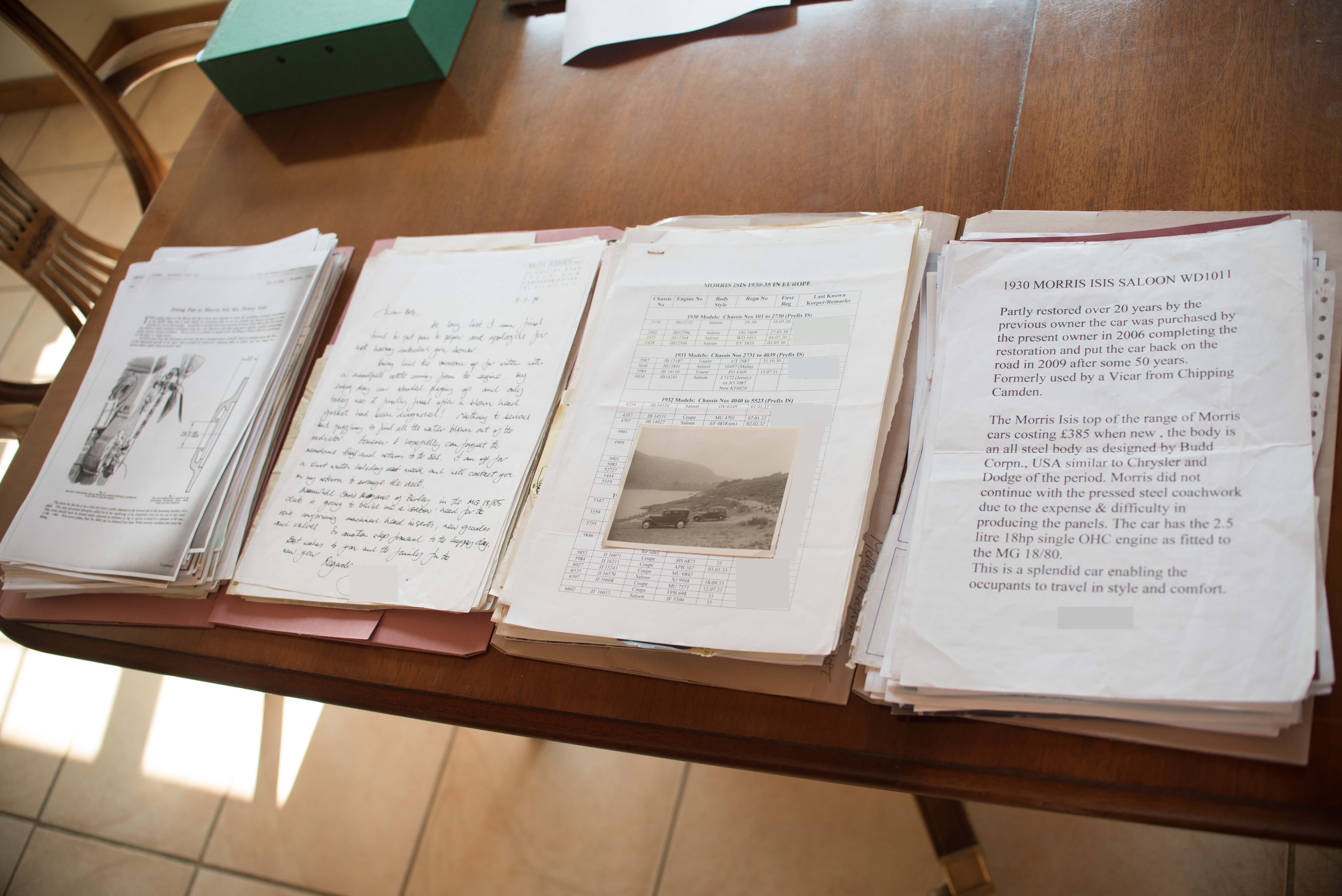
Registered on the 1st of July 1930 this is only one of four examples of this year that are still known to exist (this is documented within the raft of paperwork).
This car has led a long and loved life so far, with previous owners from all over the British Isles. There are letters that point to the car being in North of England for the first part of its life before being sold on to various other owners. There is even an original picture of this car sitting on the shores of West Water in around 1960.
For a period of time it was in the ownership of a Vicar from Chipping Camden. After they parted ways it started its long restoration period. The process started in around 1980 by one of the previous owners until it was sold in 2006 at around 75% complete to Bev Hicks (a well renowned Morris enthusiast) who completed the restoration and passed it on with only minor work left to complete. The current owner acquired the car at the end of 2020.Rj5EXDF61gj5EzkVWRibHIr2tnU67xcMzNxUSOGs.jpeg1.14 MB
The Paperwork
This Morris comes with a wealth of paperwork, from its original manual from 1930 to photocopies of workshop manuals. You are able to learn a lot about the previous works done on the car with many receipts and invoices for work done in the past.
It appears that many of the previous owners have been Morris enthusiasts and members of the Morris Register, with being members of this car club this car has benefitted from the collective knowledge of many people and with this it also brings the bonus of being able to obtain parts for this car you wouldn’t be able to get over the counter in modern parts shop.3ncl9KVoYQvzMyn4Ru8dkkpJeZtMmEz6MfNLQTOB.jpeg964.97 KB
The Interior
Finished in beautiful oxblood red leather, matching carpets and period dials the interior of this classic is somewhere special to enjoy a drive in. Thanks to the restoration that has taken place all the seats are in really good condition and a lovely place to sit.
With the car being as old as it is you can imagine that there would be a few niggles on the inside. One issue is that the cigar lighters in the rear of the car haven’t been operation in the current ownership and there is also a missing interior door handle on the rear nearside door. And finally, the Calorimeter (temperature gauge) that sits atop the front grill works, however it may not be totally accurate.
A few quirky classic features of this car within the interior include the starter button being on the floor making it foot operated. Also, because this car was built in 1930, they hadn’t quite sorted out the pedal arrangement, so the throttle pedal is in the middle and the brake pedal on the right.uBFNcuiaYWfnk7ejBw8eUbhHRvdX3XjHm1iWh9Qn.jpeg1.18 MB
The Exterior
The exterior of this Morris is in remarkable condition which is due to the restoration it has received. The two-tone paint is in good condition and has been done to a high standard. The wire wheels really make this classic stand out from the crowd allowing it to look even more period, there are images from the past which show the car was one different wheels, but these wire wheels look really good.
There are a few points on the exterior thought where there have been some repairs, some good some not so good. The most obvious issues are the fact that someone has badly colour matched a paint repair on the rear of the car and there are a few cracks within the paint on one of the front wings and one of the rear wheel arches. You will also see a repair patch on the offside passenger front wing.
One of the most period features of the car is the big trunk on the rear deck of the car. There is paperwork that comes with the car that would suggest that when new these case would’ve cost £13.10.0 with two inner cases or £16.10.0 for a trunk with three inner cases. s9GwQ63e5dx0xdB3Alv9DTlXk8hUKflHSp6MoiXd.jpeg2.37 MB
The Mechanics
This Morris starts on the button with no complaints, which would indicate that this pre-war car has been looked after very well throughout its long life.
When you look under the bonnet you will not find a fuel pump, as these hadn’t yet been implemented in 1930, what you will find however is a well looked after Auto-Vac which pulls the fuel from the tank from a vacuum produced by the engine.
Horace the Morris is one to behold. The lengthy restoration period coupled with the extensive history file makes him a well looked after example. One thing that helps prove the kind of work this Morris has received it was exhibited at the 2011 Classic Car Show.
Also, with this Morris being one of only 4 examples known to still be on the roads you can almost be sure that you will not see another one in the wild. This is from a time where motoring was still in its infancy, but you cannot tell this, it was truly a luxury car of its time, with a full leather interior, cigar lighters, and a powerful 18hp engine.
With thanks to the restoration that this car has been through it is now an exceptional example of a now rare car. Horace the Morris is a true head turner that will never fail to impress at a show, historic rally or in a car park.
Notice to bidders
Although every care is taken to ensure this listing is as factual and transparent as possible, all details within the listing are subject to the information provided to us by the seller. Car & Classic does not take responsibility for any information missing from the listing. Please ensure you are satisfied with the vehicle description and all information provided before placing a bid.
As is normal for most auctions, this vehicle is sold as seen, and therefore the Sale of Goods Act 1979 does not apply. All bids are legally binding once placed. Any winning bidder who withdraws from a sale, is subject to our bidders fee charge. Please see our FAQs and T&C's for further information. Viewings of vehicles are encouraged, but entirely at the seller's discretion.
Please see our FAQ's here and our Terms & Conditions here