1938 SS Jaguar 100

May 30, 2025
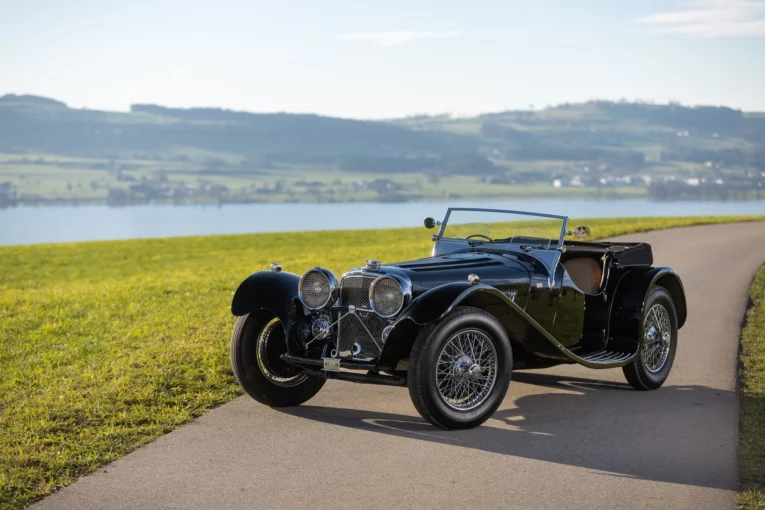
The arrival of a Jaguar SS100 on our classic car auction platform this week has got us all a-flutter. For any other car maker, creating something as beautiful as the Jaguar SS100 would have been enough. Not for William Lyons. There were beautiful saloons before, but it was with the gorgeous SS100 that he hit his stride. It kick-started a run of superb coupes, convertibles, and saloons, including the E-Type, XKs, XJs, and Mk2.
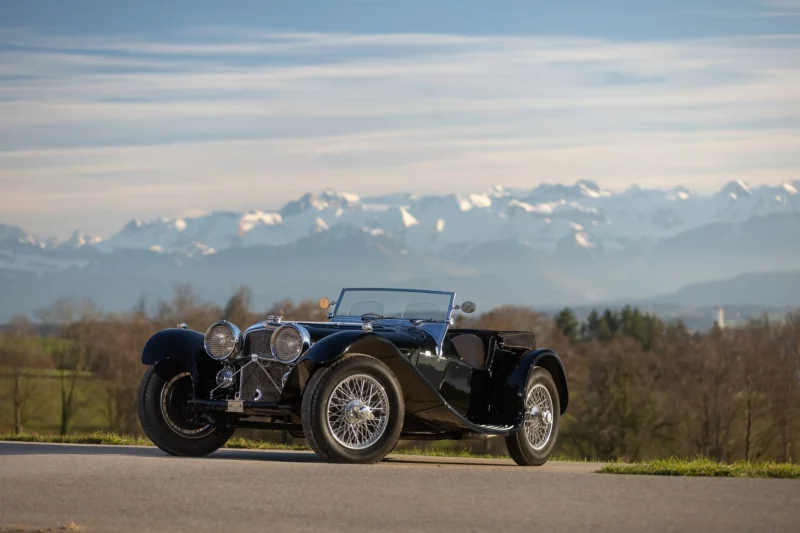
The SS100 is, of course, beautiful. To many, one of the best-looking pre-war sports cars. But it is much more than that, because it is in the development of this car that a coterie of motoring enthusiasts began to hone their skills. It gave us the first signs of the genius of William Lyons, Harry Westlake and William Heynes, three men who were crucial to creating some of post-war Britain’s engineering and motoring greats.
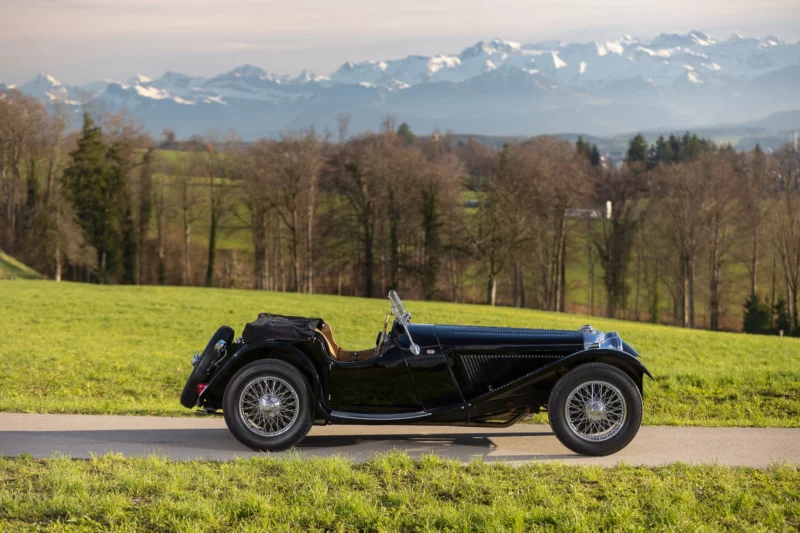
Lets start, however, with those looks. What makes the SS100 so good is its carefully wrought proportions: look at the photographs of this SS100 1938 2.7L auction car and you’ll see what we mean. It is surprisingly low for its era, a fact that is further emphasised by the long, flowing wings. This car is a paean to Lyons’ great eye for detail. In his pursuit of perfection, in later years, he would demand that prototypes be placed on the gravel drive outside his Coventry home. This was so that he could see them in the real world, rather than against a sterile design workshop backdrop. That skill began here, before evolving and crystallising with masterpieces like that list of post-war icons.
The car has become known as the Jaguar SS100 in line with Lyons’ post-war branding. Pre-war, the firm was called Swallow Sidecars, suitably abbreviated to ‘SS’. ‘Jaguar’ was a sub-brand, and 100 used to denote the specific model. The Second World War required a radical rethink, resulting in Jaguar as the company name. So, technically, this is an SS Jaguar 100. We’ll use SS100 for simplicity.
The SS100 evolved from the earlier 90, both cars based on a shortened version of the firm’s 2.5-litre saloon. It featured a Standard engine, but one that had been heavily reworked by two illustrious names – William Heynes and Harry Westlake. They would continue to work with Lyons for decades, producing two of the post-war era’s greatest engines – the Jaguar XK straight and later V12.
The car’s name is also a typically Lyonsian flourish, one that he would revisit for the XK120, 140 and 150. It refers to the claimed top speed and, as with those post-war cars, it was more theoretical than actual in the case of the original 2.7L production SS100.
When it was launched in 1936, the SS100 was an instant hit. But Swallow was a small, Blackpool-based business, and production ran at a trickle. Over three years, before the outbreak of war in 1939, just 198 2.7L cars were built, with just 116 of the later 3.5L cars leaving the works.
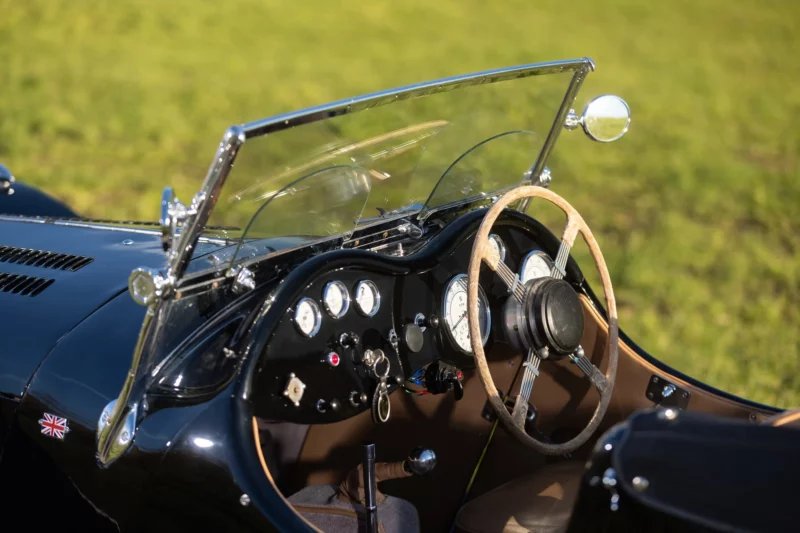
‘Our’ car was built in June 1938 and is one of the earlier 2.7L models. It was quickly despatched to Henly’s of London, where it met its first keeper. It was originally grey, which feels like a suitably understated colour for a beautiful car that needs no help to stand out.
In the early 1980s, it emerged in Arkansas before moving to Arizona. It returned to the UK in 1988, when a comprehensive three-year restoration began, resulting in the current black finish.
The previous keeper, a Swiss collector, bought the car in June 1991 with 12,237 miles on the odometer. It was relocated to Switzerland and used sparingly over the next 30 years for short local journeys. During this time, it covered just 2,353 miles. Despite the limited use, maintenance records show extensive investment, including 27,700 CHF and an invoice for £1,983.
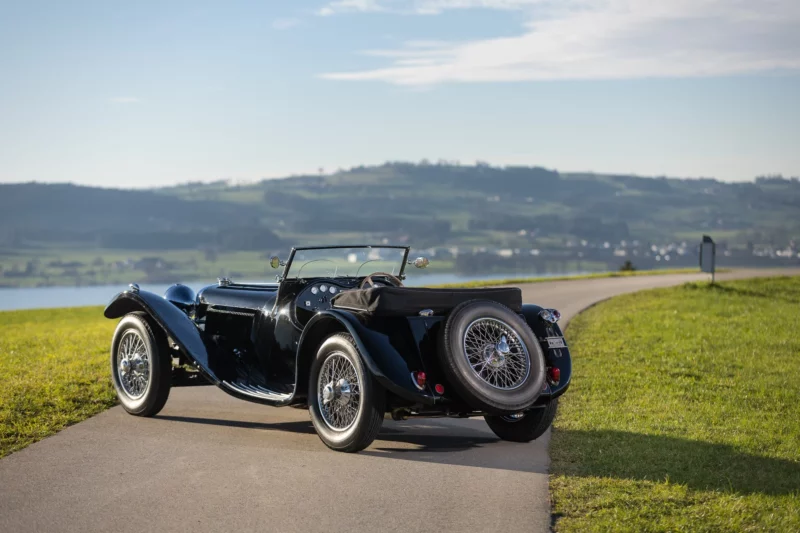
The car comes to market with a lovely, light patina resulting from its older restoration. It carries Swiss Veteranen Prufung technical inspection valid to 2027.
The SS100 is like an early work by a brilliant artist. Or, three – Lyons, Heynes and Westlake. It displays their genius and its success made their future contributions possible.
This is a car with timeless appeal. It is where the ‘grace’ and ‘pace’ parts of Jaguar’s famous motto cemented in. Even in the beautiful landscape of our photographs, this car stands out. You can find out more about the arrival of this SS Jaguar 100 on our classic car auction platform here.