Mercedes-Benz 450 SLC 5.0 – The Forgotten Group 4 Rally Legend

February 2, 2026
Think ’70s Group 4 rallying and cars like the Lancia Stratos, Ford Escort RS1800, and Fiat 131 Abarth are probably those that come to mind. One car we’d bet you don’t think of is a Mercedes SL grand touring coupé with an automatic gearbox. Nevertheless, the SLC did rally, and, moreover, it won.
Our Mercedes-Benz 450 SLC 5.0 Homologation C107 Auction Car of the Week is a chance to remember an unusual episode from Mercedes’ history that suggests the Stuttgart bods weren’t quite as uptight and staid as we imagine in the 1970s.
It seems unlikely that the Mercedes-Benz engineering team worked under any form of chemical enhancement, but that’s definitely the impression you get when considering the unlikely story of the firm’s bid for late ‘70s World Rally Championship success, using its big C107 grand tourer.
By the late 1970s, Mercedes-Benz had unfinished business in international rallying. The W123 240D had proven indestructible rather than fast, while earlier forays had hinted at potential but failed to deliver silverware. Rallying was an itch still needing scratched, and one that Mercedes, as the maker of what it perceived to be the world’s best cars, had to pacify.
To achieve this, Mercedes had to think differently. While Ford, Fiat and Opel aimed for nimbleness and lightness on the world’s gravel stages, Mercedes chose a different approach. This was mostly due to circumstances: thanks to those dedicated engineering teams and their over-engineering, no Mercedes was known for being light. But where it could outplay those Escorts, 131 Abarths and Mantas was in durability, because any Mercedes was reliable, rugged and tough, again thanks to those overworked engineers.
The C107 was chosen because, from an unlikely range of Mercedes rallying candidates, it was the most obvious choice. The rally team took the 450 SLC as its base, utilising the lightweight M117 V8 engine, and lightly developing the car with roll cage, skid plates and extra lights to compete in the gruelling 30,000km Vuelta A La America De La Sud. We can only imagine the sly looks of its rivals on the starting grid, particularly when they spotted the automatic gearbox. Piloted by Andrew Cowan, who would go on to drive for Mitsubishi’s Ralliart team, it won.
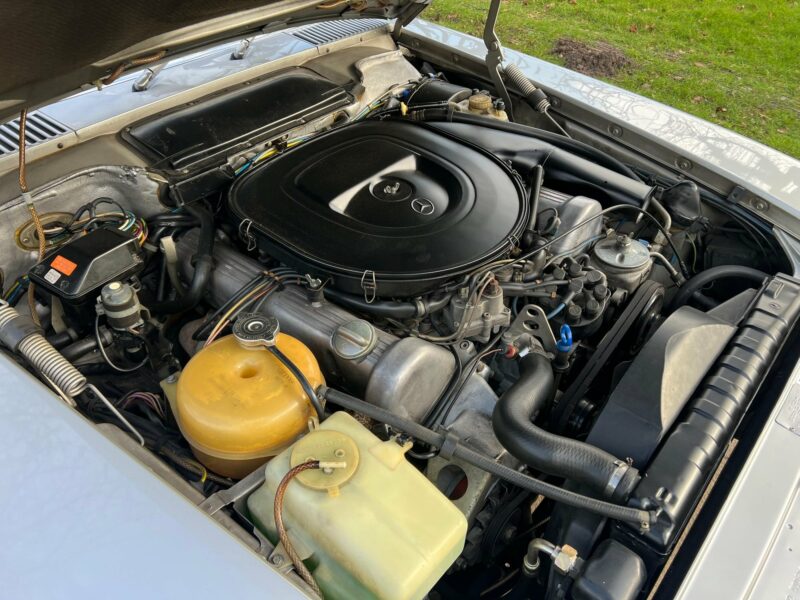
Spurred on by this success, Mercedes’ rally team began to think bigger. They conceived a more fully developed version of the 450 SLC that would be capable of competing in the World Rally Championship. The car would ‘add lightness’ by using an aluminium bonnet, boot lid, and bumpers to save around 125lb and add power by boring out the M117 engine to 4,973cc, in the process hiking performance to between 290bhp and 310bhp.
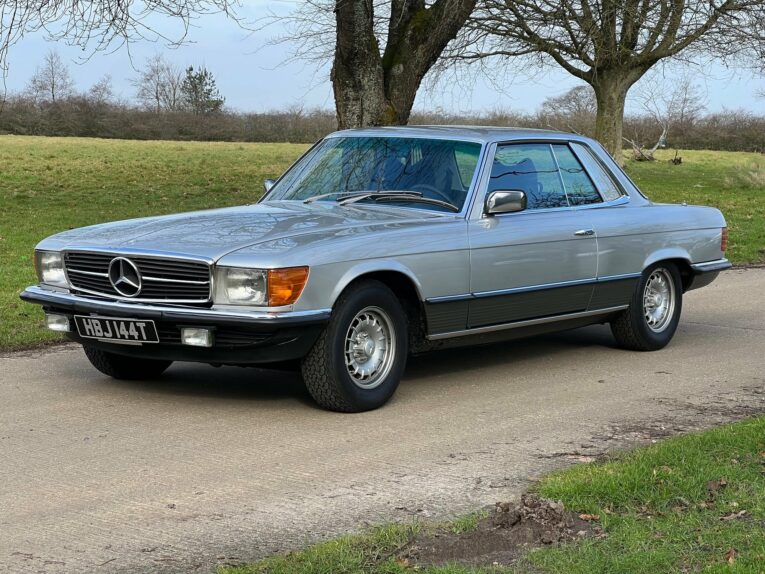
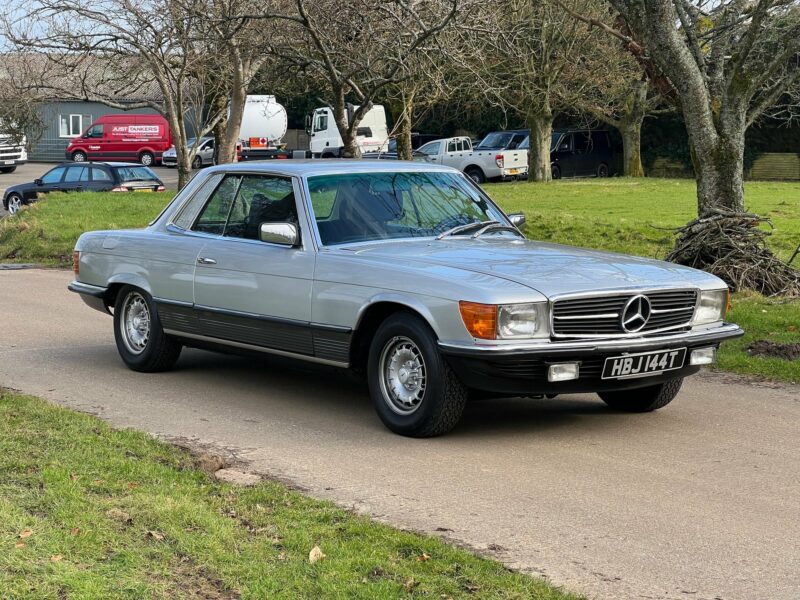
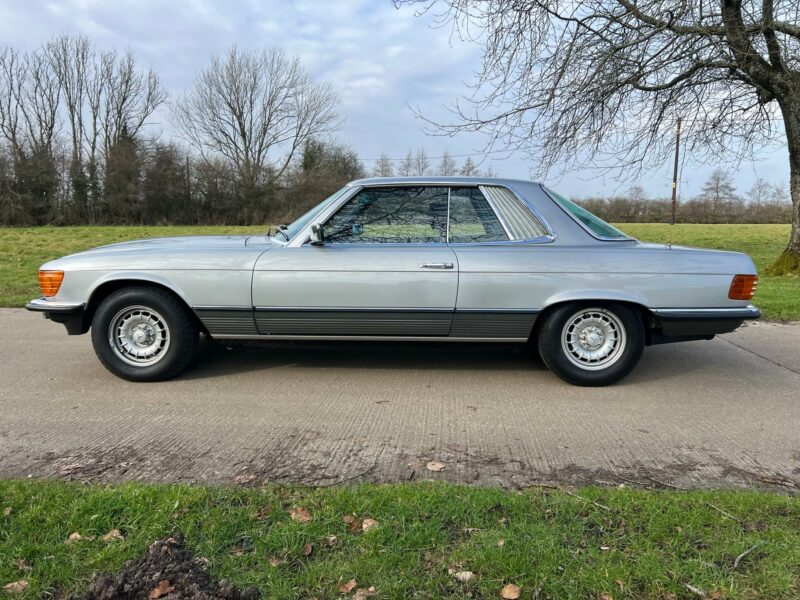
These significant changes would require FIA homologation, which meant producing a limited run of road cars. Which brings us to this 1979 auction car, one of just 1,673 built for the road to satisfy those FIA rules. The road cars got a 5,025cc version of the M117 engine, detuned to 240bhp, but were otherwise similar to the rally cars in using the aluminium bodywork. They can be easily identified by the two-tone body colouring, including the darker lower sections, front and rear lip spoilers and bespoke ‘Mexican Hat’ alloys with larger rims.
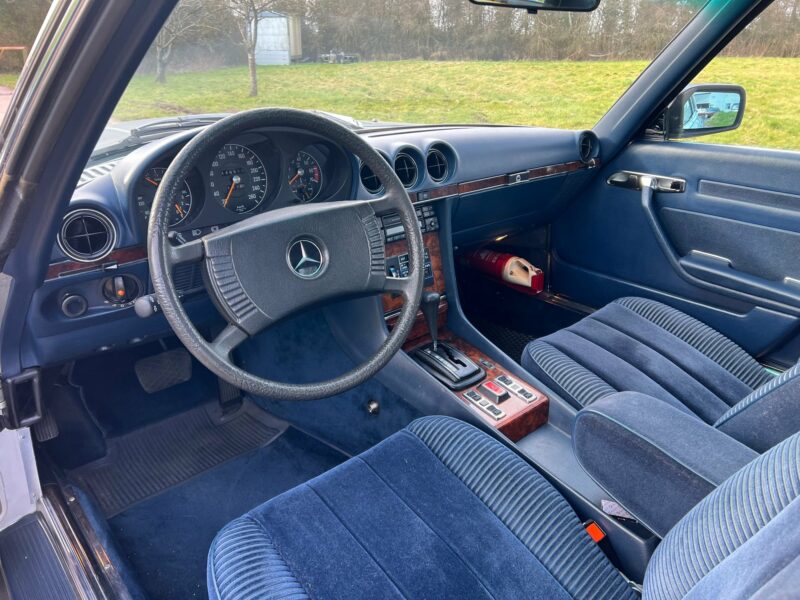
This example, of a handful of survivors, spent much of its life in Zurich before joining the current keeper’s collection. It is in really good condition, the sumptuous blue velour cabin being a particular treat.
With homologation sorted, the 450SL 5L was entered into WRC events, driven by illustrious names like Hannu Mikkola. On the stages, the big coupé quickly silenced the doubters. At a time when rallying was increasingly dominated by lighter, more agile machinery, the 450 SLC 5.0 relied on relentless consistency. Its greatest triumph came in the 1979 Bandama Rally in Côte d’Ivoire, one of the most punishing events on the calendar. Mikkola took the 450 SLC to victory while Bjorn Waldegard, another of the four 450 SLC factory entries, delivered second outright. Proof, if any were needed, of the car’s toughness and the team’s preparation. It would be the first time an automatic secured WRC victory. And quite possibly the last.
Success continued with wins in the 1980 Bandama and strong results in long-distance rallies such as the Safari and the South American events. The SLC wasn’t a flamboyant winner, but its reliability tended to ground the opposition down. Where others broke suspension, overheated or simply disintegrated, the Mercedes just kept going, its V8 thumping away as unflustered as ever.
On the road today, the 450 SLC 5.0 remains a fascinating contradiction. It’s large, comfortable and effortless, yet carries a genuine competition pedigree that few luxury coupés can claim. Values have risen as collectors have cottoned on, but it still feels underappreciated compared with more obvious homologation heroes. Perhaps that’s fitting. This was never a car that shouted about its abilities.
Instead, the C107 450 SLC 5.0 represents a uniquely Mercedes approach to motorsport: engineer it properly, build it to last, and let the results do the talking. In an era of fragile, highly strung rally specials, it stood apart – a heavyweight bruiser that won by refusing to give up. For those who know, that makes it one of the most interesting and authentic homologation cars of its time.
You can find out more about Car & Classic’s own Mercedes C107 450 SLC 5.0 Homologation auction car here.