Bugatti Veyron Turns Twenty

September 10, 2025
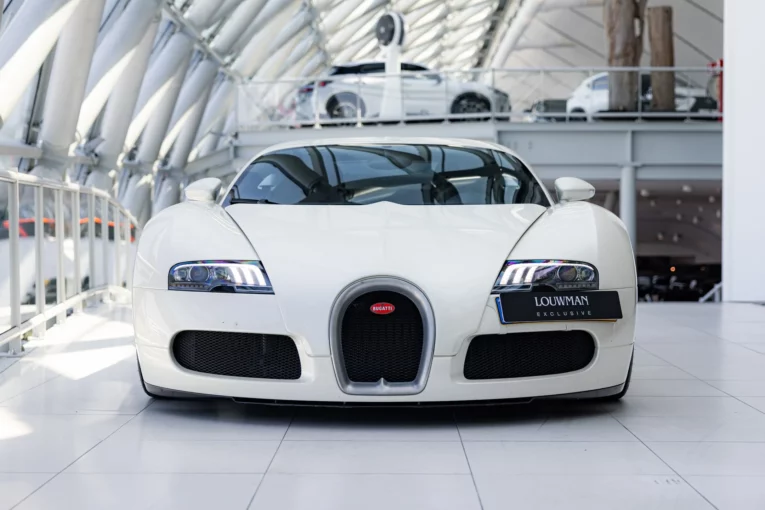
September 2025 marks twenty years of the Bugatti Veyron – the crowning glory of Ferdinand Piëch’s illustrious career and a return to form for one of the most exclusive automobile manufacturers of all time. We take a look back at the history of this esteemed marque and examine a very special Veyron that’s live on Car & Classic Auctions this week.
“If comparable, it is no longer Bugatti.”
Ettore Bugatti was not the sort of man to compromise. He regarded engineering as an art form and accepted nothing short of perfection in everything he put his name to.
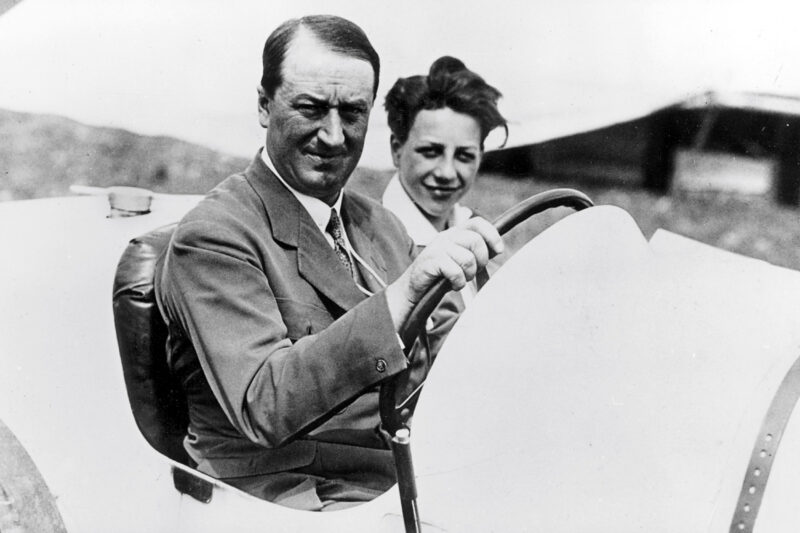
Ettore Bugatti and his son Jean in a Bugatti Type 35 at the Grand Prix de Lyon in 1924
Born into a family of artists in 1881, Ettore showed an early aptitude for vehicle design, producing his first motor tricycle with Prinetti & Stucchi in 1898. This earned him financial backing from Italian nobleman Count Gian Oberto Gulinelli, enabling Bugatti to create a second prototype in 1901.
His new design, the ‘Type 2’, attracted the attention of the French automobile firm Lorraine-Dietrich after it won an award at the Milan Trade Fair. Managing Director Baron Adrien de Turckheim asked Bugatti to join the firm. Having duly accepted, Bugatti would produce five further models with Lorraine-Dietrich over the next six years.
With a lifelong ambition to start his own company, Bugatti left in 1904, setting up shop with fellow ex-Lorraine-Dietrich employee Émile Mathis. However, this partnership lasted just two years, with Bugatti going off to work with Deutz and Peugeot.
In 1909, Ettore realised his dream and established Automobiles E. Bugatti in Molsheim. Finally, he had his very own company, but in doing so, Bugatti landed himself in the wrong place at the wrong time: Molsheim lies in the Alsace region, an area long-contested between Germany and France, so it was hardly the ideal place to be on the eve of the First World War. Predictably, Ettore was displaced during the conflict, initially travelling to Milan. He later moved to Paris, where he devoted his time to the development of aircraft engines, much like his British contemporary and rival, W.O. Bentley. Following the Treaty of Versailles, Molsheim became a region of France, having been part of Germany before the War. Ettore returned, more determined than ever to make a success of his new venture.
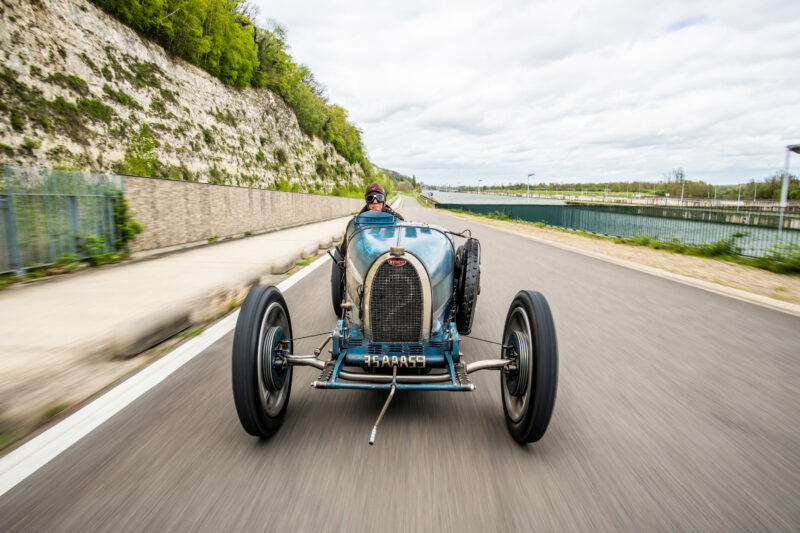
The inimitable Type 35
The sheer quantity of world-beating cars produced by Bugatti during the interwar period is quite remarkable. A Bugatti won the inaugural Monaco Grand Prix in 1929 with the groundbreaking Type 35. To this day, it remains one of the most successful competition cars of all time, winning over 1,000 races in period. Bugatti made a series of excellent road cars too, culminating in the Type 57 ‘Atlantic’, an icon of the Art Deco era.
Ettore was also a prolific inventor and personally held over one thousand patents. He developed the very first alloy wheel, his own safety glass, machining tools, high-grip hexagonal nuts, and bicycle frames. He seemed to excel in everything he turned his hand do, with the possible exception of brakes, once remarking: “I build my cars to go, not to stop.”

Victor 3rd Baron Rothschild’s exquisite Type 57 ‘Atlantic’
Things started to unravel in 1939, when Bugatti’s son and heir, also an accomplished engineer, was tragically killed aged just thirty while testing a Type 57 Tank Bodied Racer. Soon after, Bugatti was forced to leave Molsheim for a second time during the Second World War. His factory was reduced to ruins, and in 1947, Ettore died in Paris aged 65.
There were several attempts to revive the marque during the 1950s and ‘60s, but these failed to get off the ground. The story might have ended there; without Ettore at the helm, it seemed nobody had what it would take to bring Bugatti back from the brink. Until that is, Italian entrepreneur Romano Artioli acquired the brand in 1987.
Spurred on by Ferruccio Lamborghini no less, Artioli oversaw the production of the EB 110, a quad-turbo V12-engined, all-wheel drive, carbon fibre-bodied monster. In Supersport (SS) form, the EB 110 was the fastest production car in the world, albeit briefly.
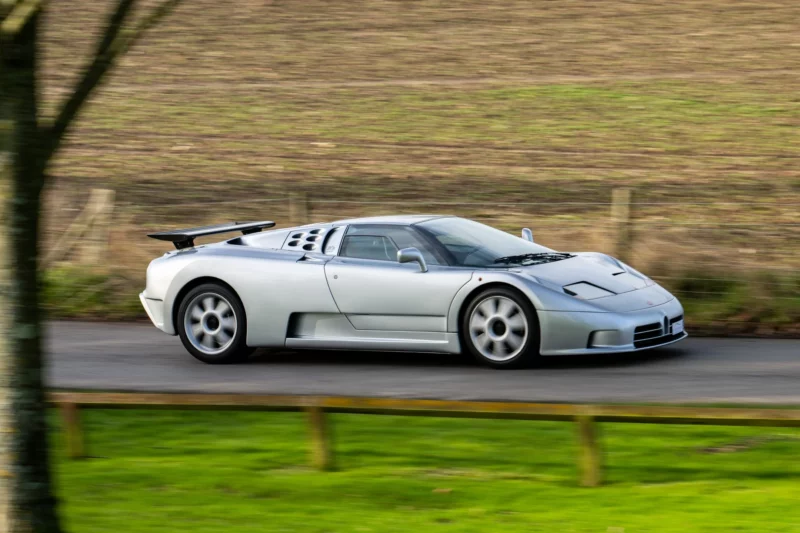
Bugatti is back in business with the EB 110
Bugatti was back, but the Artioli era was ultimately short-lived, with the firm going bankrupt in September 1995. This is when Volkswagen stepped in, and little did we know, the best was yet to come…
Named in honour of French racing driver Pierre Veyron, the Bugatti Veyron EB 16.4 was launched in September 2005, becoming what is arguably still the most significant supercar to emerge so far this century.
Equipped with an 8.0-litre quad-turbocharged 64-valve W16 engine, this thousand-horsepower force of nature stunned the world with its physics-bending performance, evocative styling, and eye-watering seven-figure price tag.
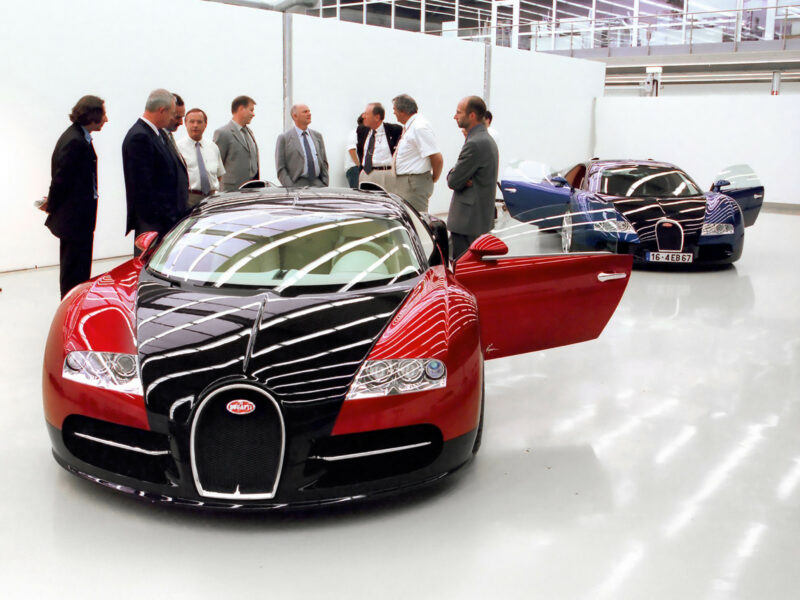
Veyron is unveiled in 2005
The Veyron was a technological tour de force, requiring no fewer than ten radiators to cool its enormous sixteen-cylinder engine. A seven-speed dual-clutch automatic gearbox with permanent Haldex all-wheel drive was specially developed by Ricardo PLC, while Michelin was tasked with creating a unique run-flat tyre capable of handling the Veyron’s top speed of over 250 miles per hour. However, the quality that made the Veyron truly unique was how well it behaved as a normal car. Inside its plush cabin, a Veyron feels as calm and collected as a Volkswagen Golf around town – something few manufacturers of envelope-pushing supercars have even come close to achieving.
The man behind the Veyron project was Ferdinand Piëch, grandson of Ferdinand Porsche, and the driving force behind the Porsche 917, Audi Quattro, and Bentley Continental GT. That’s quite a CV. With the Veyron, it seemed Piëch had just one aim: to build the greatest supercar car the world had ever seen. Against all odds, that’s exactly what he did.
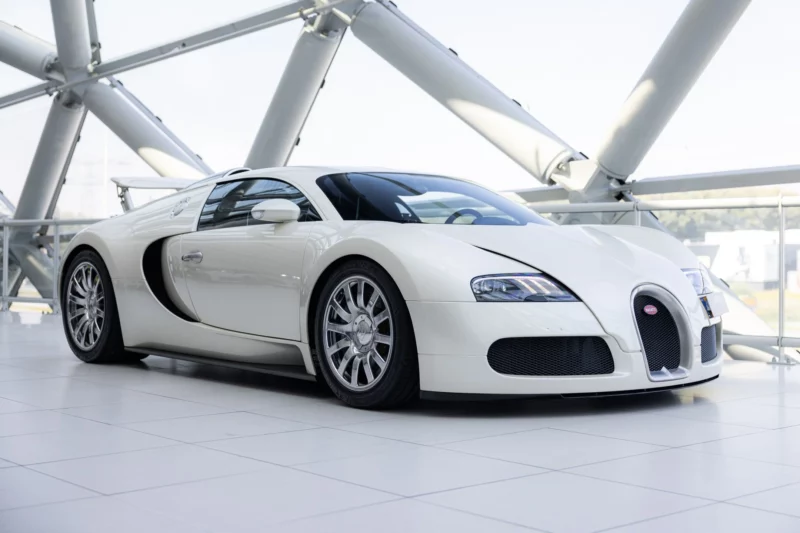
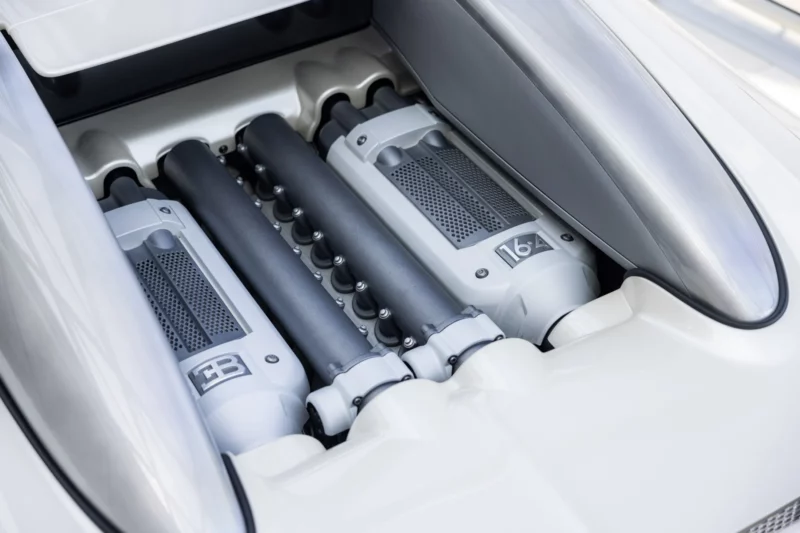
We’re in no doubt Ettore would have approved. This is the man who once said: “Nothing is too beautiful, nothing is too expensive.”
In total, just 450 Veyrons were built between 2005 and 2015.
To mark the car’s 20th anniversary year, Car & Classic is honoured to present a 2009 Bugatti Veyron 16.4 at auction. Our friend Chris Harris has taken it for a spin, and you can see what he made of it on his Chris Harris on Cars YouTube channel.
This French market car, now registered in the Netherlands, is one of the mere 252 Veyron 16.4 coupés produced worldwide. With 34,261 kilometres under its belt, we’re pleased to see this example has been used for its intended purpose, rather than simply squirrelled away in some vast collection. The Veyron has been accustomed to the superlative standard of maintenance these cars require, having been exclusively maintained by official Bugatti service partners since new. It has also recently undergone a 110-point Bugatti inspection.
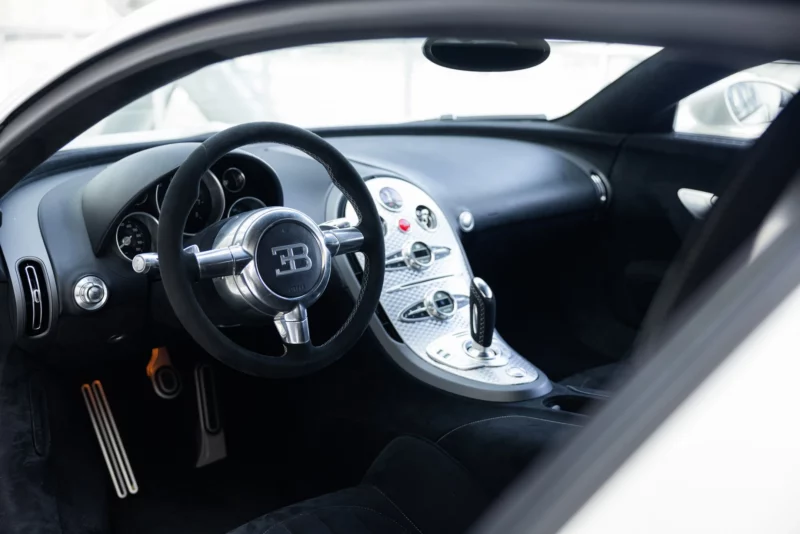
It isn’t every day one gets the opportunity to acquire a Bugatti Veyron. These truly epic machines are seldom spotted in the wild, so we hope to see the new custodian of this car will continue to increase the number on the odometer.
Photography: Bugatti