Alfa Romeo Alfa 6 – Cult Classic, not Best Seller

May 26, 2025
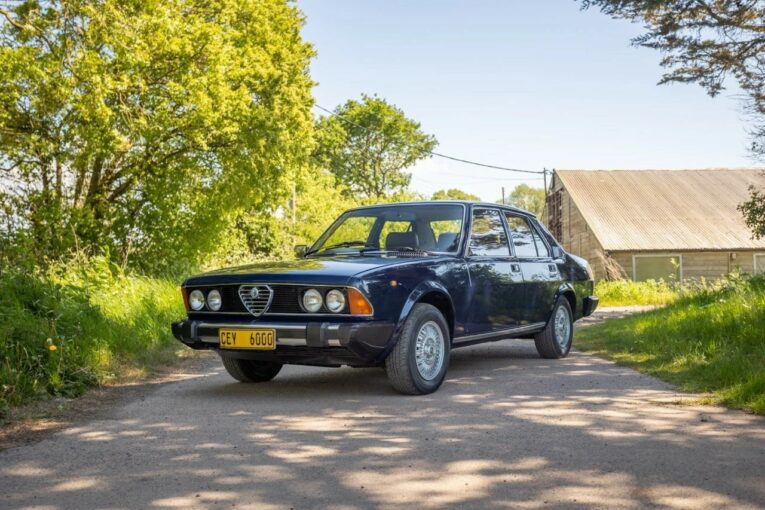
The list of cars built around the design brief ‘assassination-proof’ seems likely to be a short one. But Alfa Romeo’s simply named 6 is certainly on it, and quite probably at the top of it. The arrival of this fantastic Alfa Romeo Alfa 6 in our classic car auctions is a chance for us to venerate these oft-overlooked classic saloons.
In the late 60s and early 70s, when design work for a new Alfa Romeo range-topping saloon began, captains of Italian industry were being bumped off on a regular basis, either by the Red Brigade or by a rag-tag bunch of gun-toting mafiosi hit men. No doubt, the commute to work became a little like negotiating sniper’s alley.
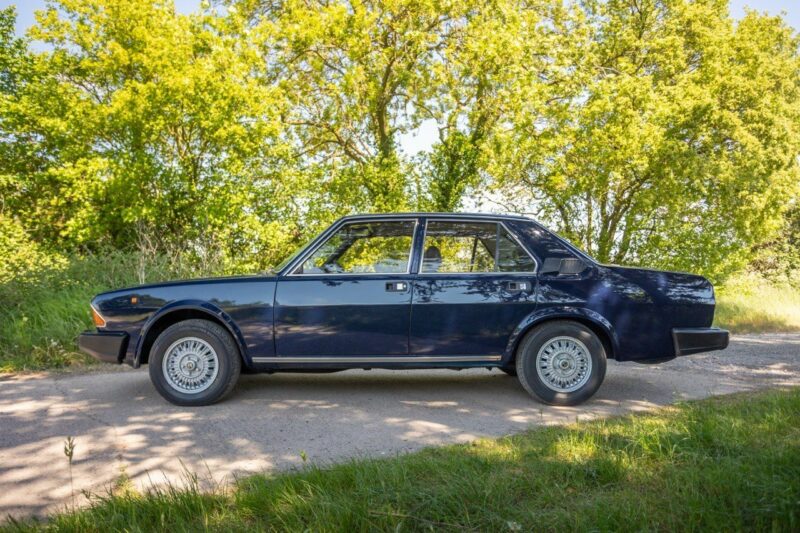
This problem likely informed the new car’s design aesthetic. Seemingly fashioned from three boxes, two small and one a little taller, the resulting Alfa 6 was not so much designed as assembled. But this understated style made it virtually indistinguishable from every other three-box design on the market in the 70s, and that, as the no doubt barrel-chested captains of industry would attest, was a very good thing.
It was, of course, a less good thing for the various hit men of Sicilian, Neapolitan and other origins who were trying to find them. They, too, needed to go incognito to avoid their targets and the Polizei, so they, too, needed the Alfa 6.
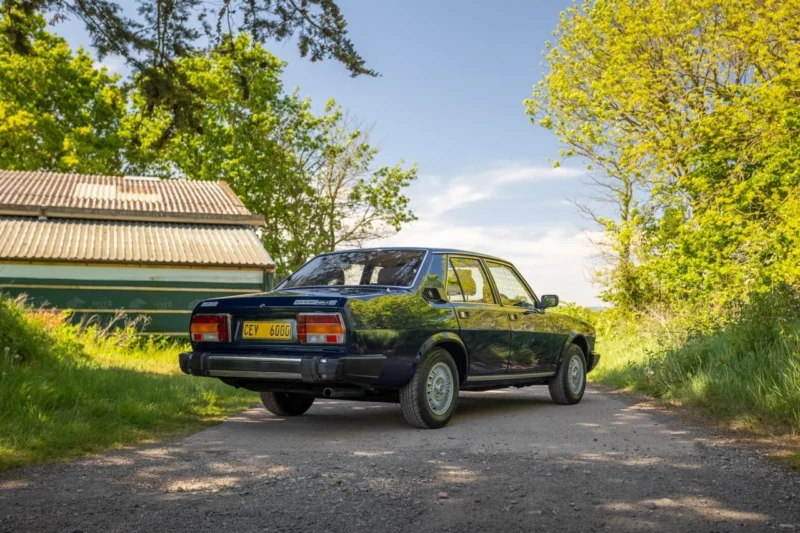
Work on the Alfa 6 began alongside its sibling, the Alfetta, in the late 1960s. The two cars shared similar architecture, including most notably the doors. That approach worked well on the smaller car but less so for the stretched 6, giving the bigger car a strange, narrow, pinched yet elongated look. To accommodate those doors, which were designed around the raised belt line of the Alfetta, the 6 features a high boot that seems like an automotive Brazilian Butt Lift.
While the Alfetta reached the market quickly, the 6 had a more strangled gestation due to the fuel crisis. Bad news for those boardroom behemoths, but better news for Alfisti because it gave the firm’s designers more time.
Having likely dashed off the ‘design’ for the panelwork in an afternoon, therefore leaving plenty of time for an evening of pasta and Pinot, the fuel crisis gave the creative chaps in Turin virtual free rein. This was a chance to apply themselves to everything about the 6 that those hit men and terrorists couldn’t immediately see.
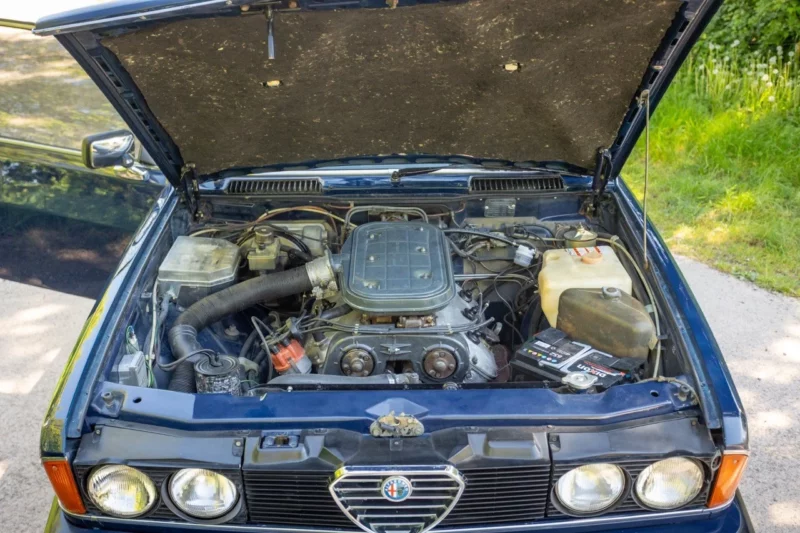
And what work they did. The 6 may be visually unremarkable, but beneath its panelwork, it is anything but. The new car got Giuseppe Busso’s new 2.5L 158bhp V6 engine. It is no stretch to say that this was and is one of the greatest engines ever built and one that would go on to transform some of Alfa Romeo’s cars like the GTV6, 75, SZ and GTA into gold-plated classics.
Rather less great or transformational was the decision to equip Busso’s masterpiece with six – yes, six – carburettors. There must have been some logic involved, but 46 years on from the idea reaching showrooms, nobody has worked out what that might actually be.
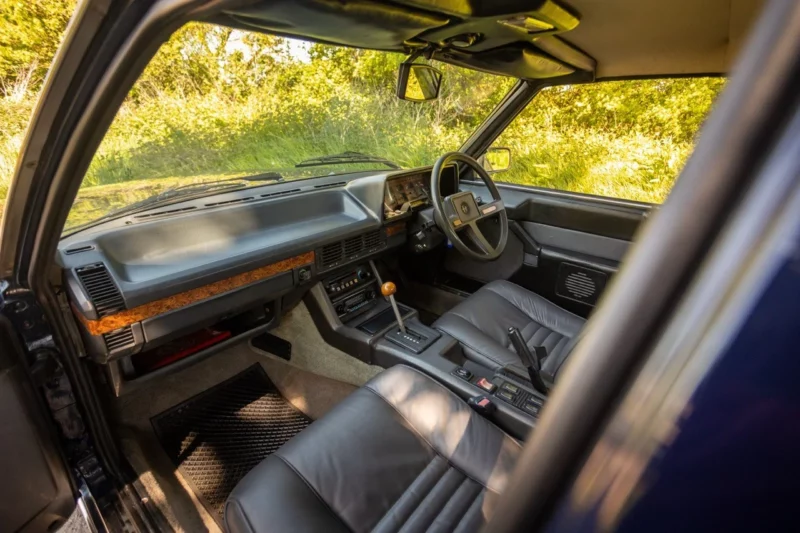
The mix of brilliance and bonkers that was the Alfa 6’s unseen bits didn’t stop there. Beyond those Alfetta doors, the team crafted a cabin seemingly built around the themes of ‘luxury,’ ‘scattergun,’ and ‘can we put in more wood veneer?’ Perhaps the designers felt sorry for those robust gentlemen of industry – because, back then, it always was men – and gave them an interior that might remind them of the dark basement clubs later made famous by Silvio Berlusconi. If so, they succeeded. Many cows were sacrificed in the making of each 6 interior. At the same time, the ‘wood’ veneer – we’re not entirely sure anything naturally played a role in its making – covered the dashboard, console, doors and even the steering wheel arms. All this is before we mention the dashboard and switchgear layout. It seems likely that, perhaps fuelled by the aforementioned pasta and Pinot, the ‘design’ came about by the team just randomly and half-heartedly throwing components at a mock-up of the dashboard. Certainly, ‘ergonomics’ was not central to the decision-making process.
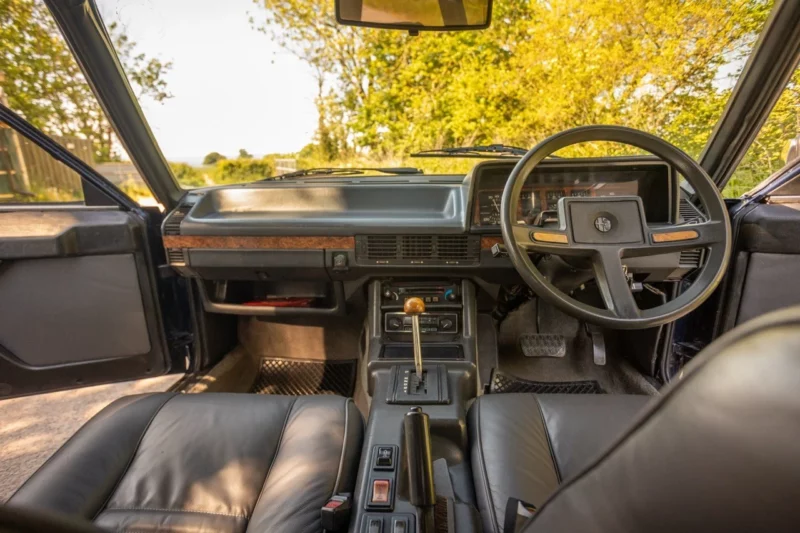
All of which is a long-winded way of saying that what you can’t see about an Alfa 6 is what makes an Alfa 6 brilliant.
The 6 finally arrived, several years late, in 1979. It was launched at Lake Como, the beautiful setting presumably chosen to distract reviewers from the dowdy-looking saloon on offer. Alfa Romeo had plans to sell 10,000 of its new car each year, which either tells you something about what the firm’s product planners were smoking at the time or is a useful reminder of the then-demand for assassination-proof cars.
Things didn’t quite work out as planned, but this being 1970s Alfa Romeo, you may have expected that. Despite the suitability of the 6 to both prey and predator, just 12,000 left the works over seven years.
Sales were not noticeably helped by a 1983 refresh that switched the multiple carburettors for fuel injection and introduced a 2L version of the V6 engine. There was also a 2.5L 5cyl turbodiesel, a clatterly choice, presumably not a popular pick with the hunted or the hunters. That quite a lot of Alfa 6 were specified with ‘bomb proof’ bodywork and glass is a hint that Alfa may actually have been onto something with the original design brief.
British capitalists were rather less troubled by assassins, and those gangsters we did have tended to favour a more flamboyant approach (hence the enthusiasm for the Jaguar Mk2 and S-Type). That may explain why just 128 were built in RHD for UK buyers. Or perhaps it was the fact that buying a big, expensive Alfa executive saloon with an awful lot of carburettors in the late 70s and early 80s was the four-wheeled equivalent of tearing up £10 notes.
Of those 128, none are currently road registered in the UK. A handful are on SORN, and we know at least one of those regularly attends Alfa Romeo Owners Club events in warmer months.
That makes the arrival of this South African Alfa 6 very welcome. Finished in rare Dutch Blue with grey leather, it is a time-warp car that has likely survived thanks to the kind local climate. Opportunities to recall the majesty of the Alfa 6’s mechanicals, multiple carburettors and characterful interior do not come along often, so savour this one in our extensive deck of photos.
The car is UK registered, and those carburettors have been properly set up and tuned prior to sale. The irony of the 6 is that a car that was so deliberately bland and invisible when new is so rare now that it stands out wherever it goes. But then, we suspect the likelihood of hit men prowling Alfa Romeo Owners Club events is pretty few and far between, although you can never rule anything out. You can find out more about our Alfa Romeo 6 classic auction car here.