Description
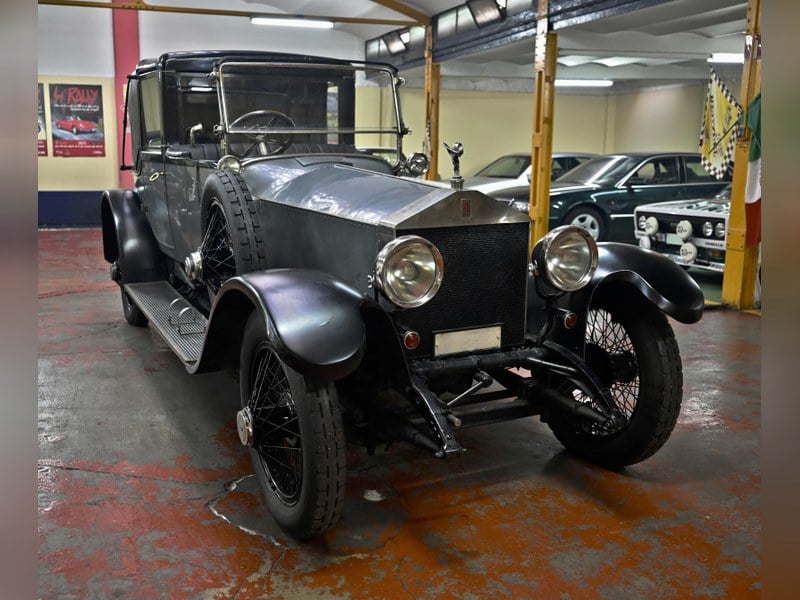
From time to time, we offer a car for sale which is so magnificent that our whole team recognise it to be very special, and unlikely to ever be repeated. In 2025 that car was a stunning Lagonda LG45 Rapide with a Mille Miglia provenance which we sold quite quickly. Although this Rolls-Royce is likely to achieve little more than a fifth of the price of that Lagonda, it falls into the same category - truly magnificent. In thirty-five years of selling a wide variety of important classic cars, we have never seen the like of this automotive giant. Meticulously restored by a former Chairman of the Rolls-Royce Enthusiasts Club, gifted engineer and businessman, the late Tony James, who advised on dozens of Rolls-Royce restorations, the Silver Ghost presented here was his passion for many years.
The Rolls-Royce Silver Ghost is widely regarded as one of the most important cars in automotive history. Introduced in 1906 by Rolls-Royce Motor Cars, it established the company's international reputation for engineering excellence, reliability, and quiet operation. Its development marked the transition of the motor car from an experimental machine into a dependable luxury vehicle suitable for long-distance travel. Henry Royce had already gained a reputation for meticulous engineering and precision manufacturing and his partnership with businessman Charles Rolls combined technical innovation with effective promotion and salesmanship. By 1906, the company sought to produce a car that would surpass all rivals in smoothness, silence, and reliability. The result was the 40/ 50 hp model, powered by a six-cylinder engine of approximately seven litres. At a time when many cars were noisy, fragile, and mechanically temperamental, the new Rolls-Royce demonstrated remarkable refinement. Royce focused intensely on balancing the engine, reducing vibration, and improving durability.
The name "Silver Ghost" originally referred to a single demonstration car finished in silver paint with silver plated fittings. The press car, chassis number 60551, carried registration AX201. Because of its almost silent running and ghost-like smoothness, journalists and customers began calling it the "Silver Ghost," and eventually the nickname became associated with the entire model range. The Silver Ghost featured engineering advances that were exceptional for the Edwardian era:
A six-cylinder side-valve engine providing smooth and flexible power.
Pressure lubrication and high manufacturing precision for improved reliability.
A strong separate chassis capable of supporting custom coach-built bodies.
Multi-plate clutch and refined transmission system.
Exceptionally quiet operation compared with rival cars.
Each chassis was sold separately, allowing wealthy customers to commission bodies from specialist coachbuilders. As a result, Silver Ghosts appeared as touring cars, limousines, landaulettes, and sporting models. The car's reputation was cemented through extensive endurance testing. In 1907, Rolls-Royce subjected the Silver Ghost to a famous reliability trial covering over 14, 000 miles. The car completed the journey with minimal mechanical trouble, an extraordinary achievement at a time when long-distance motoring was still highly uncertain.
This demonstration led the British magazine Autocar to describe the Silver Ghost as "the best car in the world," a phrase that became permanently linked with Rolls-Royce advertising and prestige. Production of the Silver Ghost continued until 1926, when it was succeeded by the Rolls-Royce Phantom I. By that time, more than 7, 000 examples had been built.
The Silver Ghost established many of the characteristics that became synonymous with Rolls-Royce. Today, surviving Silver Ghosts are among the most prized early motor cars in the world. Historians often consider the model to represent a turning point in automotive engineering because it demonstrated that motor vehicles could combine luxury, durability, and everyday usability at a level previously thought impossible.
This particular chassis, 82 EU was sold to Coachbuilders Barker & Co at a list price of £1850 with a 15% discount on November 4th, 1924. It was sent from the Rolls-Royce Derby works to the London Coachbuilder on L. M. S good train U176 on New Years Day 1925. Barkers bodied it for the first owner, one Benjamin Sassoon of London. Factory records show that some ten years later it was in the ownership of a Bradford company. Being a late Silver Ghost, it benefitted from four-wheel brakes and an Autovac fuel feed. We are told that this chassis spent many years in a Danish museum before becoming the subject of a complete and meticulous restoration by Tony James, using the body of an earlier Silver-Ghost, an open-drive example built by Steuarts of Calcutta circa 1913. It is believed the body was built for the noted royal Rolls-Royce Enthusiast, Krishna Raja Wadiyar IV, the Maharajah of Mysore, one of the world's richest rulers who bought up to seven Rolls-Royces at a time! This design was a copy of a body built by Barkers in 1913, which was displayed at Olympia on chassis number '2366'. Steuarts were a noted coachbuilding concern of Scottish ancestry, and this body was imported from India in 1967. The car, with fully restored body, chassis and running gear was completed in 2008 and there is a wealth of history with it. We are told it has graced the RREC stand at the N. E. C. and is recognised as one of the finest surviving examples. During 2022 and 2023 the car benefitted from almost £5, 600 of careful re-recommissioning and service work by noted marque specialists. At seven feet tall and over seventeen feet in length it is an imposing machine which dwarfs most cars of its era. With its semi-open front compartment, it is an exhilarating car to drive and a unique experience. Online data reports that R 2509 was bid up to £172, 500 in 2023 at auction. We expect this sale to represent the bargain of a lifetime for a discerning collector, and we invite offers for this very special Rolls-Royce.