
Description
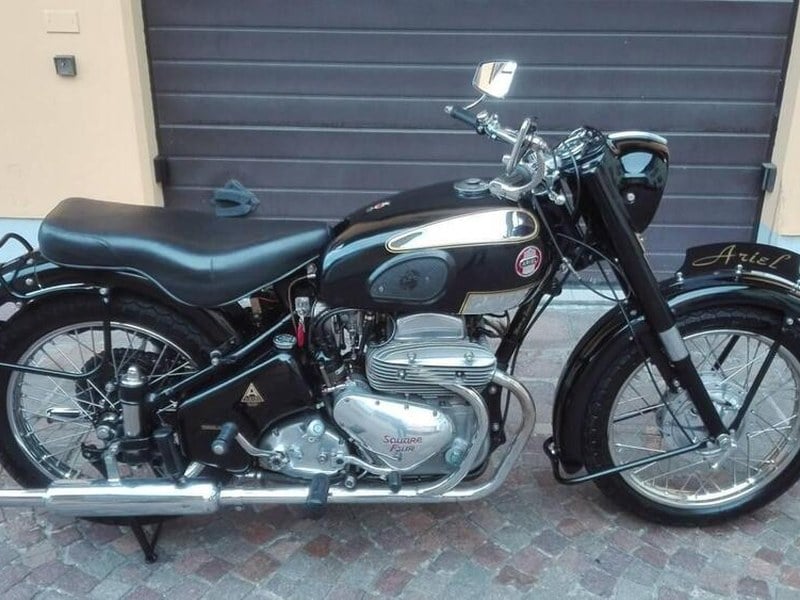
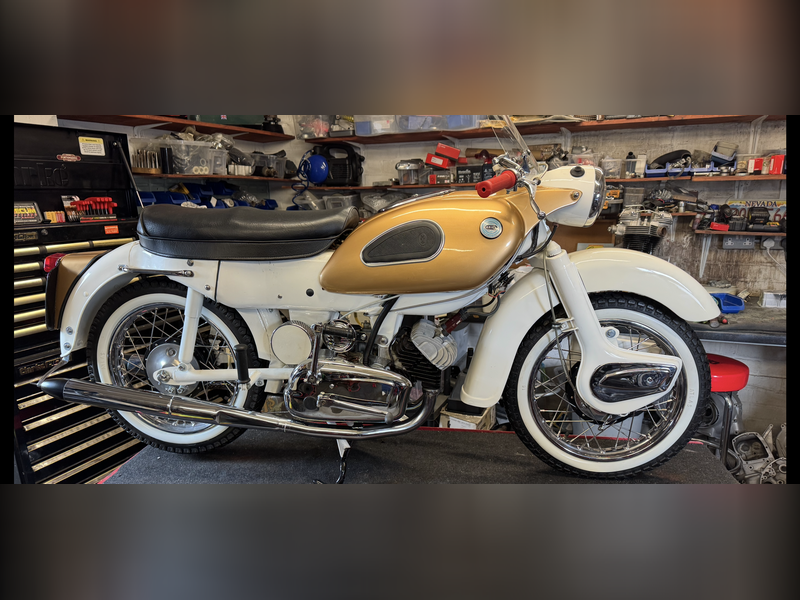
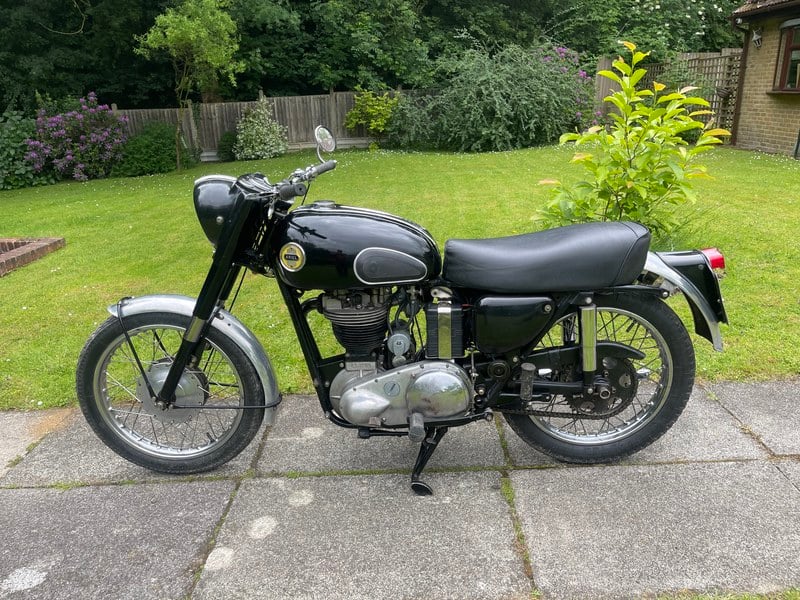
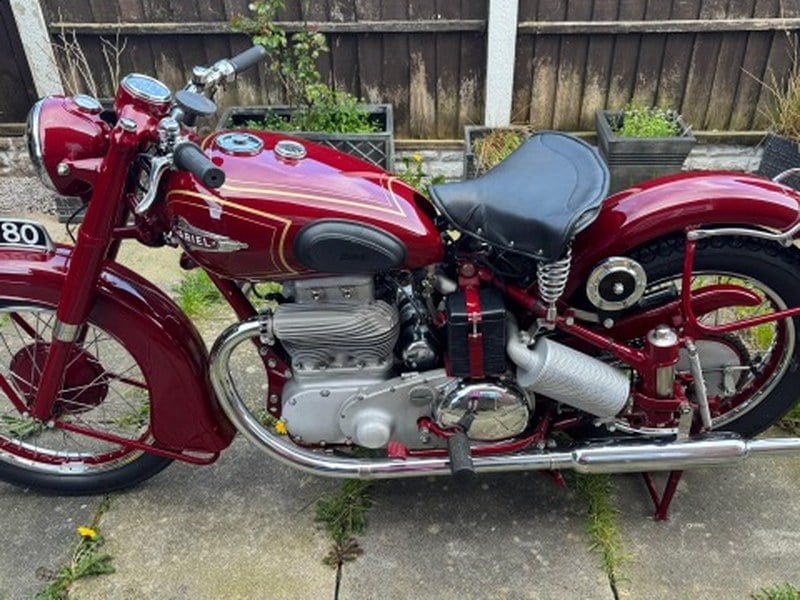
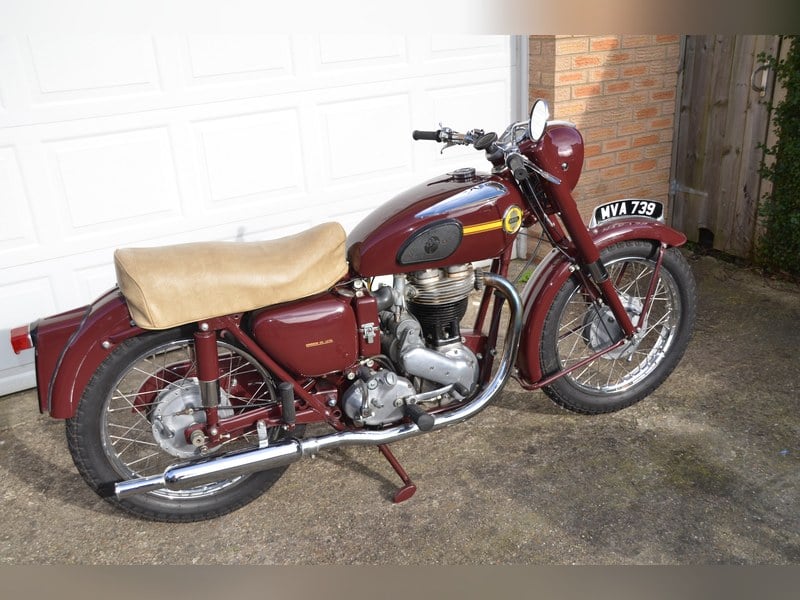
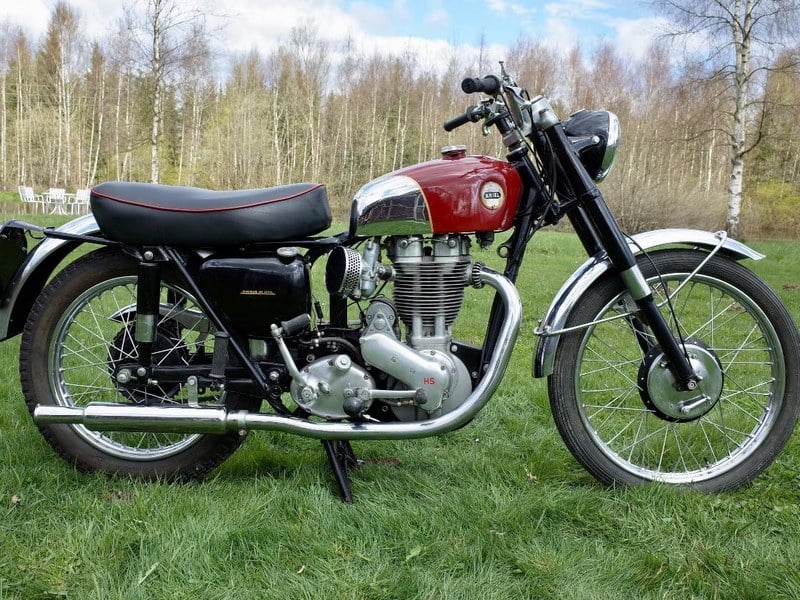
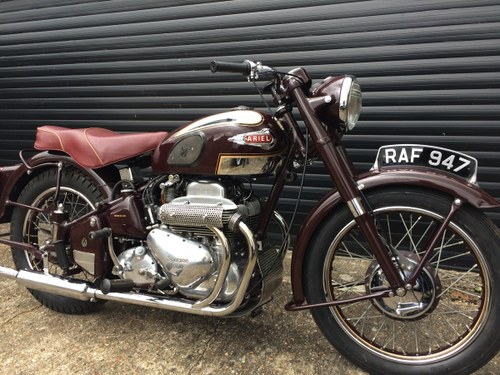
1953 Ariel Square Four Mark II 1000
Frame no. ES720
Engine no. XJ686
First registered 23/ 07/ 1953.
In 1928, engineer Edward Turner was shopping a new motorcycle design to English manufacturers. BSA turned him down, but Ariel was interested. The engine was an unusual four-cylinder. V-twins and inline fours, set both lengthwise and across the frame, had been used previously but Turner’s new design had two vertical twins sharing a common crankcase. The cylinder barrels were cast as a unit in a monobloc design. Their two crankshafts were joined by a flywheel and rotated in opposite directions. By having the two pistons of one crank at top and bottom dead centre and the pistons of the second shaft at half stroke, the design was ingeniously compact and the firing order made it practically vibration free. The Ariel Square Four 4F made its debut at the 1930 Olympia Motorcycle Show featuring an overhead camshaft 500cc with a hand shift for the Burman gearbox, which was integral with the crankcase. Overhead camshafts and unit construction were well into the future for most firms, so Ariel was a real pioneer. Few knew then that the bike would become a legend of the British industry, both for its performance and dependability. The latter was underscored by the Square Four’s widespread used in the British law enforcement community.
Improvements were continuous during the Square Four’s 28-year production run. In 1932, the 4F was taken out to 600cc, although the 500 remained available. The next year, a 4F 600 fitted with a supercharger lapped the famous Brooklands speed bowl at 110 miles per hour. 4F production continued almost to the war, but some late 4Fs were fitted with 600cc overhead-valve engines.
The 4G was introduced in 1936 with a new 996cc overhead-valve engine. To accommodate the larger displacement, a new crankshaft was set in a much stronger crankcase. These years saw the British economy recovering in the run up to World War II, and Square Fours were seen on the road more often, where they were known as the “Monarch of the Multis”, referring to their multi-cylinder engines in a sea of British singles and twins. By the immediate post-World War II period, the 4G had a plunger rear end and telescopic front forks. Further refinement was added in the form of aluminium cylinder barrels when the Mark I began production in 1949.
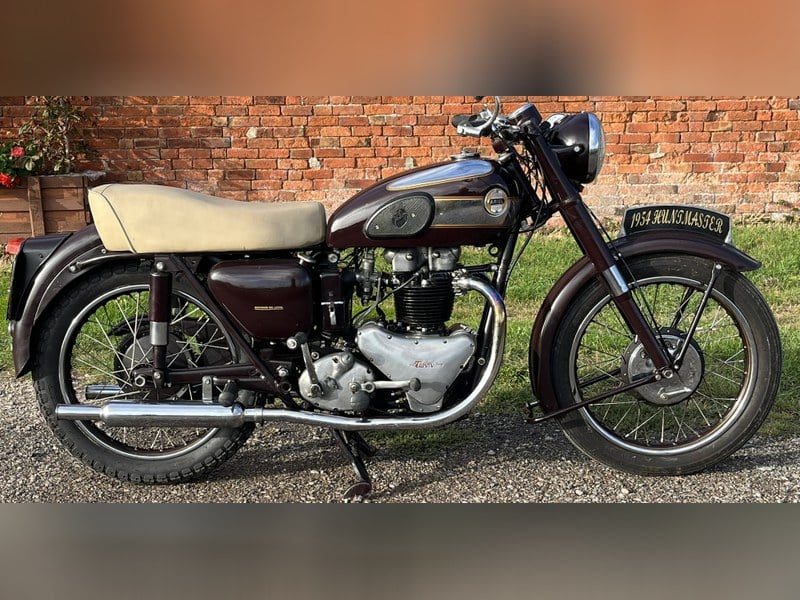
My bike is the final iteration of the Ariel Square Four, a Mark II 1000, from the first year of production. The Mark II was introduced in 1953 and is the most desirable model of this iconic motorcycle. The monobloc cylinder barrel was replaced by individual units, resulting in four separate exhaust pipes, eliminating the overhead-camshaft engine’s weakness of overheating the rear cylinders. A redesigned head upped the power and the Square Four had no problem reaching “the ton” – 100 miles per hour.
The bike was extensively restored at Dragonfly by the previous owner, and since then has only travelled 500 miles. I have owned the bike for 3 years and it has always started easily and run well. I am selling the bike due to commitments elsewhere, and as a result I used the bike sparingly through the summer of 2019. You will notice further refinements to the bike, not normally seen on this model, such as the engine guards, sump guard and additions to the header pipes. This is truly a stand out example, along with a cherished number plate which I've been told is worth in excess of £3K, which again sets the bike apart from its peers.
Included in the sale is the Ariel Tool Roll as well as various handbooks and paperwork.