
Description
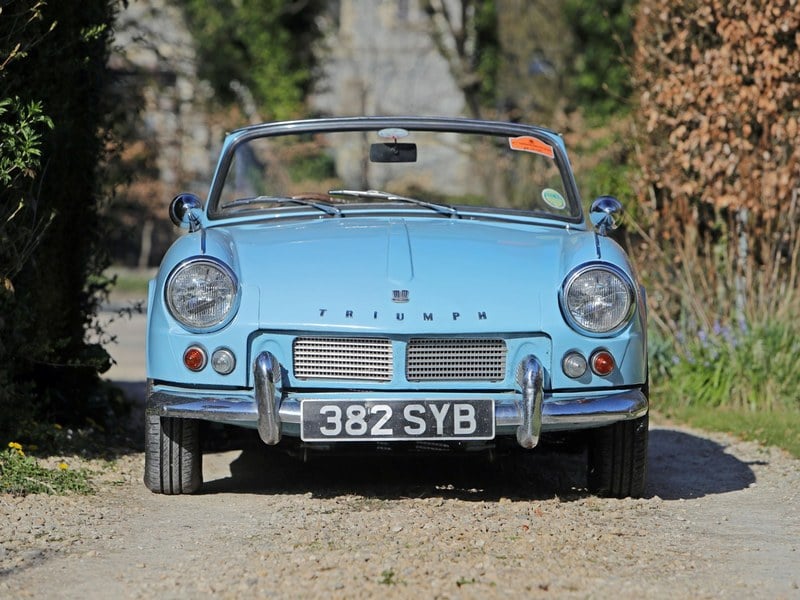
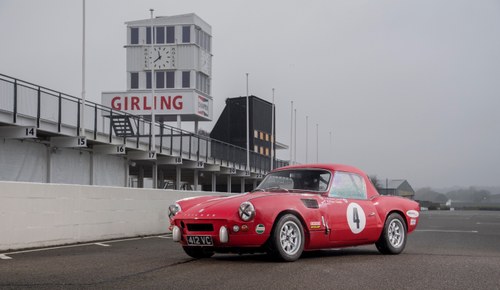
'412 VC' became the face of the Spitfire internationally, in the USA, Great Britain and Europe as the publicity vehicle for Triumph from 62, being a very early prototype that was subsequently used by the Works during 1964 as a development car for their rally effort.
‘412 VC’ started life in right hand drive format but was almost immediately converted to left-hand drive, acting as the press demonstrator for the export market before being returned to right-hand drive form and assigned to the Competitions Department. There it served as the factory’s ‘test mule’ and, as the first official competitions Spitfire, it was driven on several British events by Roy Fidler and John Hopwood, retiring on most of them but finding form when finishing in a magnificent 2nd place in the 1964 Welsh Rally and was latterly the official recce car driven by Fred Nicklin for the 65 Lombard RAC.
The valuable lessons learned during the development of ‘412 VC’ served Triumph well. In 1964, the Spitfire’s first full year of competition, the works car of Rob Slotemaker/ Terry Hunter won its class in the 10-day Tour de France marathon, defeating the mighty Alpine-Renaults in the process. Jean-Jacques Thuner took a class win in the 1965 Geneva Rally and teamed with Simo Lampinen to take another 1st in class at Le Mans, while Lampinen won the French Alpine Rally’s Prototype category outright later in the year. After such a promising start the Spitifire looked set for a lengthy and successful career. Sadly, an untimely change in the FIA’s Appendix J regulations forced Triumph to redirect its efforts towards the 2000 saloon and the Spitfire was not used in a Works application after 1965.
‘412 VC’ continued to be rallied for several years after its career as a works car had ended in the hands of Terry Hunter, before being purchased (via Peter Clark) by Richard Lloyd (later of 'GTI Engineering' and 'RLR Porsche' Le Mans fame). Richard Lloyd then commissioned Cox & Clarke to convert it to race specification for Lloyd to race it under the 'Gold Seal Sports Cars' banner, alongside Chris Marshall (later to become James Hunt's manager in his early career). Lloyd raced the car successfully in 1968/ 9 in the Mod Sports Championship, taking a memorable overall victory at a rain-soaked televised Crystal Palace meeting, beating a formidable grid which included much-modified Jaguar E-types! Another notable event was racing it at the daunting Mugello meeting in 1969 with Peter Cox. By 1970, Richard Lloyd had put his race career temporarily on hold due to lack of funds, being forced to sell his very successful Spitfire before resuming racing in 1973 with his Chevrolet Camaro.
'412 VC' continued to be raced in club events for several seasons in various hands before being retired. It was later rediscovered in 1984 by Julius Thurgood, who knew the car and Richard Lloyd well. A deal was immediately struck with Richard to buy his old car back. It was a while before Lloyd decided to have the car restored and that that process was not started until 1998 when Lloyd commission the same Peter Clark to restore and convert the car back to its original Works specification. Rebuilt for racing, this ex-Works Spitfire enjoyed considerable success in Richard’s hands in historic events at Spa Francorchamps, Pau, Oulton Park and importantly the Goodwood Revival in 2001, where Lloyd had an impressive outing in the Fordwater Trophy, taking 5th o/ a against the might of a grid consisting of Mercedes-Benz 300SLs, Jaguar XKs, Aston Martins, AC-Bristols and Works MGBs. A significant achievement with just 1147cc on tap!
'412 VC' was sold again in 2008 as part of Richard Lloyd's estate after his sad demise in an aircraft accident. Almost two decades have past since this important car in the post-war history of British motor sport has been used in anger. Still in great overall condition, it will require a re-commissioning programme before it continues its illustrious competition history. ‘412 VC’ is now offered with its old FIA papers, Swansea V5C registration document and a substantial history file.
Rarely do ex-Works cars with a such a substantiated history come onto the market. Let alone one that provides an accessible entry to an elevated sector of the historic competition area and one with an enviable 'passport' to obtain invitations to the very best events - worldwide.