Beskrivning
For sale in our forthcoming auction 'Retromobile the Official Sale', on 2 February 2024 :
Danish title
Chassis no. 40488
Engine no. 387
- Original chassis, engine and body
- Very low number of owners, known history
- High-quality restoration
This Bugatti Type 40 is remarkable in many ways: for its exceptionally well-preserved condition and its extremely clear history.
That history began in June 1927, when its chassis, no. 40488, equipped with engine no. 387, was assembled at the Bugatti works, at the same time as the chassis with engine nos. 377-401. The chassis was then delivered on 20 August 1928 to the coachbuilder Gangloff in Colmar; the invoice from the factory dated 27 July 1928 also covered chassis nos. 40612, 40563 and 40567. The invoice mentioned a price of 40, 000 francs, higher than the 31, 000 francs for a standard Type 40. These four Type 40 chassis included the reference "sp mod pr special", which may have meant "special modification, special price".
The factory delivery booklet is marked in pencil with the letter 'W', corresponding to 'Wiederkehr', the name of Gangloff's previous owner. As of 19 August 1928, the same booklet indicates that these chassis were to be supplied to 'W', i. e. Gangloff. Gangloff then fitted the Type 40 which concerns us here with an attractive roadster body with a spider tail, before it was delivered to Stand Auto in Paris, an official Bugatti agent run by Robert Sénéchal and Jean Bilovucic, with its head office at 182 boulevard Pereire and a showroom in the Galerie des Portières at 144-146 avenue des Champs-Elysées. The Type 40 doubtless remained there for a few months before it was sold to a customer from south-west France.
On 3 September 1929, it was officially registered for the first time, as 3898-JV (corresponding to the Lot-et-Garonne department), in the name of Jean Joseph René Marc Dupont. Born on 20 March 1893 at Marmande and married twice (in 1920 and 1946), Dupont began his studies in medicine in 1913. Appointed an assistant physician during the First World War, he qualified in 1920; he also had a diploma as a pharmacist and in 1924 opened his own clinic. A chief physician in the Second World War, he was taken prisoner in 1940 and was made a Chevalier of the Légion d'honneur the same year. Actively involved in his town, he became a town councillor in 1937, and again in 1949 and 1950. A street in Marmande is named after him.
To come back to the Bugatti 40, with the new registration system which came into effect in 1950, it was given the number 86 X 47, still in the Lot-et-Garonne and possibly still in the name of Marc Dupont.
Two years later, around 1952, it was sold to Roger Berthaud, who lived in Les Essards, a village of fewer than 200 inhabitants in Charente. The recollection of the family is that the car was bought in Bordeaux, which may suggest that it was sold through a garage.
Roger Berthaud was a close friend of André Bouchard, Bugatti's sales representative for the Dordogne region. They regularly went on trips together in their Bugattis, and Bouchard looked after the maintenance of Berthaud's cars, a Type 44 and then a Type 40. The Berthaud family owned the grocery and tobacconist's in the village, of which Berthaud was mayor for several years. His first Bugatti was a Type 44 Vanvooren saloon, which he bought in July 1937 and kept until 1960, when it was sold to L. Mette and then, in 1962, to F. Lecorché in Clermont-Ferrand.
In 1952, Berthaud gave the Type 40 to his daughter Marguerite, who was then 25. According to her husband, Michel Maignan, Berthaud originally bought the Type 40 specially for his daughter, as at the time he used the roomier Type 44.
Registered as 507 AT 16, the Type 40 can be seen in a photograph in front of the Framezelle Bugatti garage in Paris, and also at Les Essards, with François Berthaud, a sculptor and Marguerite's brother, sitting in the back. During its time with Marguerite, whose training as a graphic designer enabled her to join the magazine Elle, the Type 40 was registered 533 HZY 75 at her Paris home at 22 rue Pernety in the 16th arrondissement. She used it regularly until 1986, in particular to go on holiday in the south of France.
In 2011, Marguerite and her husband realised that the car needed a thorough restoration and decided to sell it. It was bought on 14 November 2011 by Bruno Vendiesse and at the time was red with grey wheels. Vendiesse sold it shortly afterwards to the Belgian collector Bernard Marreyt, from whom its current owner bought it.
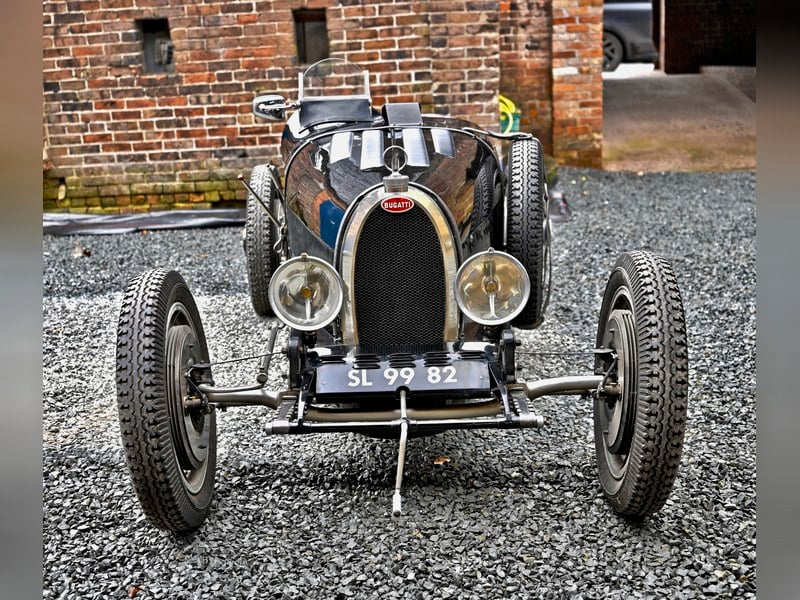
Today, the car has its original chassis and engine, as well as its original body, which has been restored in dark green, respecting the car's integrity. The complete high-quality restoration was carried out by Gubso Garage in Denmark, a specialist Bugatti restorer. The interior is dominated by the magnificent four-spoke steering wheel with a wooden rim and the dashboard is complete with all its instruments, mounted on a metal plate on a wooden panel. Under the bonnet, the engine compartment displays the mechanical beauty typical of Bugattis.
The car has its original plate from Stand Auto, as well as that from Gangloff. It should be noted that it is the only known survivor of this roadster body produced by Gangloff.
This Type 40 is remarkable for its exceptionally well-preserved condition, its rare and appealing body, its original parts and its very low number of owners, listed in a well-documented history drawn up by the historian Pierre-Yves Laugier, making it one of the most desirable examples still in existence.