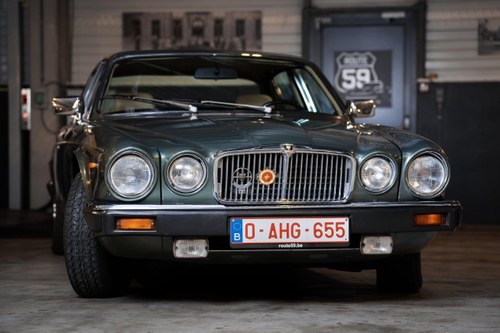

Beschreibung
Die Jaguar XJ6 Sovereign Serie 3 von 1985 gehört zur neuesten Evolution einer ikonischen Baureihe, die 1968 ihren Ursprung nahm. Ursprünglich war die XJ-Reihe das persönliche Projekt von Sir William Lyons, der eine Limousine schaffen wollte, die Luxus, Ruhe und Fahrverhalten vereint. Nach der Serie 1 von 1968 und der Serie 2 von 1973 präsentiert Jaguar 1979 die Serie 3, entwickelt mit Unterstützung des italienischen Karosseriebauers Pininfarina. Diese Zusammenarbeit spiegelt sich in einem modernisierten Stil wider: eine höhere Dachlinie, vergrößerte Fensterflächen, integrierte Stoßfänger und eine Silhouette, die britische Eleganz bewahrt, aber eine im Stil der 80er Jahre typisch zeitgenössische Note annimmt.
1985 zählt die XJ6 Sovereign zu den luxuriösesten Modellen der Baureihe. Sie besticht durch ein besonders gepflegtes Interieur mit reichlich Leder, lackierten Verkleidungen aus Holz und einer raffinierten Präsentation. Unter der Haube steckt die endgültige Evolution des XK-Motors, ein mythischer Sechszylinder, der Ende der 1940er Jahre konzipiert wurde und im Laufe der Jahrzehnte verfeinert wurde. In dieser Endphase der Serie 3 erreicht er eine große Reife: sanft, geschmeidig, leise und sehr gut geeignet für die souveräne Philosophie dieses Autos. Jaguar befindet sich nun an einem wichtigen Wendepunkt: nach der Wiedererlangung der Unabhängigkeit nach der Trennung von British Leyland im Jahr 1984 bemüht sich die Marke, Qualität und Image zu steigern. Die Modelle von 1985 profitieren daher von einer vergrößerten Aufmerksamkeit bei Zusammenbau und Verarbeitung, was die Sovereign zu einem der Höhepunkte britischer klassischer Eleganz macht.
Die Produktion der Serie 3 mit Sechszylinder endet 1987 und weicht der moderneren XJ40, die den Retro-Charme der Serie 3 jedoch nicht mehr vollständig besitzt. Rückblickend wirkt die XJ6 Sovereign von 1985 wie eine der letzten großen Jaguars mit traditionellem Stil, der gestreckte Linienführung und Zeitlosigkeit, legendärer Mechanik und einer gedämpften, einzigartigen Atmosphäre verbindet.
Technische Daten: Die europäische Version von 1985 wird von einem 4, 2-Liter-Sechszylinder mit elektronischer Bosch L-Jetronic Einspritzung (unter Lucas-Lizenz) angetrieben, der ca. 205 PS bei ca. 5000 min-1 entwickelt und ein Drehmoment von knapp 325 Nm liefert. Die Höchstgeschwindigkeit liegt bei rund 200 km/ h und der Sprint von 0 auf 100 km/ h dauert etwa zehn Sekunden. Bei der Mehrzahl der Modelle kommt eine Borg-Warner- oder ZF-Automatik je nach Baujahr zum Einsatz, während das Handschaltgetriebe mit Overdrive theoretisch verfügbar bleibt. Der Verbrauch, treu der klassischen XK-Architektur, schwankt je nach Fahrstil zwischen 13 und 18 Litern pro 100 Kilometer.
Dieser Exemplar wurde am 5. August 1985 neu in Belgien ausgeliefert. Seitdem hat er 116. 000 km zurückgelegt, der aktuelle Besitzer die letzten 15. 000 km seit 2004.
Der Wagen wurde stets gut betreut und gepflegt. In den letzten Jahren:
2017 – 112. 000 km: neue Edelstahl-Auspuffanlage, neue Reifen, neuer Dachhimmel
2020 – 115. 000 km: komplette Bremsenrevision
2025 – 116. 000 km: komplette Wartung
Der Wagen läuft sehr gut, das Getriebe wechselt die Gänge sanft. Die Laufleistung von 116. 000 km scheint mit der Dokumentation und dem Zustand des Fahrzeugs übereinzustimmen.