Description
Introduction
A very usable modern classic—responsive, quick, and quite the head-turner. I’ll be genuinely sad to see this one go. If I had the space, I wouldn’t even consider selling, but a new career direction now means I need something more suited to daily practicality.
Key Details
• First Registered: 27th August 1993
• Body Style: 3-door Hatchback
• Colour: Nocturne Blue (234)
• Interior: Persian velour upholstery (H74)
• Transmission: 5-speed manual
• Mileage: 141, 414
• Interior restoration
• 12 months M. O. T
• Recent Oil and filter change
• Recent Thermostat & Coolant change
• Headlining replaced in 2011
• Crack-free dashboard
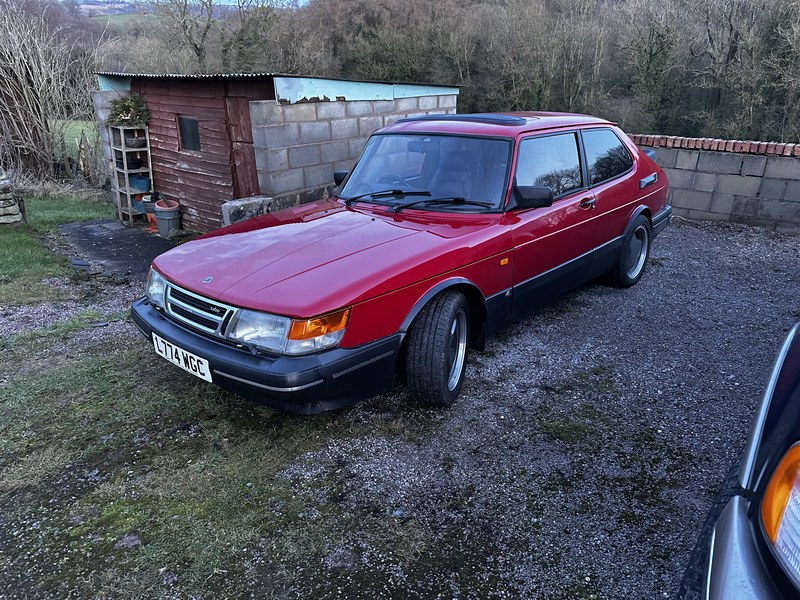
This is one of the final hardtop Saab 900's to roll off the Trollhättan production line, making it an increasingly rare and sought-after model. Finished in classic Nocturne Blue with luxury Persian velour upholstery, it delivers that unmistakable Swedish design elegance alongside spirited turbo performance.
Fun Fact: This very car has even been featured as the "Saab 900" on Wikipedia for several years, which speaks volumes about its significance in the Saab community.
Highlights
• Full-service history with all paperwork, receipts, and MOT records
• Original stamped service book, Saab wallet, and factory documents
• 2 original keys with leather Saab Scania fobs
• Countless hours of interior restoration
• Rare final-year hardtop model – a collector’s gem
• Short-throw gear shifter for added driver engagement
• Carlsson-spec wind deflector – stylish and functional
Performance & Driving
This car is an absolute pleasure on the road. The 2. 0-litre 16-valve B202 light-pressure turbo engine produces 145 BHP, delivering smooth and responsive performance. The short-throw shifter enhances gear changes, while the wind deflector adds a touch of classic Carlsson style and refinement—perfect for enjoying the open air via the electric sunroof.
Factory Features Include:
• ABS
• Power steering
• Central locking
• Air conditioning
• Electric sunroof
• Electric windows and mirrors
• Heated front seats (automatic)
• Automatic radio antenna
• 15” Alloy wheels
Practicality & Storage
• Boot capacity: 21. 3 ft³
• With seats folded: A cavernous 56. 5 ft³
• Bonus storage: Underfloor compartment housing:
• Original space-saver spare wheel
• Original jack
• Original Hazard warning triangle
We took this car on a family trip to Wales—two adults, two kids, fully packed—and it didn’t miss a beat. Comfortable, capable, and turning heads wherever we went. It’s a true testament to Saab’s engineering that a 30-year-old car can still deliver such a confident and enjoyable journey.
Running costs
Surprisingly affordable for a classic car.
• Classic insurance: Approx. £120. 00 for 12 months
• Tax: £360 for 12 months
Fuel economy
• Urban: 23. 0 mpg
• 56 mph (90 km/ h): 38. 7 mpg
• 75 mph: 27. 7 mpg
The Light-Pressure Turbo Advantage
The final run of 2. 0-litre hardtops for the UK market were fitted with Saab’s Light-Pressure Turbo. These were engineered to deliver a flatter torque curve, giving excellent overtaking performance at real-world speeds while also improving drivability in urban settings.
• Smoother acceleration
• Reduced gear changes in stop-start traffic
• Quieter engine operation
• Lower exhaust emissions (thanks to the catalytic converter)
It’s an ideal balance of efficiency, refinement, and character.
LPT & Performance Potential
Abbott Saab, a respected name in the Saab tuning world, offers a Chargecooler System specifically tailored to LPT models. They note:
“LPT models respond extremely well to the chargecooler system as their smaller compressor turbine gives faster spool-up than a T16, however the final power of the T16 is ultimately higher.”
Innovation & Safety
One of Saab’s greatest legacies is its uncompromising commitment to safety and innovation. The 900 series was designed to meet—and often exceed—the world’s most demanding safety regulations. These cars weren’t just built to perform; they were engineered to protect.
Some of the key safety innovations in the Saab 900 include:
• Windscreen pillars made from 2. 5mm thick sheet steel, designed to absorb impact forces from the front, sides, or roof
• Energy-absorbing crash members that redirect forces from a frontal impact into the wheel housings while halting rearward engine movement
• Reinforced floor pan and doors, with moulded struts and welded-in strengthening members
• Deeply curved laminated windscreen, helping prevent contact injuries in a frontal collision
• Patented “buckling” steering column, which collapses on impact to protect the driver—one of the safest designs of its era
• Centrally-mounted ignition key, located between the seats to prevent knee injuries (and a signature Saab touch).
These innovations—many of which were ahead of their time—show just how far Saab was willing to go to engineer not only performance, but peace of mind. Ownership & History
• Keepers 1–3 (27/ 08/ 1993 – 25/ 03/ 1994):
Registered to Robert Bowett Saab (Leeds). The reasons for three keepers within a short timeframe remain unclear, but it’s possible this was an internal dealership transfer, as the main dealership is also listed as a previous keeper—which is unusual, but not unheard of. The first three services are stamped 'Robert Bowett (Leeds) LTD'.
• Keeper 4 (25/ 03/ 1994 – ~2021):
A single private owner who purchased the vehicle with just 6, 000 miles on the odometer from Robert Bowett Saab. Incredibly, he kept the car for over 27 years. During his ownership, the car was cherished and meticulously maintained, as evidenced by a large folder of receipts, MOT certificates dating back to 1993, and a fully stamped service book.
• Keeper 5 (30/ 04/ 2021 – 19/ 01/ 2023):
A legal professional and Saab enthusiast who used the car regularly for work-related travel. He reluctantly sold it due to needing to downsize his collection. During his ownership:
• The car was serviced and underside wax-oil treated
• New clutch, master & slave cylinder, and pipe fitted at 135, 740 miles
• O/ S CV gaiter and both front anti-roll bar bushes replaced at 136, 879 miles
• Keeper 6 (19/ 01/ 2023 to present):
I've owned this Saab for nearly 2½ years, during which time I’ve invested countless hours and several thousand pounds into a sympathetic interior and mechanical restoration. My aim has been to honour the car’s originality while gently refreshing the areas that needed attention, always with an enthusiast’s eye for detail.
Inspection & Early Work
Early in my ownership, the car went to a trusted Saab specialist for a thorough inspection who proceeded to service and repair areas that needed attention, including:
• Welding to all corroded areas
• New water pump & hose installed
• New pyramid drain case
• Underside treated with Waxoyl
• Brake hoses replaced
• Full service and MOT
That invoice alone came in over £1, 700—with detailed photos and full documentation provided.
Exterior Refurbishment
Next, I tackled the front and rear bumpers, disassembling them to:
• Address loose fasteners, broken clips, and missing trim
• Prep for new number plates and chrome bumper accents
General Use & Period-Correct Upgrades
Over the next year, I drove the car regularly—weekend outings, errands, and longer road trips. And I continued improving it using OEM or period-correct parts, including:
• Turbo grille badge
• Front indicator lenses
• Rear bump stops
• Chrome bumper trims
• Rear headrests
• Number plates (to match originals as best possible)
• Headlamp motors & wiper blades
• New carpet mats
• Exhaust rubbers
• All bulbs (incl. upgraded headlamps)
• Velour-trimmed door inserts
• Folding seat buttons
• Interior light delay module
• Engine immobiliser
One major functional upgrade: a short-throw gear shifter—a transformative improvement. I still have the original shifter in case the next owner prefers to revert.
Interior Restoration & Electrical Refresh
It started with a failed battery and ended with a full interior refresh!
The battery failure turned out to be caused by a faulty alternator regulator—both replaced. Then a squeaky clutch pedal led to pulling trim panels, and before I knew it, I was in deep. As an engineer I want components to function as they were intended.
Every part removed was photographed, bagged, labelled.
Highlights:
• Treated the crack-free dash with vinyl conditioner
• Replaced all perished duct seals—airflow is now excellent
• Renewed perished vacuum lines
• Cleaned all locks, window motors, central locking and switches
• Replaced electrical connectors for high spec ones
• Cleaned and tidied all internal wiring
• Wet-vac’d carpets and seats
• Resolved vent squeaks, fitted new instrument & speedo bulbs
• Soundproofed rear arches & floor
• Removed, cleaned and resealed the rear spoiler
Cooling System Overhaul (new parts)
• Radiator (with larger core)
• 89-degree thermostat
• Coolant bypass valve
• Coolant expansion tank
• System flush and new coolant
What’s Left & Why I’m Selling
My vision was to go even further: remove/ rebuild the engine, clean up the engine bay, and get the A/ C system working again (currently non-functional—conversion from R12 to R134A is approx. £150).
I even sourced the official Saab 900 Service Manual to go beyond what the Haynes manual could offer.
But life, as it tends to, had other plans. I’m now heading in a new direction, and I simply don’t have the time or space to continue this project.
Final Thoughts
This classic Saab 900 isn’t a concours car, but it’s a rare and well-preserved example of a fast-disappearing icon. It’s ready for weekend use or as a base for further restoration.
I've taken detailed photos throughout my ownership to show the car’s true condition and journey. If you have any questions or would like to see something specific, I’d be more than happy to share.