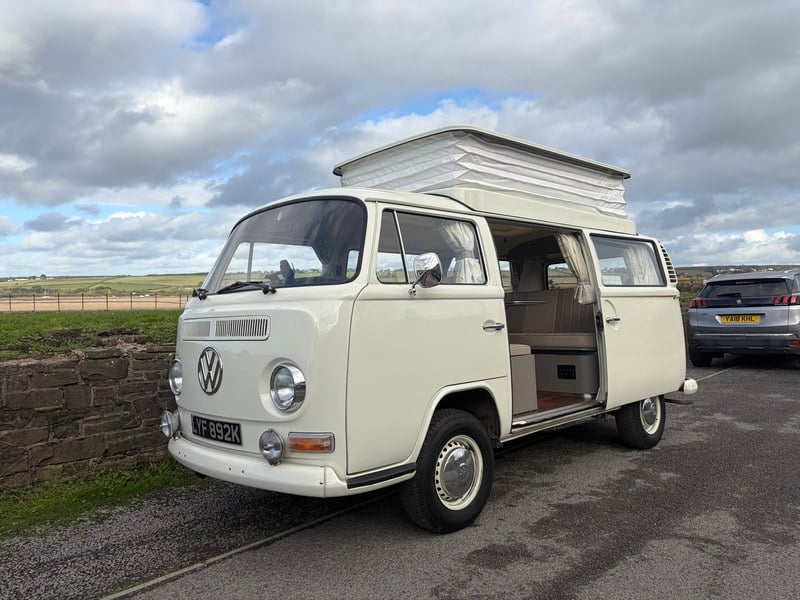
Description
1970 VW T2 Early Bay camper, left-hand drive and successfully DVLA-registered as a reconstructed classic. Running, driving and MOT’d until 10 August 2027, but still an unfinished bespoke camper project. The bodywork needs attention, and the remaining upholstery and camper finishing still need completed.
The original air-cooled engine was replaced with a fully rebuilt 1998cc 16-valve Subaru Legacy petrol engine, professionally converted by TSR / AMR Motors in Suffolk. The odometer showed 68, 715 miles when the Subaru installation was commissioned and now reads approximately 69, 524, so it has covered just 809 miles since commissioning.
The original VW four-speed gearbox was retained, professionally refurbished and re-ratioed as a freeway gearbox to suit the Subaru engine. All four forward gears and reverse select reliably. The external gearshift/ selector linkage is not quite as tight or precise as it once was, but remains perfectly usable.
Mechanical upgrades include LiteSteer electric power steering, slightly lowered suspension, uprated KYB shocks, Bus Boys front beam adjusters, CSP front disc brakes and brake servo assistance.
The camper interior was designed and built by me. Before joining the fire service I worked as a joiner and cabinet maker. It is built from high-quality veneered furniture ply with matched grain, solid oak worktops, Osmo oil finish and soft-close fittings. There is a two-level pull-out larder, slide-out table, cutlery drawer, extensive storage and bespoke under-seat storage, with the required steel fabrication already completed.
The two front captain-style seats were professionally upholstered. The passenger seat has a bespoke swivel conversion allowing it to rotate and face the living area, an unusual Early Bay feature which took considerable design and fabrication.
A three-quarter-width rock-and-roll bed is installed with fixed three-point seatbelt mounting points, chosen with family use in mind and provision for up to two child seats. Upholstery material is included, but it still requires foam and final upholstery.
Camper equipment includes a SMEV sink and twin-burner hob, gas locker and 6kg Calor cylinder, Isotherm Cruise 65 Elegance compressor fridge/ freezer and Propex HS2000 blown-air heater. Both were fitted new during the build and have seen negligible use.
There is a fresh-water tank with external filler and electric pumped tap, plus a bespoke external shower system using a custom roof tank, pressure-operated pump and concealed shower hose. It was tested during the build but later partly disconnected, so the next owner can decide whether to recommission it.
The electrical installation includes a leisure battery, Victron split charging, two roof-mounted solar panels, EPEVER MPPT controller and MT50 display, Numax mains charger, 2000W pure sine-wave inverter, 230V campsite hookup, consumer unit, 12V fuse board and battery monitoring. The solar panels have been fitted for around eight years and show cosmetic weathering; I have not recently measured their output.
The camper lighting circuits are already wired. The light fittings and a 5m warm-white LED strip for concealed furniture/ worktop lighting are included but still need fitting.
The pop-top has a replacement canvas with zip-out openings and mosquito mesh, plus NitroLift gas struts. The original narrow upper bunk was removed and a full-width upper bed conversion started but not completed. The intended layout sleeps two downstairs and two upstairs.
Also included are a previously fitted and wired towbar and electrics for refitting, Thule/ Omnistor four-step alloy ladder, thermal window screens, tailgate and sliding-door mosquito meshes, Mad Matz/ sisal-style cab carpeting, matching carpet, upholstery material, door-card weatherproofing membrane, matching veneered furniture ply, timber and other finishing materials.
The body looked extremely smart when I bought it, but the previous paint and body repairs are now showing their age. There is localised corrosion around the sliding door, rear wheel arches and tailgate, a small rear-quarter dent, minor paint defects and some older filler repairs becoming visible. If I were keeping it, I would now prepare and repaint the body.
The visible corrosion appears superficial rather than structural. When the interior was stripped during the conversion, the internal shell was exceptionally clean. Some welding was carried out to the nearside chassis for a previous MOT, and the latest MOT mechanic commented positively on the general condition underneath. Existing underbody protection predates my ownership.
A TOAD alarm/ immobiliser and remote central locking system are fitted. These were tested and working when installed and there is nothing to suggest otherwise, although they have seen very little use for some time.
This is a substantially progressed project rather than a finished camper, but an enormous amount of the difficult and expensive work has already been done.
I bought the van in October 2017 from the widow of its previous owner. It had already had body and paint work carried out and was a running camper, but the interior was basic compared with what I wanted to create.
Before purchasing it I carried out a full HPI check on 5 October 2017. At the time I was entirely comfortable with the vehicle and its history. The registration, supplied VIN and V5 details matched and no adverse data was recorded.
I spent the first couple of years working fairly intensively on the van, including the Subaru conversion, gearbox work, power steering, brakes, suspension, camper electrics, heating, plumbing and the bespoke interior.
In 2019 DVLA contacted me after their records flagged another vehicle attempting to use the same historic registration identity.
The only original-style VIN identification I had ever been able to locate on the van was on a riveted Volkswagen identification plate behind the passenger seat rather than a number stamped directly into the chassis. Despite a detailed search of the vehicle, no reliable chassis-stamped VIN could be located. Equally, there was no obvious evidence of a chassis number having been deliberately removed.
The van then successfully went through the formal DVLA reconstructed-classic process. As part of this it was inspected by the Historic Volkswagen Club (UK) on 26 June 2021 and again on 28 March 2022.
From the body construction and surviving original or contemporary components they were able to establish it as a 1970 Volkswagen. Their report identified the transmission, rear suspension, rear brakes, steering gear, front suspension and general ancillary components as original or contemporary with that period.
That evidence supported the successful DVLA application. The van was subsequently registered as a 1970 reconstructed classic, allocated a replacement DVLA VIN and issued its current age-related H registration. The replacement VIN is permanently etched into the vehicle in two locations.
The current registration has been in place since 1 March 2023, so the identity process is now completed and historical rather than an ongoing issue.
For additional reassurance I carried out another full HPI check in September 2026 against the current DVLA identity. That check is also clear and confirms that the current registration, DVLA-issued VIN and V5C details match with no adverse data recorded.
Both HPI reports, Historic Volkswagen Club documentation, current V5C, relevant DVLA correspondence, MOT paperwork, TSR/ AMR invoices and a substantial quantity of build documentation, manuals and receipts are included with the van.
The registration saga was hugely frustrating at the time and undoubtedly contributed to the project losing momentum. Since buying the van we have also had two children, the demands of my work have changed considerably and around five years ago we bought a caravan, largely because it had become clear that the Bay was not going to get finished quickly. We were later lucky enough to buy a modern VW California Beach as well.
Once we had the caravan, the urgency to finish the Bay largely disappeared. It has seen very little use in recent years and I am now realistic enough to accept that I am not going to find the time or enthusiasm to restart the project properly.
I am selling it with a fair amount of regret. There has been a huge amount of thought, time and money put into it and I genuinely wanted to see the finished van through. I am not going to recover anything close to what I have spent on it, never mind the time involved, but that is not really the point now.
I would simply like somebody to take it on, understand what has already gone into it, finish it in their own way and hopefully get the years of use and enjoyment from it that we never quite managed.
I will happily explain everything I know and hand over all the documentation, manuals and notes I have. After several years away from working on it I cannot remember the purpose of every wire or every decision I made during the build, so part of taking it on will inevitably be getting familiar with the project yourself. I am hoping to sell the van, rather than accidentally take on a lifetime position in its technical support department!