1951 Mercedes-Benz 170S Cabriolet B – The Car Who Came In From The Cold

June 23, 2025
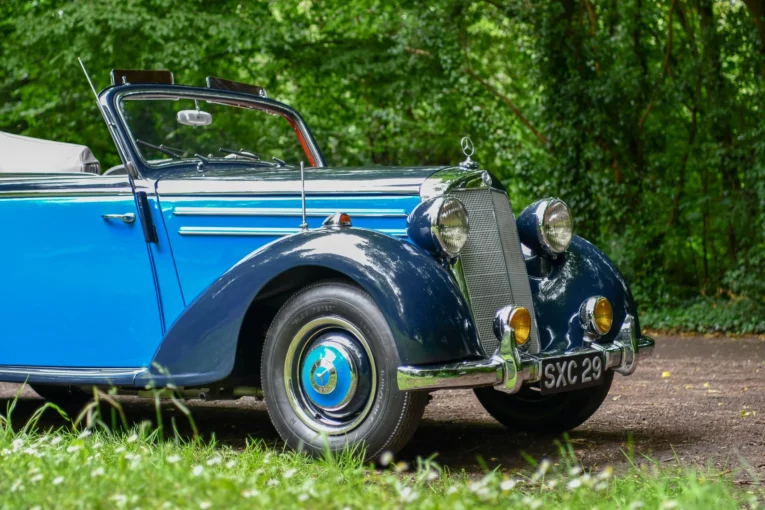
Forget Bond’s DB5. Here’s a real spy’s car. It was involved in one of the most daring MI6/CIA joint operations of the Cold War; a tale of secret tunnels, Soviet ‘moles’, codebreaking, and nuclear weapons. A story almost too far-fetched to be the work of Fleming or Le Carré. But it really did happen, and this 1951 Mercedes-Benz 170S Cabriolet B was at the very heart of it.

MI6 purchased this Berlin-registered Mercedes-Benz 170S in February 1955, and it was assigned to agent Howard Greville, a former Engineer in the Royal Signals during the Second World War. Greville was recruited by MI6 in 1946, having demonstrated his considerable resourcefulness and nerve by passing key intelligence to the Allies while held up in a German POW camp, Stalag XVIIIA.
Howard was fluent in German, so MI6 stationed him in Berlin’s British-occupied zone. His duties included recruiting German agents and codebreakers, as well as passing information on the Soviets to his superiors. Greville’s hand-written mileage reports show the car was used to commute daily between his home, Platanenallee 26, Charlottenberg, to MI6 HQ at the Olympic Games Stadium. He also used the car to gather intelligence further afield, visiting Denmark, Norway and Sweden during the summer of 1955. Greville also recorded a trip to Holland to liaise with Heinz Bonatz, the German Admiralty’s chief codebreaker during World War II.
While the Soviet Union had joined the fight against Fascism in 1941, the end of hostilities and the ensuing struggle for global influence led to the ‘Iron Curtain’ descending across Europe, signalling the start of the so-called Cold War. This was to be a war of intelligence, with each side vying to expand its sphere of influence. By 1954, Britain and America were concerned that the USSR might be planning a nuclear attack; the Soviets had already tested an atomic bomb in August 1953. Therefore, in a joint operation between MI6 and the CIA, British and American agents began work on an audacious listening project, burrowing a 1,476 foot tunnel under Berlin’s Soviet Zone. Dubbed ‘Operation Gold’ by the Americans and ‘Operation Stopwatch’ by the British, this was one of the most daring acts of espionage in Cold War history.
Unbeknownst to the British and American Intelligence, their tunnel had a mole in it. And we don’t mean the furry kind…
Here’s where our Mercedes 170S re-enters the story. Another resident of Platanenallee 26, Charlottenberg, was fellow MI6 officer George Blake. Cold War buffs will know Blake as one of the most infamous and effective double agents of all time, and it was he who blew Operation Gold/Stopwatch’s cover to the USSR, almost as soon as work on the tunnel began. Blake’s role in MI6 was very similar to that of Howard Greville, and both men lived at the same address, so it’s highly likely that Blake travelled in this car during the time he was spilling secrets to the Soviets.
So as not to curtail Blake’s usefulness, the USSR opted not to “discover” the tunnel until April 1956, by which time the apparatus within had been used to record around ninety thousand communications. Much of what went on is still classified information.

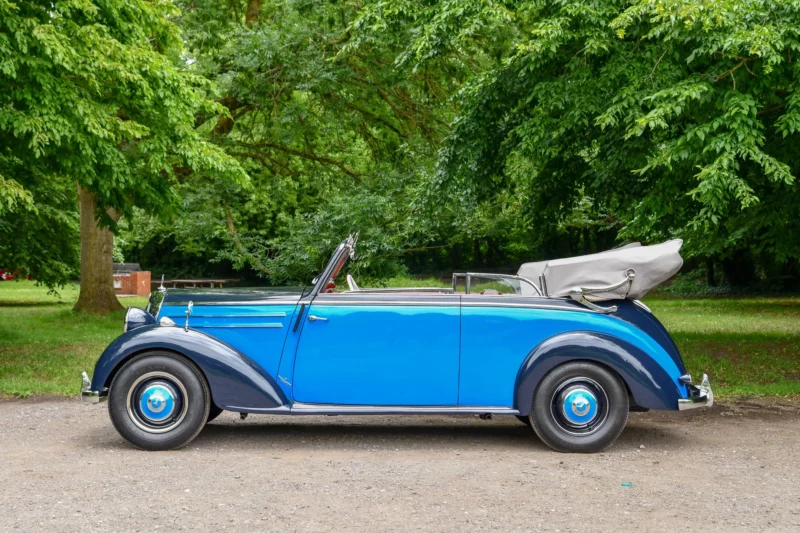
Two days before Operation Gold was burst wide open by the USSR, Howard Greville exported our 170S B to the UK, where it was initially registered under ‘E64 9BZ’ and soon changed to ‘SXC 29’. It also underwent a colour change from blue to green in 1962 – a new disguise, you might say. It’s understood that Greville retained the car until 1972, during which time it fell into a state of disrepair, but was saved by renowned restorer Kenneth Foat.
The car underwent a mammoth rebuild, replacing the engine and gearbox, and leaving nothing untouched. The Mercedes has since won copious awards, was displayed for several years at Mercedes-Benz World, Brooklands, and has garnered compliments from none other than Sir Stirling Moss and John Surtees.
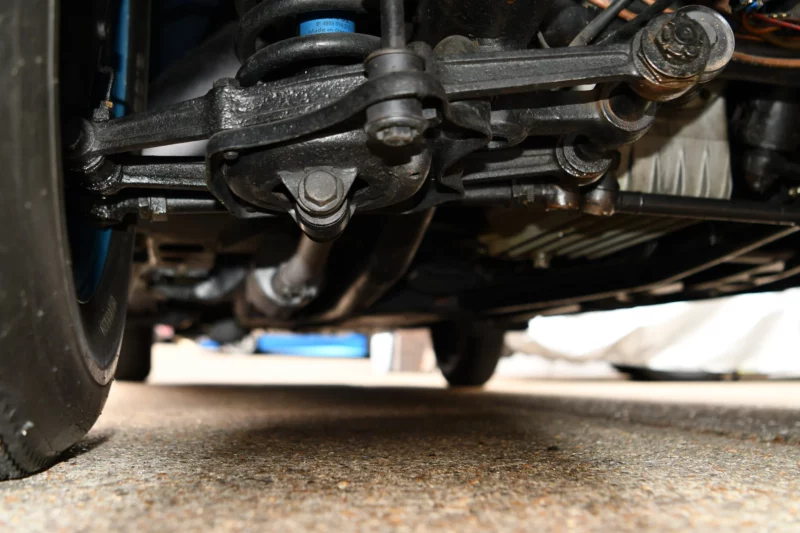
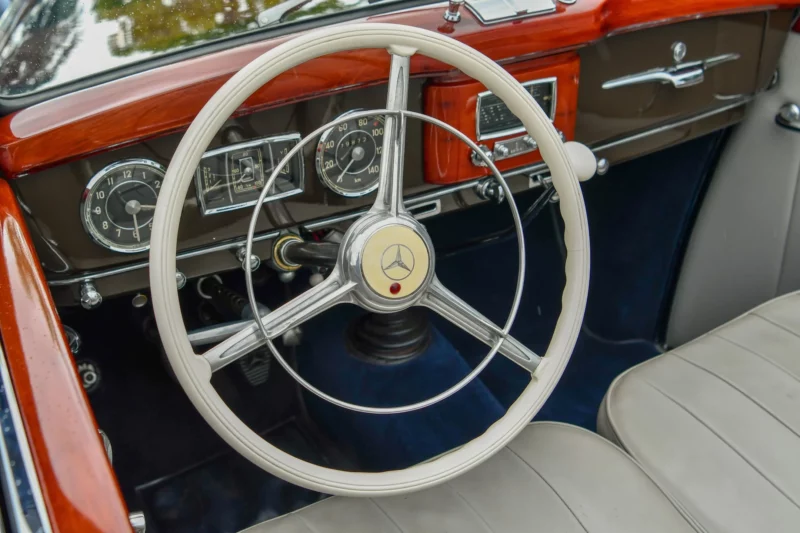
The 170S was instrumental in the revival of Mercedes-Benz after World War II. While German factories, including those owned by the carmaker, were heavily bombed during the Second World War, the 170 plant and all its tooling survived, allowing passenger car production to resume. The first convertible was produced in May 1949, and with a more powerful engine, improved suspension and a more luxurious cabin than its predecessor, the 170S became Mercedes-Benz’s flagship model. ‘SXC 29’ was one of the last of its kind, among the final examples of the 170S B to roll off the Sindelfingen production line.

So, what became of the key players in this real-life Cold War thriller?
Howard Greville eventually wrote up his Wartime experiences and published ‘Prison Camp Spies. Espionage Behind the Wire’, in 1998. He was later reunited with the Mercedes in 2008, and the Greville and Foat families have been in touch ever since. George Blake was arrested in 1961 and sentenced to 42 years’ imprisonment in Wormwood Scrubs. After five years, Blake escaped with the help of three conspirators and was smuggled across the English Channel in a campervan. He eventually made it to East Germany and from there, the Soviet Union. He died in Moscow in 2020, aged 98, and was buried with military honours.
There hasn’t yet been a film adaptation of Operation Gold, likely because much of the information is still classified. This Mercedes-Benz 170S is so much more than just an old car; it’s an artefact from the Cold War that has been beautifully preserved through painstaking restoration and careful curating of its history. Now you have the opportunity to add this car to your collection, as it’s up for auction with Car & Classic.