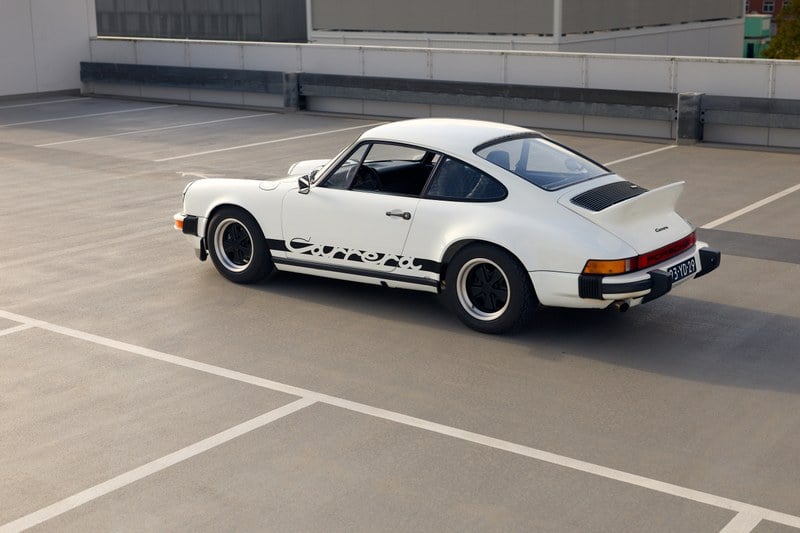

Description
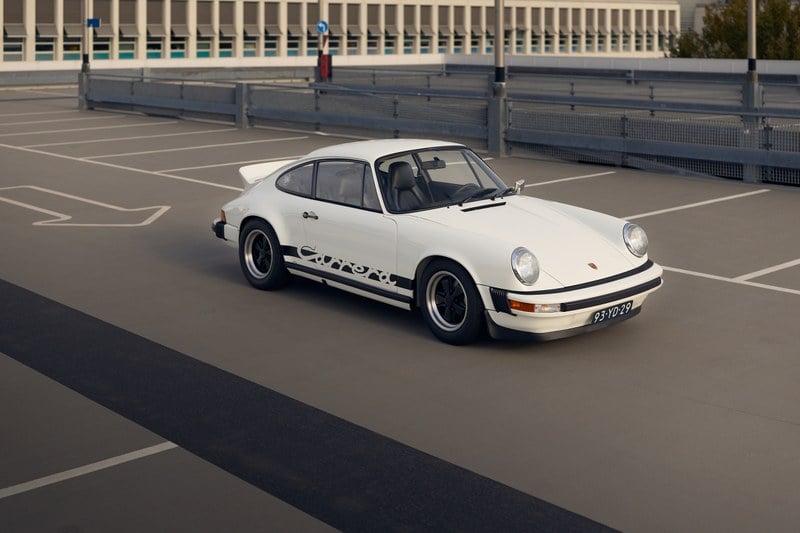
Although Porsche never officially designated the Carrera 2. 7 MFI as an RS, beneath its updated G-Series bodywork lies the same 2. 7-litre, mechanically fuel-injected Type 911/ 83 engine that powered the legendary 1973 Carrera RS. Equally significant, the Carrera 2. 7 MFI retained the essential mechanical characteristics and remarkably low weight that had made its predecessor such an exceptional driver’s car and formidable competition machine.
Its sporting credentials were further underlined by FIA Group 3 homologation, which enabled the model to compete in international motorsport, including events such as the Targa Florio and the Monte Carlo Rally.
Produced in similarly limited numbers as the celebrated Carrera RS, the Carrera 2. 7 MFI remains one of the rarest and most significant road-going 911 models of its generation.
It is a car that combines the engineering purity of the original RS with the understated appearance of the succeeding G-Series, occupying a distinctive place in Porsche’s history.
More information and photo’s will follow.
An Extraordinary Sicilian History
The story of this particular Carrera 2. 7 MFI is as remarkable as the model itself.
Finished in Grand Prix White and manufactured in November 1973 for the 1974 model year, the car was supplied new to Italy through Porsche Verona. It was equipped with the mandatory Italian-market front lighting arrangement and specified from the factory with a limited-slip differential.
Its first registration took place on 10 July 1974, in the name of Rocco Lo Porto, a footballer from Partinico, near Palermo, who played as a left-back for Alcamo.
The Porsche’s Sicilian Mafia History
The Porsche subsequently passed into other hands, beginning an altogether more turbulent chapter in its history.
On 7 October 1977, the Carrera was registered to Salvatore Montalto, a friend and consigliere of Salvatore Inzerillo, one of the most influential Mafia figures in Sicily during the 1970s and early 1980s.
Less than a year later, on 27 May 1978, ownership passed to Salvatore Inzerillo himself.
The circumstances surrounding this transfer remain unknown. What is known is that Montalto subsequently aligned himself with Totò Riina, the ruthless leader of the Corleonesi clan, whose ambition was to establish control over the various Mafia families operating throughout Sicily. The Inzerillo family was among those unwilling to submit to Riina’s authority.
The resulting conflict became part of the violent struggle for supremacy that culminated in the Second Mafia War, one of the bloodiest periods in the history of organised crime in Sicily.
On 11 May 1981, Inzerillo was ambushed outside a residential building in Via Brunelleschi, Palermo, after visiting his mistress. As he approached his armoured Alfa Romeo Alfetta, he was attacked by a group of gunmen and killed in a hail of bullets. The assassination formed part of Riina’s campaign against the established Palermo Mafia families. Inzerillo’s brothers, Santo and Pietro, were also murdered during the conflict.
The Porsche remained within the Inzerillo family. On 4 December 1981, it was registered jointly in the names of Inzerillo’s sons Giuseppe and Giovanni, his daughter Maria, and his widow Filippa Spatola.
On 4 July 1985, it was transferred into the name of Antonio Mannino, believed to have acted as a representative of the Inzerillo family. Mannino later emigrated to the United States, where he was subsequently convicted of criminal offences. On 28 March 1989, the Carrera was registered in the name of the notary Giulio Reggio, who subsequently arranged its sale.
On 20 July 1990, it was acquired by Ferdinando Hardoin Monroy, a member of one of Sicily’s most distinguished aristocratic families.
A Return to Competition
On 3 December 2001, the Porsche passed into the ownership of Giovanni Vittorio.
Under Vittorio’s stewardship, the Carrera returned to the competition environment for which its mechanical specification had always made it particularly well suited. The car underwent a number of modifications in preparation for motorsport, including the installation of a roll cage, a ducktail rear spoiler and alterations to certain gearbox ratios.
Competing as part of Filippone Racing Palermo, Vittorio entered the Porsche in a number of hill-climb events, achieving respectable results.
Importantly, this period of the car’s history is supported by surviving competition documentation, including an FIA report and a Passaporto Tecnico issued by the CSAI (Commissione Sportiva Automobilistica Italiana). These documents record the car’s participation in competition during this period and provide a valuable addition to its historical file.
For a Carrera 2. 7 MFI, a model homologated for FIA Group 3 competition, this later involvement in motorsport represents a particularly appropriate continuation of its sporting heritage.