Description
• Motor Show display car at the 1956 Earl’s Court Motor Show.
• Privately entered and prepared by Ken Rudd for the 1959 24 Hours of Le Mans.
• Class-winning AC Ace-Bristol, finishing 7th overall in a field of 53 starters.
• Offered from over six decades of continuous family ownership, with a complete and exceptionally detailed history.
Few post-war British sports cars so perfectly encapsulate the spirit of privateer endurance racing as this remarkable 1956 AC Ace-Bristol, chassis BE 214, better known by its evocative registration 650 BPK. A Motor Show display car, 1959 Le Mans class winner, and cherished long-term road car, it offers an unbroken and richly documented narrative stretching across seven decades.
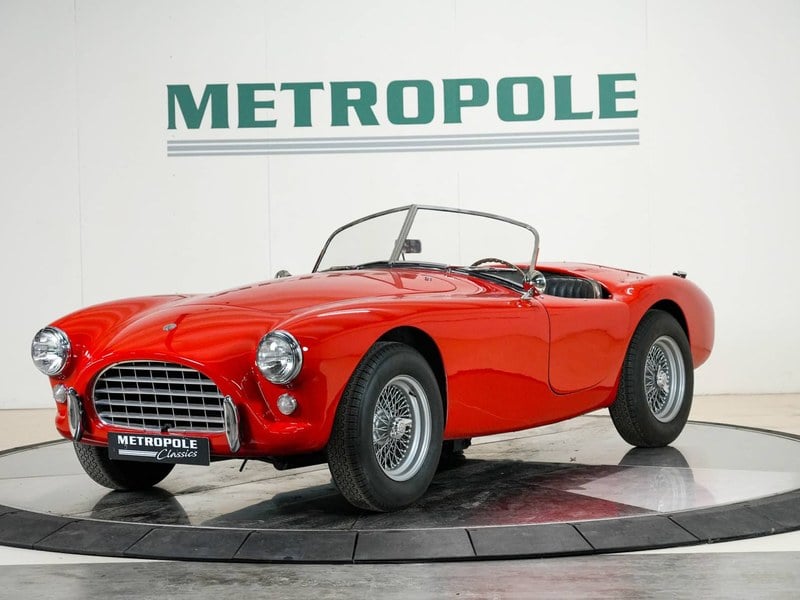
Chassis BE 214 was completed in late 1956 and selected for display on the AC stand at the Earl’s Court Motor Show that October. Finished in Svecia Red with off-white trim, it was dispatched from the factory on 8 November 1956.
Shortly thereafter, the car was supplied via Ken Rudd’s garage to its first owner, Don Levy of Nottinghamshire. Levy campaigned the Ace-Bristol in club racing during 1957 with encouraging results, before his season was interrupted with an accident at Mallory Park which bought his season to an end and would see 650 BPK returned to Thames Ditton and rebuilt at the AC factory.
Following the repair, in early 1958 the Ace-Bristol was acquired by one of the most fascinating figures in its history: Jane Waugh of Maidstone, Kent. A committed motoring enthusiast and active member, indeed social secretary of the Maidstone and Mid-Kent Motor Club, Waugh was far from a casual owner.
Her association with the Ace model dated back to 1953, when she saw the prototype AC-engined Ace at the Motor Show and promptly ordered one. Delivered in 1954, she campaigned it extensively in rallies, sprints, and speed trials that very summer. Following the unfortunate loss of that car in a road accident, she ordered another in 1955—evidence of her commitment to the marque and to competitive motoring at a time when female entrants were still a rarity.
The arrival of the Bristol-engined Ace in early 1956 represented the ultimate evolution of the model, and it was the improved performance and competition potential of this variant that drew her to 650 BPK. By this stage, Jane and her husband Robert were already immersed in endurance racing circles, having supported the AC works effort at the 24 Hours of Le Mans in 1957, assisting with timekeeping and team logistics. They were, in every sense, committed privateers.
In early 1959, learning that no British-based AC entry was planned for Le Mans, Jane Waugh resolved to act. Offering both her car and financial backing, she enlisted Ken Rudd to organise and manage the effort.
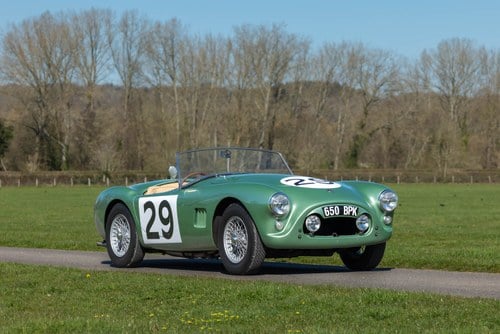
The project gathered momentum quickly and 650 BPK was delivered to Rudd Racing in April 1959 for comprehensive preparation. The Bristol engine was stripped and rebuilt; the electrical system uprated; higher-ratio rear axle and competition clutch installed; and numerous detail modifications undertaken to ensure endurance reliability. The body was refinished in AC Racing Green—also known as “Jewellescent Green”—and fitted with an enveloping aerodynamic windscreen. Race number 29 was applied, and the car underwent rigorous testing, including practice at Goodwood.
Scrutineering in France proved exacting, yet the Ace-Bristol passed without drama. Lined up among 53 starters on the grid at Le Mans, the privately entered British machine faced factory-backed opposition from across Europe.
Driven by John Turner and Ted Whiteaway, 650 BPK adopted a disciplined, measured pace from the outset. While faster cars faltered through mechanical failure or accident, the Ace-Bristol ran consistently, its triple-carburettor Bristol engine proving both tractable and durable.
Through the night the attrition rate climbed. By dawn, only a fraction of the original field remained, and the AC was firmly in contention within the two-litre class. Minor issues—among them a fan belt and carburettor attention—were resolved swiftly in the pits. As rivals retired, the class battle narrowed to a duel.
After 24 hours and 274 laps—3, 684. 830 kilometres—650 BPK crossed the finish line 7th overall, claiming class victory with an average speed of 153. 530 km/ h. Of 53 starters, only 13 finished. It was a class victory earned not through outright speed but through preparation, discipline, and mechanical integrity—the very essence of endurance racing.
In a period touch almost unimaginable today, the victorious car was subsequently driven home from France, still in race tune.
In the early 1960s, the Ace-Bristol passed into the care of Albert Parker, who embraced the car not just as a piece of Le Mans history, but as his everyday transport. Over the ensuing two decades, Parker and 650 BPK covered thousands of miles across Britain, from fast A-road dashes to long cross-country journeys. Frequently accompanying him was his nephew, John Deveson - formative drives that would leave a lasting impression and quietly secure the car’s future custodianship within the family.
When Parker passed away in 1981, the future of the Ace-Bristol became the subject of thoughtful family discussion. It was ultimately decided that John Deveson would acquire 650 BPK from his uncle’s estate—those vivid early journeys clearly having forged a lasting connection. By then, after decades road use, the car showed the wear of a regularly driven car and required restoration.
What followed was a painstaking seven-year restoration. The chassis was stripped back to bare metal and carefully refinished using traditional rustproofing techniques; suspension components were rebuilt throughout, and the mechanical systems methodically overhauled.
By December 1988, the mechanical restoration was complete and 650 BPK was once again roadworthy, leaving only the matter of exterior finish. Determined to return the Ace-Bristol to its authentic 1959 Le Mans appearance, extensive research was conducted to identify the correct shade. The result was AC’s distinctive “Jewellescent Green”—a subtle, semi-metallic hue unique to the marque’s racing cars of the period. Applied with great care, it restored the car to the appearance it carried to class victory at Le Mans, providing a fitting conclusion to years of devoted restoration.
In the years that followed, 650 BPK returned repeatedly to Le Mans as part of historic cavalcades for former competitors, retracing its triumphant 1959 route - now altered by chicanes along the Mulsanne Straight. In 1999 it was reunited with John Turner, one of its original Le Mans drivers, an emotional moment underscoring the authenticity and continuity of its history.
650 BPK stands among the most significant surviving examples of the Ace-Bristol, offered from an extraordinary 45-year continuous ownership and having remained within the same family for more than six decades. Supported by an exceptionally comprehensive history file - meticulously documenting its Le Mans class victory and long-term custodianship - and now presented publicly for the first time, this celebrated endurance veteran represents a rare and compelling opportunity to acquire an authentic and highly distinguished piece of British motorsport history.