Highlights
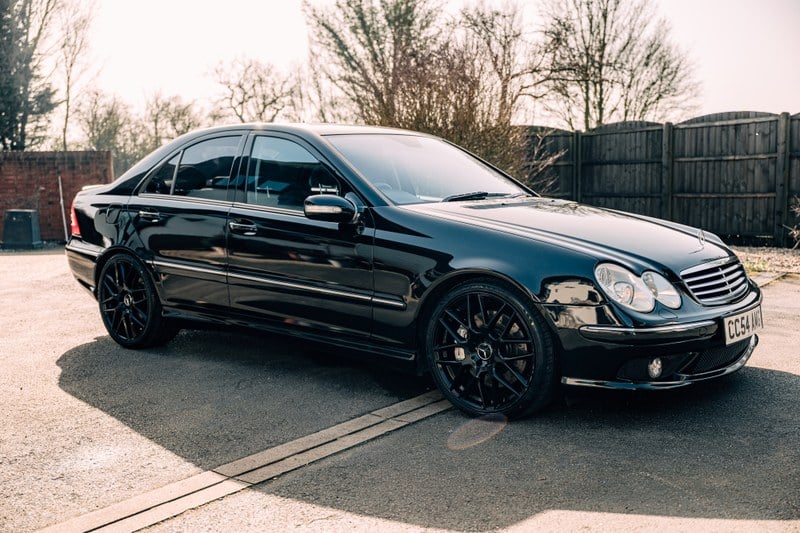
- Low mileage 367bhp 5.4L supercharged W203
- Spent its life in Japan on salt‑free roads to 2022
- Well maintained in Japan and UK
- Checks, servicing and brake fluid change 2025 by main dealer
- Recent new control arm and drop links to tighten suspension
- £2,638 gearbox-out service and engine mounts in 2024
- Starter motor and crankshaft sensor replaced December 2025
- MOT until October 2026 with advisories rectified
The Appeal
The C55 AMG replaced the C32 in 2004 as part of Mercedes’ determined bid to out‑BMW. To achieve this, the firm took the cubic capacity route, equipping the new car with an AMG‑fettled version of its supercharged 5.4L V8 that was good for 367bhp.
Where BMWs erred towards shouty, the C55 was Mercedes‑understated, with only detail visual clues differentiating it from more humble W203s. Unlike some aftermarket modified cars, this low mileage Obsidian Black C55 sticks to that theme, adding only black alloys to dial up the menace. It is a Japanese-market car that remained on the nation’s salt‑free roads until 2022 when it arrived in the UK.
The vendor acquired the car last year and has continued the previous keepers’ theme of regular maintenance. We are told that prior to purchase, it received a gearbox-out service and new engine mounts in 2024. In 2025 it was sent to Mercedes-Benz Bishop Stortford for checks, servicing and fresh brake fluid. Other recent 2025 work includes new control arms and drop links to sharpen the suspension and replacement starter motor and crankshaft sensor. The MOT runs to October 2026. The last test showed advisories for all four tyres - we are told that the tyres were replaced in early February 2026.
The C55 has the soundtrack and performance to properly entertain drivers, plus the luxury to appeal to passengers. With all its recent investment, this car appears to be in good order.
The vendor says:
“The C55 AMG is built around Mercedes’ M113 5.4‑litre naturally aspirated V8 paired with the 5G‑Tronic automatic and a conventional rear‑wheel‑drive layout with a limited‑slip differential. The drivetrain is characteristically robust and mechanically cohesive; throttle inputs translate immediately into forward motion with no lag, and the torque delivery feels dense and tightly wound rather than elastic. The engine pulls cleanly from low revs and builds in a linear, uninterrupted sweep to the upper range, with the transmission engaging positively and without flare. Steering is hydraulic, offering consistent resistance and mechanical feedback, and the chassis feels structurally solid with minimal driveline slack or play. Under load, the car feels compact and taut, with the driveline responding as a single, integrated unit — controlled, direct and muscular rather than loose or over‑assisted.”