
Beschreibung
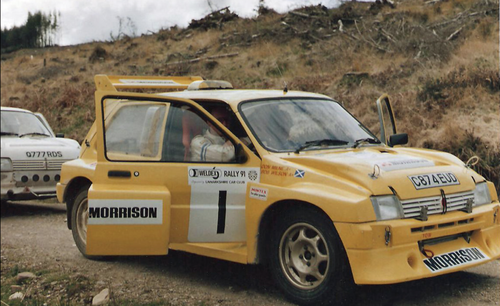
1985 MG Metro 6R4 works car C874 EUD
Much has been written about the wonderfully crazy Group B rally cars. A show case for manufacturers technology, it had relaxed homologation requirements (only 200 road cars needed to be registered) and liberal regulations producing cars that soon captured the hearts of fans and drivers. Built around spaceframes they were little more than silhouettes of their road going cousins.
The MG Metro was designed by Williams Grand Prix Engineering. It was clear the car had to be 4WD to be competitive, but choice of engine was less straight forward. Whilst many other manufacturers went for smaller turbocharged engines, Austin Rover took the view that turbo lag would offset the power advantage and instead initially planned to fit a Rover V8 with two cylinders taken off the front of the block, but works driver Tony Pond was emphatic “I can’t drive this thing quickly through a forest stage – I can’t see the front end from where I’d be sitting” so the car was powered by a new bespoke mid mounted quad cam, 24 valve 3 litre V6 producing in International spec 410 bhp. It was the first ever engine designed specifically for rallying - most other manufacturers modified a production block and cylinder head.
The first 6R4 debuted in 1984 at York National Rally and was almost 3 minutes ahead of its nearest Audi Quattro after 55 stage miles when it had to retire with an alternator fire. Testing continued and the first 6R4 victory came in early 1985 beating a Quattro on the Skip Brown Rally. In order to comply with homologation, 200 Clubman cars were produced detuned to 250 bhp with standard forest suspension. These cars retailed at £40, 000.
Tony Pond and Malcom Wilson both drove 410 bhp works cars on the RAC Lombard Rally in November 1985 with Pond running as high as 2nd overall before finishing 3rd. Pond set 9 quickest stages, 14 second quickest and 15 third fastest. The gauntlet had been laid down and the plan would be for 1986 to be a learning year with full assault on the World Rally Championship in 1987. Sadly Group B was stopped at the end of 1986.
The engine design was sold to TWR (Tom Walkinshaw Racing) and, after some development work on the cambelts and plenums, the engine would make a re-appearance; initially in 3. 5-litre form in the Group C Jaguar racing cars, but then in the back of the sensational 217mph Jaguar XJ220.
Our car registration C874 EUD Chassis 134
As one of the nine “works cars” Chassis 134 left the factory with the full International spec including the 410 bhp engine and was initially used as a recce car for Tony Pond. The car, registered C874 EUD which it still carries to this day, is the last of the EUD range of plates which starts with C867 EUD.
Following the demise of Group B at the end of 1986 the car was sold to privateer Donald Milne. As regulations required the engine was then reduced to Clubman 2. 5 litre. A passionate privateer and early mentor to Colin McRae, Donald started campaigning the car in 1988. Early in the season for the Welsh National Rally he changed car to a full yellow livery. Highlights of the 1988 season included a win in the International Motors Panaround Stages beating another ex-works car, C97 KOG, as well as two 2nd places at Wyedean Stages Rally and Mercury Snowman, a third at York National and 4th at Auto Fit Stages Rally where a young Colin McRae came second in a Nissan 240RS belonging to Donald Milne. With a 2nd and 3rd in two qualifying rounds of the European Motorsport BTRDA Gold Star Competition, it was a good year! The season was rounded off competing in the Starko Rally of Indonesia.
Due to work commitments in 1989 Donald lent the car to Peter Lloyd. Highlights included the SGC Printing Harry Flatters rally where he finished second navigated by Alan McCann. Peter also took part in the standalone Birmingham Super Prix Esso Metro Superchallenge inspired Metro 6R4 Trophy Race which supported the FIA Formula 3000 race where Tony Pond won for the second year running.
Chassis 134 was wheeled out for a couple of events in 1990 resulting in his second outright victory, this time on the Johnstons & Paton Rally in Argyll and 3rd on the Scotphone Stages. That set him up for 1991 where he committed to the full national Esso Scottish Rally Championship series. This time the car ran the Nissan 240RS engine. Three straight wins on the Mercury Snowman, Scotphone and Weldex were followed by a maximum point score on the RSAC Scottish National event. He finished 2nd behind Murray Grierson’s Metro Hart on the Jim Clark Rally and was 4th on the Border. This was a particularly satisfying result as Richard Burns was 3rd in a Subaru Legacy behind rally winner Stewart Robertson and runner-up Dom Buckley. This was sufficient to give him the 1991 Championship victory.
There was one other brief foray in 1994 when he teamed up again with Bob Wilson and wheeled out his MG Metro 6R4. He started the season with a bang winning the Snowman, finishing 3rd on the Valentine behind George Gauld and Neale Dougan, and then beat arch-rival David Gillanders to the victory on the Granite City. He next won the Weldex ahead of Dougan and was 12th on the RSAC Scottish after trouble with the car, and that was it, rallying finished. Chassis 134 was then sold in September 1994 to James Leask who kept the car until 2003 when it was sold to the current owner.
The car was restored to the works Computervision livery, correct 3 litre “works” engine built by Goodmans running on the correct Lucas injection and the all important RAC logbooks with scrutineers signatures documenting all the engine changes and rallies entered.
This is a tremendously important works car with championship winning history by a man instrumental in the start of Colin McRae’s incredible career.
Opportunities to buy an exciting Group B car with such provenance do not come along very often – we are offering this immaculate car for £450, 000