
Beschreibung
H&H Classic Auction @ The Imperial War Museum, Duxford/ Cambridgeshire
20th September, 2023 13:00
c. 1950 (1961) Aston Martin-Triumph DB1 Special
No Reserve
Registration No: 788 VPG
Chassis No: 8YC91. 4/ 2264
MOT: Exempt
‘After hours’ factory project at Aston Martin HQ
Benefits from Aston Martin DB1 engine 49/ 19, reportedly DBR Racing seats and more
Registered as an Aston Martin in 1961
Reportedly previously owned by AMOC racer Shaun Magee, using it as a source of emergency spare parts when racing a DB1
In current ownership for the last 26 years
During World War II, the Aston Martin Company was under the ownership of R. G. Sutherland. Just before the war erupted, their chief engineer developed a 2-liter (1970cc) 4-cylinder pushrod engine capable of producing around 90 BHP. Dr. Rollason, the present owner of the Atom, suspects that there might have been intentions to supercharge it. After the war, production began, and it's believed that around 70 engine blocks were cast, and 18 cars built. One of these gave Britain its first significant post war motor sport win at Spa in 1948 driven by Sir John Horsfall.
In parallel, the company was acquired by David Brown, who shortly after also acquired the Lagonda company. With this acquisition came a 6-cylinder twin overhead camshaft engine designed by W. O. Bentley. It boasted a displacement of 2590cc and produced 105 BHP at 5000 RPM in standard form, and 120 BHP in "Vantage" form. These engines were subsequently utilized in future Aston models, which became known as the DB2. Interestingly, the preceding 18 cars were retrospectively named DB1s, even though their design predated David Brown's involvement.
While more than 18 of the engine blocks were assembled into engines, others were employed as replacements for the pre-war 2-litres at service items. Some were also built into interesting variants. Nevertheless, many blocks were discarded, still in their boxes, and sold to a local scrap dealer named Coleys. An car called the Sigma is believed to exist in America, and the Aston Creed apparently survived until the 1960s.
Engine number 19 found its way to Aston guru Dudley Coram, who passed it on to Tony Hills, a member of the Aston factory team. This engine was installed in Mr. Hill's 1934 Triumph Gloria, with assistance from Tony Tocock, a young apprentice at the time. During the early 1950s, the car was reportedly used as a daily commuter to the factory. Unfortunately, its fate after Mr. Hill relocated remains unknown.
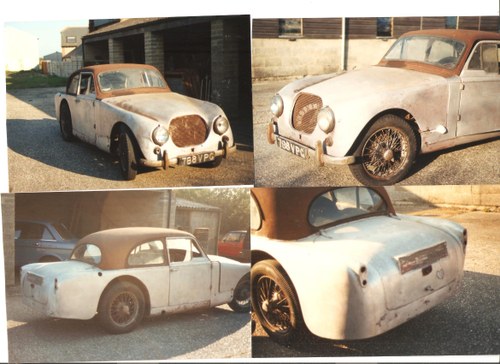
Around 1960, the car was acquired by Mr. K. P. Brewer of Thorpe Leas, Egham Surrey. The original Gloria bodywork was replaced with an aluminum and steel body, which remains on the car to this day. Ater this body transplant, Surrey County Council insisted on assigning a new chassis number (SYC 91-4/ 2264) and the registration number 788 VPG. The Gloria had been registered as AUB 485. The body, which has at some point been repaired after an accident is attached to a tubular frame that has been altered in places. Notably, the bonnet has been replaced and does not match the quality of the rest of the body. The steel roof was that of an Austin A35, with the rest hand-finished. Designer Frank Gerald Feeley, a member of Sir David Brown's Lagonda team, played a role in the design of the new generation of Aston Martins (the 6-cylinder engine DB2 onwards) after R. G. Sutherland sold Aston Martin Ltd. It's possible that this body was one of his design exercises, potentially damaged during testing and subsequently repaired and fitted onto the Aston-mechanically-equipped Triumph Gloria.
Originally, in its Triumph Gloria form, the car passed an MOT test in March 1961 (possibly one of the earliest MOTs), but it was officially registered as an Aston on June 22, 1961. The subsequent ownership history remains unclear. Notably, AMOC racer Shaun Magee owned the car at some point, using it as a source of emergency spare parts when racing a DB1. Magee mentioned that the front seats were sourced from a DBR racer.
In 1997, the current owner acquired the car from David Wynne of Wimborne Dorset, with the actual transfer taking place in Poole. The car was sent to a friend for restoration, who sadly became ill and the project stalled. The car was recovered to his premises, where it has laid in project form ever since. At the time, the The engine was operational, and though the car is nearly complete, lacking only two brake drums, it is in need of restoration. The possibilities include rebodying it as a super tourer or retaining its unique saloon style, but this certainly presents an interesting opportunity for a collector or enthusiast looking to acquire what could be considered an "after-hours factory car," possessing some historical significance.