
Beschreibung
Malicet Et Blin (M. A. B.) was a French manufacturer of bicycles, automobiles, automotive components and, ultimately, aero engines, from 1890 to 1925.
Founded in 1890 by Paul Malicet and Eugène Blin in Aubervilliers, a north east suburb of Paris, M. A. B initially made bicycles before expanding into the motor industry in 1897, producing components such as chassis and steering gear, along with various accessories.
One of the leaders in the nascent French automotive industry at the time, M. A. B initially produced a Vis-à-vis (face to face) four seater with a four cv (horsepower) engine, and by 1903 M. A. B was making its own complete cars badged Malicet & Blin. The range included four cv, six cv and eight cv models powered by a single cylinder engine. Production was limited, though, however M. A. B also variously supplied components, chassis, and complete cars to Alatac, Bridgwater Motor Company (aka CCC), Ernst, Excelsior, Eysink, Garage Moderne, Ivor, La Torpille, Lucerna, Marlborough, Mutel, Sigma, and Tuar.
In 1914 M. A. B also became involved in building aircraft engines at its French factory, manufacturing power units for the Sopwith 1½ Strutter and the seaplane fighter of Louis Schreck's Franco-British Aviation.
Paul Malicet died in October 1923, however the business continued until 1925.
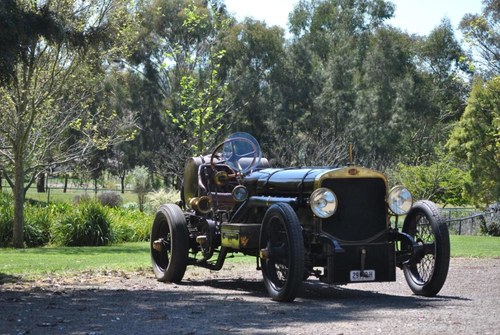
Eligible for the S. F. Edge Trophy Race at Goodwood, this magnificent 1908 M. A. B Saunders Aero Engined Special is unique in Australia and one of only a handful of similar fire-spitting Edwardian racers in existence around the world.
The early years of motor racing are known as the ?Heroic Age?.
It was a time when the cars dwarfed their drivers, spat flames from open exhausts and snorted smoke, raced hell-for-leather on crude, usually unsurfaced roads, often from point-to-point, all for the sake of glory and the love of speed. Back then, more than a century ago, the quest for ever greater speed saw many of these leviathans converted to run huge capacity aero engines originally used in or intended for aircraft.
Found in a paddock near Wagga Wagga (NSW) by Dr Stuart Saunders of the ACT, little is known of this M. A. B?s early history in Australia, other than it is one of two chassis imported here. M. A. B was stamped on the remains of its brass radiator and on many of the bearings, bushes and castings, enabling Dr Saunders to establish its identity.
The M. A. B had been used on the property and when found was fitted with the remains of a truck tray, however it was mechanically complete other than the engine, of which only the bottom end and cylinder block remained.
?There was very little left of the (original) engine and so a 1918 Packard-Liberty V12 aero engine was installed, to build a facsimile of a pre-1910 racing car,? Dr Saunders explained.
With a 27 litre capacity, the Liberty V12 is typical of aero engines used in period.
The Liberty V12 is similar to that which powered the famous ?Babs?, a leviathan driven to the World Land Speed record in the UK in 1926 at over 100 mph, set by Englishman John Parry-Thomas. Indeed today, this M. A. B Saunders Special wears one of Babs? original rocker covers, replacing one cracked on a tour of New Zealand in 1990.
Restored by Dr Saunders from the Wagga Wagga wreck in the mid-1980s, all the original mechanicals on what is now the M. A. B Saunders Special from the flywheel backward were retained, aside from the clutch, which is now a 1940s Dana-Spicer unit needed to cope with the Liberty?s torque.
With the engine weighing a not inconsiderable 380 kg itself, it produces around 1000 ft/ lb of torque, 400 brake horsepower and revs to just 2000rpm, enabling this M. A. B Special to cruise comfortably at 80 mph, with a top speed of around 100 mph. At 1000rpm it is travelling at 53 mph!
With a 50/ 50 weight distribution, the M. A. B Saunders Special is said to handle very well but its brakes are described as ?terrible?.
Often on display at the Binalong Motor Museum (NSW), the Saunders Special is certainly no stranger to use, being notably one of just 28 entrants to take on the Outback Stage of the 1988 Australian Bicentennial World Rally.
Running from Darwin through Adelaide to Canberra, the M. A. B Saunders Special successfully crossed the continent before joining the remaining 1150 Bicentennial entrants in the national capital, in what was at the time the largest long-distance rally held anywhere in the world.
The M. A. B also competed in the first Targa Tasmania, in 1992, covering 2000km in five days.
?Apart from twisted drive-shafts in the early years, the car has been very reliable.? Dr Saunders said.
Today the imposing M. A. B Saunders Special is finished in a rich dark brown with black wire wheels. This aero-engined monster wears all the right jewelry too. Its brass G. Moreux brand radiator shell (number 8065) is replicated by the large rear fuel tank, beautiful period Bosch headlights, side-mounted CA Vandervell & co of London (CAV) spotlights, Lux-Auto hand crank brass horn, and by the frame of the monocle-style windscreen.
Inside, the two seats are trimmed in rich burgundy leather and the workmanlike cockpit timber-floored, all of it like the exterior in great condition, complete, with an air of patina that only adds to the aura of the car.
The M. A. B Saunders Special was also featured in the ?Icons of Speed? display at the 2022 Motorclassica in Melbourne
